

10 Thai Foods You Should Try At Least Once
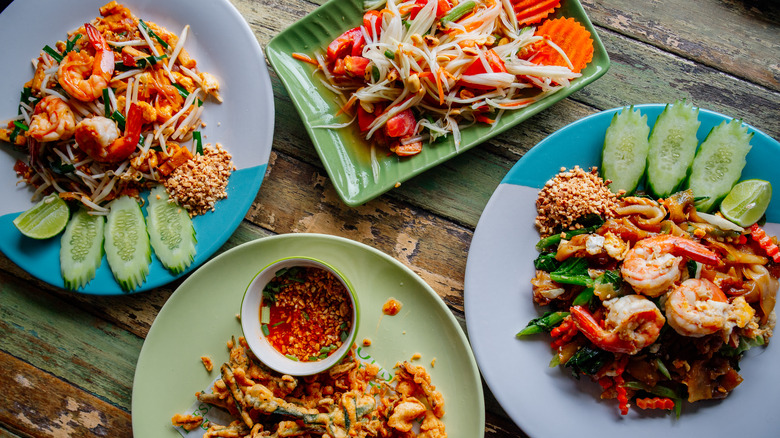
The first time I visited Thailand, I was blown away by the sheer abundance of tasty food at every turn. It seemed like no matter where I went, I was never far from a fiery curry, tangy soup, or bowl of springy noodles. That first trip sparked somewhat of an obsession with Southeast Asian cuisine in me. Not long afterward, I packed my bags and moved to the region, first living in neighboring Cambodia and later in Vietnam and Indonesia. Over the course of a decade, I visited Thailand every chance I got to explore more of the country and cuisine.
One of the things that makes Thai cuisine so appealing is the variety of textures and flavors. The main goal is to create a harmonious balance between five key flavors: sweet, salty, sour, spicy, and savory or umami. To achieve this, cooks use local ingredients like tamarind, palm sugar, fish sauce, and chiles to make sauces and pastes that can be mixed with herbs, fruits, veggies, seafood, and meats. The result is a fantastic range of dishes that are colorful, aromatic, and incredibly vibrant.
There are so many Thai dishes that I could wax lyrical about, but in the interest of brevity, I narrowed it down to just ten that I think everyone should try once. I included a mix of popular dishes from all over Thailand, as well as some lesser-known dishes you don't always see at Thai restaurants abroad. So, grab a fork and spoon (the preferred eating utensils in Thailand), and let's dig into some delicious Thai dishes that should be on every foodie's radar.
1. Khao soi
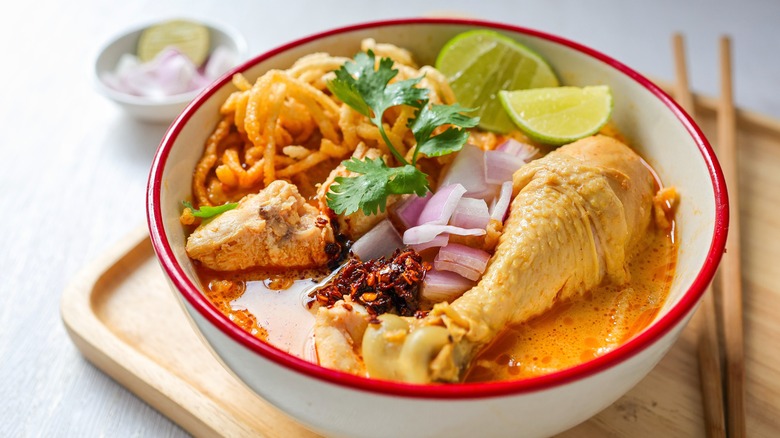
Head to Northern Thailand, and you'll find countless vendors in towns and cities hawking bowls of rich, creamy khao soi. This creamy curry noodle soup sports a vibrant yellowish-orange hue, and it packs a ton of flavor thanks to the rich curry paste, creamy coconut milk, egg noodles, and braised chicken (sometimes swapped for pork or beef). Plus, you get varying textures from the soft and crispy fried noodles and condiments sprinkled on top.
The secret to good khao soi lies in the curry paste. Thai curries differ from Indian curries in that Thai curry paste is made by pounding dry and fresh ingredients in a mortar and pestle before cooking, rather than frying spices in hot oil. For khao soi, the paste typically consists of ginger, garlic, shallots, turmeric, lemongrass, coriander, cardamom, shrimp paste, chiles, and lime zest. The paste is cooked with coconut milk to make a broth that the chicken is braised in. The chicken and broth are then ladled into a bowl with fresh egg noodles.
Khao soi is typically served with a variety of condiments that you can pile on to amp up the flavor. Crispy fried egg noodles are an absolute must, and are often added to the dish right before serving. Other common toppings you might find served on the side include sliced shallots, pickled mustard greens, chile flakes, and coriander. Lime wedges are also often on hand for squeezing, and the juice adds bright pops of acidity. Stir everything together, and you have a hearty and intensely flavorful soup that's good any time of day.
2. Tod mun pla
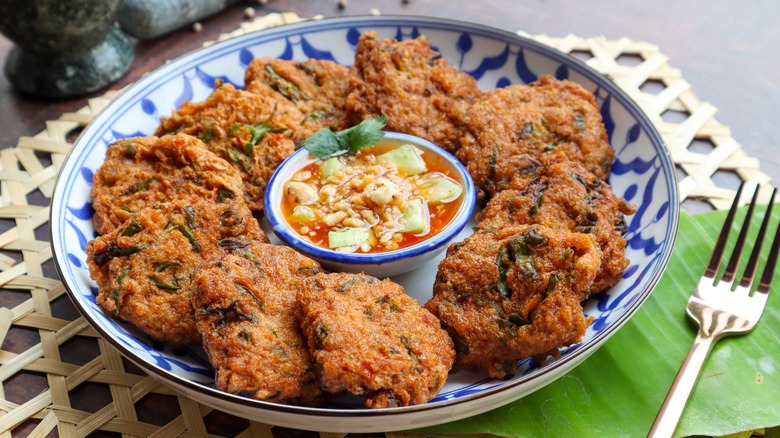
Popular all over Thailand, tod mun pla are fried fish cakes. But don't expect Western-style fish cakes with crispy breading on the outside and flakes of fish on the inside. Thai fish cakes are softer and have a springy texture. That's because they're made with fish paste, which is essentially pieces of fish pulverized into a smooth consistency. In addition, the fish cakes are seasoned well to give them a slightly spicy flavor, and they have flecks of chopped long beans throughout.
Tod mun pla are popular street food snacks, and you can often find them at Thai restaurants. They're also pretty easy to make at home. Cod works well for fish cakes because it's tender and mild, which is great for soaking up the flavor of the spices. Basa, tilapia, and snapper are also great choices. You can blitz up the fish in a food processor or pound it in with a mortar and pestle. Then, you mix in red curry paste, corn flour, coriander, raw egg, sugar, chopped long beans, and thinly sliced kaffir lime leaves.
The key with shaping tod mun pla is to make them small and on the thinner side so that they cook through more evenly. Many cooks simply add dollops of the mixture into a pan with hot oil and wait for them to puff up and brown on the bottom, then flip them and brown the other side. The fish cakes are often served with sweet chili sauce for dipping and lime wedges to squeeze on top.
3. Som tam
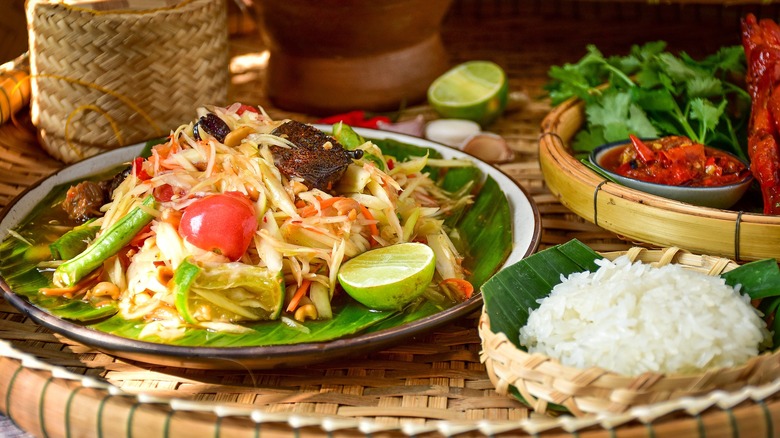
When many people think of Thai food, curries, noodles, and rice dishes come to mind. However, there are also plenty of refreshing salads that are perfect for beating the tropical heat. One that's particularly effective at cooling the body is som tam, a pounded salad featuring green papaya, dried shrimp, and red chiles. You might think that eating fiery chiles in sweltering heat would be counterproductive, but spicy food is actually great for hot days because it causes your body to sweat, and when the sweat evaporates, you feel cooler.
Som tam starts with unripe green papaya, which is sliced into very thin strips. Then, you make the dressing by pounding fresh chiles, dried shrimp, garlic, roasted peanuts, and palm sugar in a mortar and pestle. Once everything is well mixed, add the green papaya along with sliced tomatoes, fish sauce, and lime juice. Some people also add other veggies like long beans. Everything gets pounded again to release the juices and flavors.
One of the great things about som tam is that it's very customizable. Green papaya is common, but it can be swapped out for something else that's crunchy and tart, like sliced green apple or unripe mango. You can also add extra ingredients like Thai eggplant, cucumbers, crab, prawns, or fermented fish. What you're really going for is that classic Thai combo of salty, spicy, sweet, sour, and umami flavors. It's typically served with sticky rice to help soak up all the dressing, but jasmine or plain white rice are also good matches.
4. Guay tiew ruea (boat noodles)
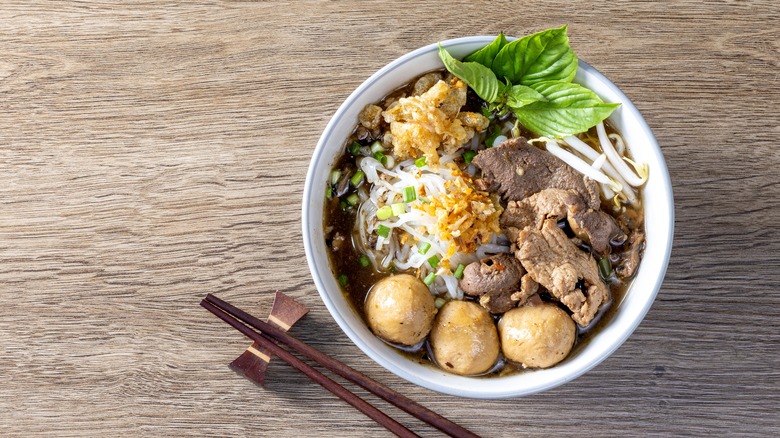
Bangkok is Thailand's capital and is renowned as one of the best food cities in the world. In pretty much every neighborhood you stroll through, you'll find a myriad of dishes being sold at markets, restaurants, street stands, and even boats floating down the city's many canals. The waterways are where the wildly popular guay tiew ruea originated, otherwise known as "boat noodles." Visit certain canals, and you'll find tons of vendors selling bowls of this rich, fragrant noodle soup from what are essentially floating food stalls.
Thai boat noodles get their heady aromas and flavors from a rich broth made by simmering beef or pork bones with an array of spices, including cinnamon, star anise, coriander seeds, and pandan leaf. The broth is also enhanced with light and dark soy sauces, rock sugar, garlic, daikon, galangal, cilantro stems, fermented bean curd, and blood. The broth is ladled into bowls with slippery rice noodles, chunks of meat like braised pork or beef, meatballs, and leafy greens like water spinach. It's often finished with a splash of chili vinegar.
In Bangkok, guay tiew ruea is often sold in small bowls because it's easier for the boat vendors to pass them off without spilling the soup. You can also find the dish at stalls on land, where you might see larger portions. Versions vary, with some cooks adding unique touches, such as organ meat. Most vendors also offer a variety of toppings, like fried garlic, chili flakes, Thai basil, and crispy pork rinds.
5. Tom yum
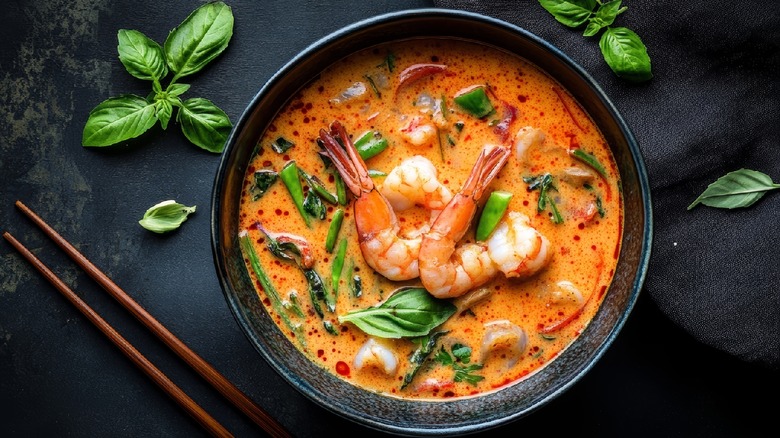
Thai food lovers will probably already be familiar with tom yum, as you can find it all over Thailand. It's also a staple at Thai restaurants outside of the country. Like many Thai dishes, this vibrant soup marries a myriad of flavors, including spicy, sour, salty, savory, and sweet. The broth is made by simmering aromatic ingredients like lemongrass, galangal, tamarind paste, chili paste, lime juice, fish sauce, kaffir lime leaves, and sugar. It's often served with mushrooms and meat or seafood.
Tom yum likely originated in central Thailand, and it was traditionally made with freshwater prawns. Today, tom yum goong is one of the most popular iterations of the soup (goong means "prawns" in Thai). The prawns are typically simmered whole with the shells to infuse the broth with maximum shrimp flavor. You can also find variations of tom yum with chicken, fish, or other seafood as the protein, as well as veggie versions.
Some cooks also add coconut milk or evaporated milk to their tom yum to add extra richness and tone down the spice a bit. If you're a fan of creamy tom yum, you'll also love tom kha gai, which is a coconut chicken soup. The broth is made with many of the same aromatic ingredients as tom yum, but a little less spice, and it's finished with coconut milk, chicken, and mushrooms. Both tom yum and tom kha gai are often served with rice on the side.
6. Massaman curry
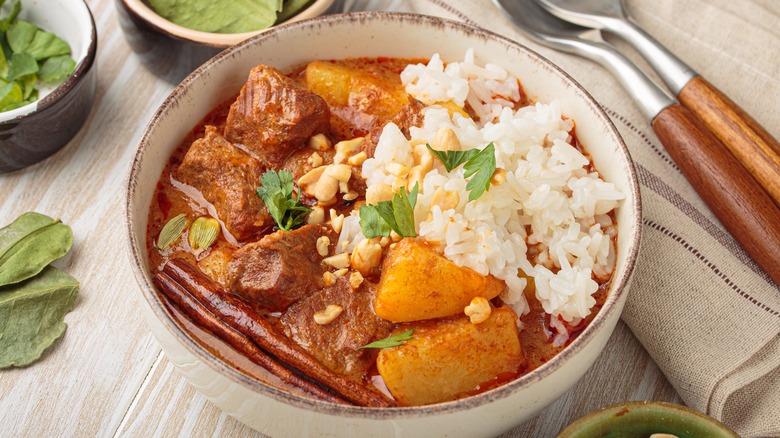
Of the numerous curries you can find around the world, Thai curries stand out for their aromatic blend of fresh herbs, chiles, and dry spices. Thai red and green curries are the most well-known, but there are several other Thai curries worth trying. One of my personal favorites is massaman curry because it's rich and hearty, laden with comforting spices, and it has a variety of textures. It's also a tad milder than red and green curries, which is great for those who can't handle much mouth-searing heat.
Massaman curry was heavily influenced by Muslim traders from the Middle East and India. The name likely evolved from the word "Mosulman," which meant "Muslim." You can see foreign influences in the curry paste, which features dry spices like cinnamon, cloves, cumin, and coriander seeds. Those get mixed with typical Thai ingredients like galangal, chiles, lemongrass, and fermented fish paste. The curry paste is then simmered with palm sugar, tamarind paste, and fish sauce until aromatic, and served with meat such as beef, goat, or chicken.
While many Thai curries can be made with a wide variety of proteins, massaman curry typically never contains pork, particularly in the south of Thailand, where there is a large Muslim population. Another thing that sets this curry apart is that it also often contains chunks of potato, which gives it some stew-like bulk. In addition, it's often topped with chopped roasted peanuts and sometimes crispy fried shallots to give it a bit of crunch.
7. Pad Kra Pao
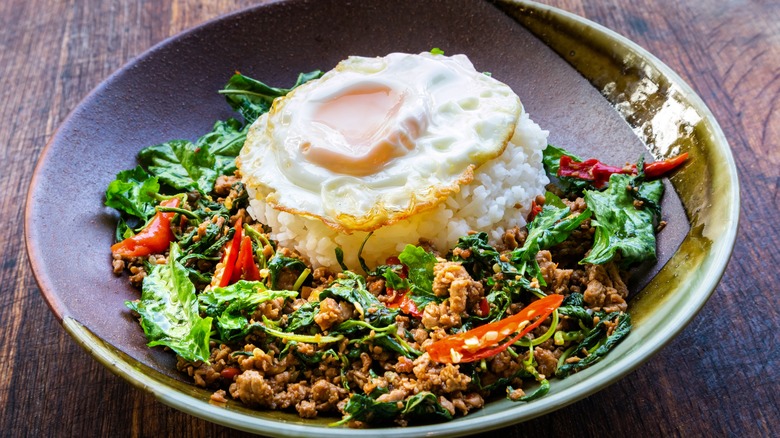
Stir-fries are one of the easiest ways to make a flavorful meal with just a few ingredients, and in Thailand, there are tons of versions. One of the most popular is pad kra pao (sometimes spelled Pad Krapow or Pad Kra Pao). Pad means "stir-fry" in Thai, and kra pao means "holy basil." The dish consists of ground meat (often chicken, but you can also use beef, pork, or seafood) stir-fried with holy basil in a zesty sauce that's spicy, savory, and just a touch sweet.
The first step to making pad kra pao is to grind chiles and garlic in a mortar and pestle. The paste is fried in a wok with hot oil, then the meat is added, along with a sauce made from oyster sauce, soy sauce, fish sauce, and sugar. Everything is tossed until the sauce is fully incorporated and the meat is cooked through. The final step is to take the wok off the heat and fold in chopped holy basil.
Pad Kra Pao may be simple to make, but it goes big on flavor. The key element is the holy basil, which gives the dish earthy, peppery, grassy notes. You also get a nice kick of heat from the fresh chiles. The dish is often served over rice, and many people add a fried egg on top. Usually, the fried egg is cooked so that the yolk is still runny, then mixed into the meat for added richness.
8. Pad Thai
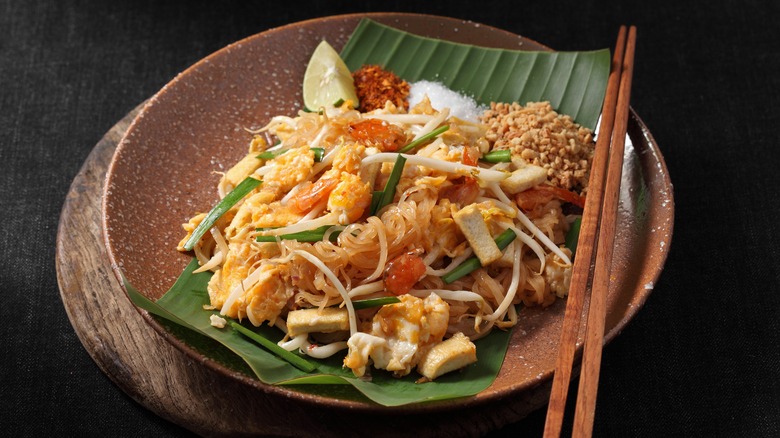
Few Thai dishes are as well-known and beloved around the world as pad Thai. The name translates to "Thai stir-fry," which is how the dish with thin rice noodles with garlic, shallots, dried shrimp, preserved radish, eggs, and tofu is made in a tangy sauce of tamarind paste, palm sugar, and fish sauce. Toppings can include peanuts, chili flakes, bean sprouts, and chopped chives. Fresh lime wedges are also often provided to squeeze the juice over the noodles.
Pad Thai actually has an interesting back story. During the 1940s, many rice paddies were damaged when the Chao Phraya River flooded, prompting Prime Minister Plaek Phibunsongkhram to launch a campaign urging people to eat more noodles. He even promised free food carts to people who wanted to sell noodles. The prime minister was also on a mission to promote Thai nationalism, and a national dish fit right in. Chinese-style stir-fried kuay teaw noodles were already popular, and with the addition of local ingredients, a truly Thai version was born.
Today, you can find countless versions of pad Thai in Thailand and abroad. Many include additional proteins such as chicken, beef, or pork. Outside of Thailand, some ingredients may be swapped or removed entirely. For example, some cooks might leave out the dried shrimp or preserved radish. I once worked at a restaurant in Toronto where the cooks used ketchup instead of tamarind paste (a move that many Thais would find appalling). Those tweaks may do in a pinch, but trust me — it's well worth seeking out the real-deal ingredients if you want the best flavor.
9. Gai Tod Hat Yai
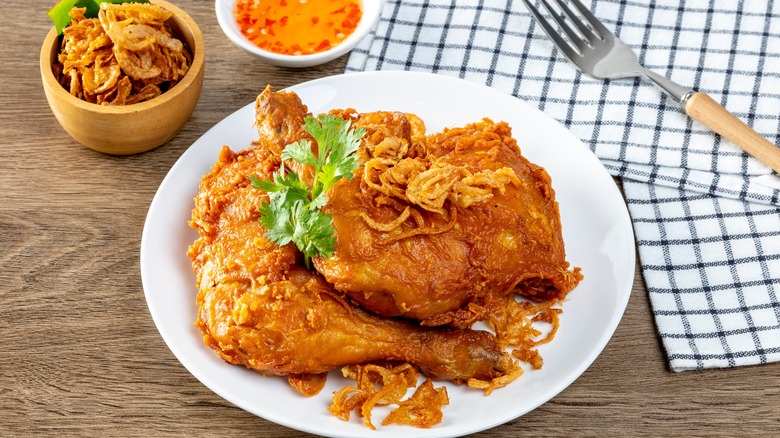
It's hard to find a country where you can't find fried chicken in some form, and Thailand is no exception. There are plenty of styles, from simple fried chicken wings to chain restaurant biggies like KFC, but if you want the most flavorful fried chicken, many Thais will tell you Gai Tod Hat Yai is the way to go. It's named after the city of Hat Yai in southern Thailand, where it was born, and it gets its signature flavor from crispy fried shallots.
The legend of Gai Tod Hat Yai states that sometime in the late 1980s or 1990s, a couple started selling fried chicken at a market as a way to use up fresh chickens that didn't sell. One day, the couple received some shallots that were about to go off, so the husband fried them up alongside the chicken. Customers found the aroma alluring and asked for shallots on the chicken. The dish took off and spread all over Thailand. It became so popular that Lay's created a Hat Yai fried chicken-flavored potato chip.
Beyond just the crispy fried shallots, Hat Yai fried chicken also gets extra flavor from its marinade. Recipes vary, but they often include a paste of peppercorns, garlic, and cilantro leaves or coriander powder. That gets mixed with sugar, soy sauce, fish sauce, and water or milk. The chicken sits in the saucy mixture overnight, then it's rolled in rice flour and deep fried. The crispy shallots are sprinkled on top, and the chicken is typically served with sticky rice.
10. Faktong sangkaya
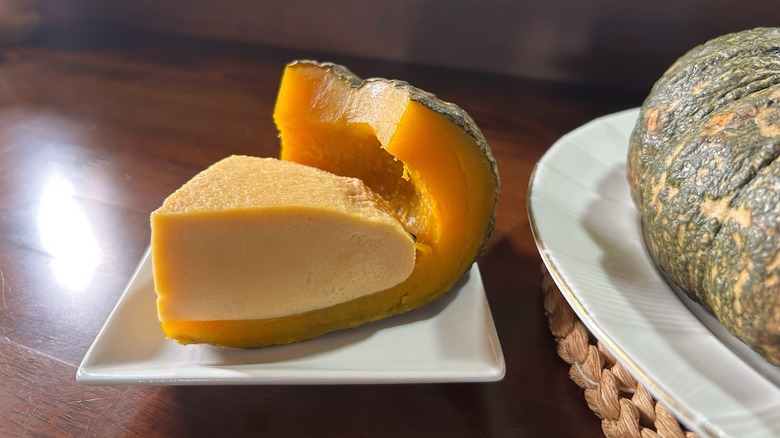
So you've seared your tongue on spicy som tam, indulged in rich, hearty Massaman curry, and savored the crunchy goodness of Hat Yai fried chicken. Now, it might be time for something sweet. Thailand offers up a plethora of desserts, and one of my hands-down favorites is faktong sangkaya. It's a creamy pumpkin custard made (and often served) right in the shell to infuse it with sweet, earthy squash flavor.
Faktong sangkaya looks fancy, but it's not so difficult to make. The custard is made with coconut milk, palm sugar, and pandan leaves, simmered gently until the sugar dissolves. If you don't have pandan leaves, vanilla is a good substitute. If using pandan, take out the leaves after simmering, stir in a pinch of salt and rice flour, then pour the mixture into beaten eggs. From there, the mixture goes into hollowed-out kombucha squash and is steamed until firm.
Where this dish really manages to impress is the presentation. Once the pumpkin and custard have cooled, you can cut them into slices and serve them like a cake. You get the green skin of the squash (which is edible), an orange layer of squash flesh, and the faintly orange-tinged layer of creamy custard. It's easy to see why this dish is popular in Thailand and the wider region. I actually first came across it when I was in Cambodia, where it's called sangh khya lapov, and I was an instant fan. Now, I make it for friends and family often, and it never fails to impress.