

The State That Produces The Most Pecans Is Famous For A Totally Different Crop
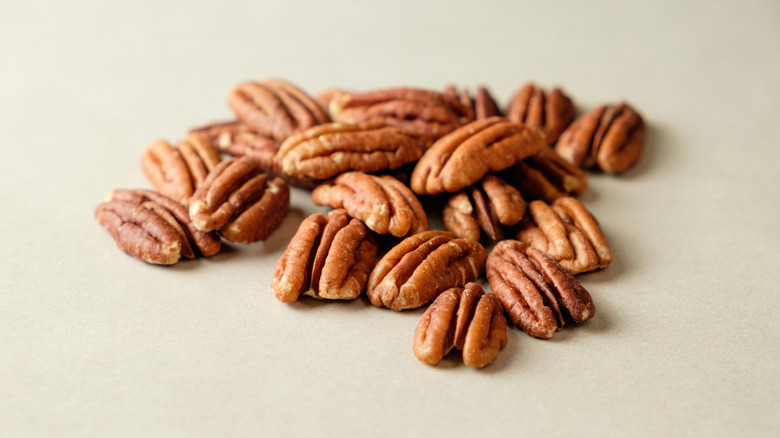
If you had to guess the U.S. state that produces the most pecans, which is most likely to come to mind? Texas? Perhaps Georgia? Maybe even Oklahoma? While all are good guesses, and some have held the label as the state that produces the most pecans in the U.S. at one point in time, as of 2024, the baton has been passed over to the sunny state of New Mexico.
This is according to the United States Department of Agriculture's 2024 report on pecan production, which found that New Mexico had the highest utilized production of in-shell pecans coming in at a whopping 100 million pounds. Georgia follows at 88.3 million pounds. Interestingly, New Mexico is known for a completely different crop that likely doesn't have much to do with trail mixes and autumnal baked goods: Hatch chiles. In fact, New Mexico is the only state where farmers can grow Hatch chiles because the name encompasses a range of chile peppers grown along the state's Hatch Valley.
So how did New Mexico take over as the current leader in pecan production in the United States? Pecan trees are believed to have set their roots in New Mexico during the dawn of the 20th century. At the time, Fabian Garcia, director of the New Mexico Agricultural Experiment Station, planted some of the state's first pecan trees in the Mesilla Valley. To this date, the region remains a hub for pecan production that is responsible for New Mexico's status as a leading producer of this beloved tree nut.
A brief insight into the origin of pecan farming in New Mexico
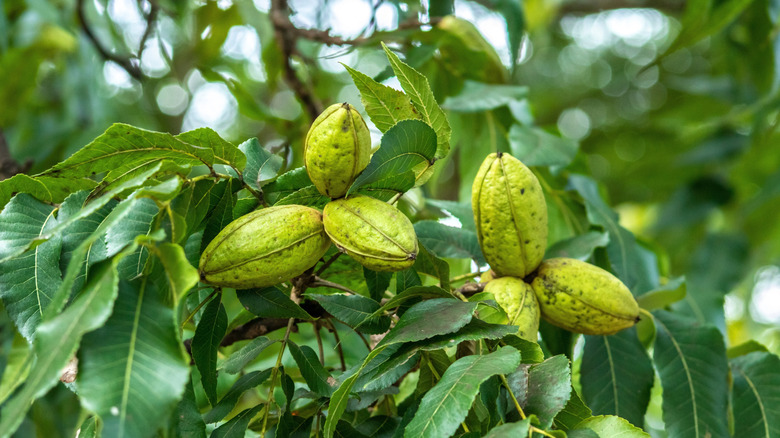
Fun fact: Pecans are the only major tree nut that's native to North America, and have been a valuable source of nutrition for the indigenous and Native communities of the land since as far back as the 1500s. Native Americans were pioneers in cultivating pecans from the wild, and in addition to their delicious taste, they were also relatively easier to shell than other nuts.
The term "pecan" seemingly originates from the word pacane, an Algonquin Tribe word which means "a nut too hard to crack by hand." Traditionally, pecan nuts were used in a number of ways, including being roasted and ground into a flour or boiled. Other parts of the plant, like the leaves and bark, were prized for their medicinal properties. When Europeans first discovered pecans in the 16th century, they became a valuable commodity to trade with other European nations. Modern-day cultivation ensued during the 18th and 19th centuries along the southern United States — which is currently responsible for producing most of the country's pecans — where the conditions are best suited for growing pecan trees. Eventually, pecans became a key crop that, to this day, bolsters an entire industry.
Now, pecans have garnered notable recognition as a seasonal favorite, serving as the foundation for a number of delicious eats. Whether you're making two-ingredient candied pecans, simple butter pecan cookies, or just toasting them plain in the oven, chances are that the pecans you're using are from New Mexico.