

The 7 Biggest Controversies To Ever Happen At Starbucks
Corporations are no strangers to controversy, and the larger the company, the more visible the backlash. When you have a huge company like Starbucks come under fire, the popularity of the company can amplify the controversy even more. And Starbucks has had its share, from odd issues that weren't really illegal but that just got a lot of publicity, to larger controversies that have affected the company's reputation to the point of boycotts.
The controversies that Starbucks has had to deal with may not be on the scale of, say, massive data breaches of supposedly secure databases or fraudulent banking practices at national financial institutions. But they've still changed how many customers view Starbucks (for better or for worse), and they've brought to light some legitimate issues. Some have turned out to not be what they seem, and of course, some have just been strange. So, grab one of those viral bear cups if you can find one, sit back, and read about seven of the biggest controversies to happen at Starbucks.
1. The company was accused of firing people for unionizing
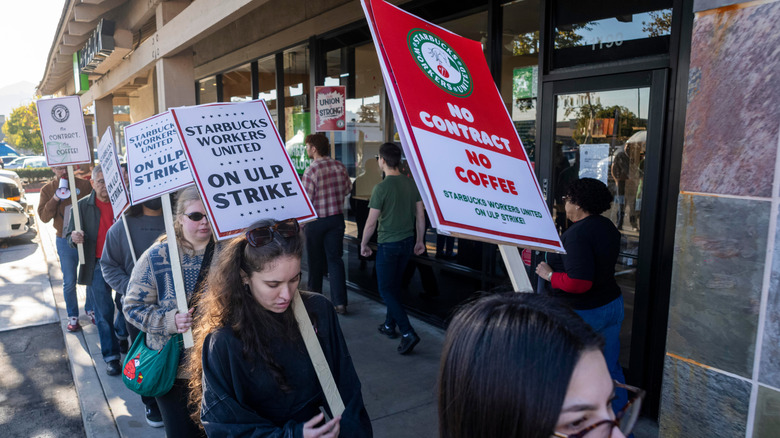
Starbucks employees at many of the company's stores have unionized over the years, and more stores have employees who want to bring the union to their locations. Unfortunately, several of these employees have been fired over the years, and they've filed complaints with the National Labor Relations Board (NLRB), claiming that they were fired specifically for union activity and no other reason. The union that represents Starbucks workers said in 2023 that over 200 people had been fired and others essentially forced to quit between the end of 2021 and mid-2023.
In some cases, the NLRB did find that Starbucks had engaged in illegal behavior due to the employees' union activity and not because of any actual performance issues. For example, in December 2023, the board found that Starbucks had threatened an employee with stricter rules and surveillance over the union, rather than the safety and cash-handling issues that the company claimed were behind the firing. In fact, the board noted that the company hadn't trained her in proper cash-handling techniques to begin with, and ordered Starbucks to rehire her.
However, Starbucks has also had its share of victories. In one case, the NLRB had sought to force Starbucks to rehire some employees in Memphis, and a lower court had approved the NLRB's injunction. But in June 2024, the Supreme Court threw out the ruling, claiming that the lower court's process for evaluating the injunction request was too lenient.
2. It faced criticism over holiday cup designs
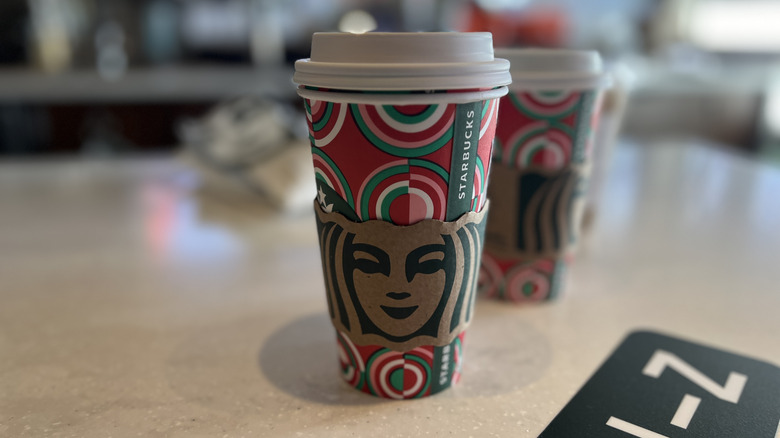
Starbucks holiday cup designs have been a tradition since 1997, but the past decade has seen many of these cups become the subject of controversy because of tiny details — or lack of details entirely. The first cup to become "controversial" in 2015 was just a plain, slightly two-toned red cup with the Starbucks logo on it. That's about as plain as you can get without giving people a blank white cup, and it still made people mad.
The story behind the 2015 cup was that the plain red design was misinterpreted by a very angry customer as being a sign that Starbucks was trying to eliminate Christmas from its cups. The claim received so much attention that even Donald Trump suggested boycotting Starbucks, despite red being a very traditional Christmas color. 2016's cup, which featured a drawing of a crowd of faces with a green-and-white color scheme, was also somehow an attack on Christians, according to opponents. 2017's cup fared even worse. Its whimsical black, white, and red art depicting presents, hands holding each other, and hearts were held up as promoting a gay agenda because Starbucks had a separate video for the cups that showed two women holding hands.
3. Contaminated ice was found at some Starbucks locations
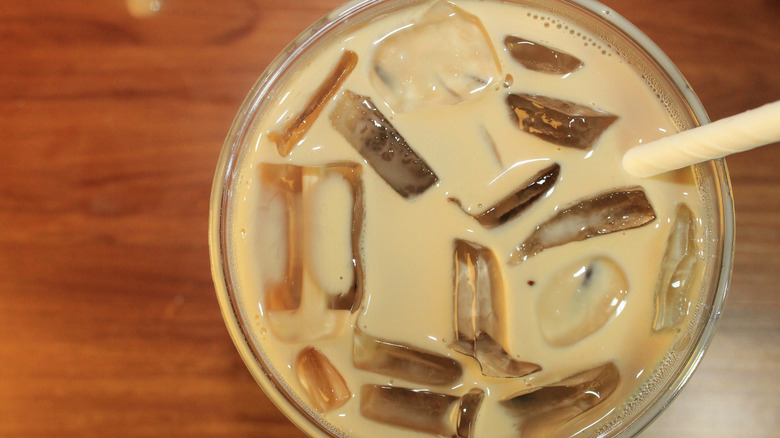
In 2017, consumers in the United Kingdom got news about ice that no one ever wants to hear: A team of investigators from the BBC had sampled the ice at a few coffee chains and found high levels of fecal coliform bacteria. Among those chains were some Starbucks locations. The investigators claimed the levels were so high that illness could be a possibility for anyone ingesting the ice. But representatives from other organizations noted that the investigation used only a small number of samples, and that environmental health officials had been notified and the problem would be taken care of.
Consumers were disgusted anyway, and Starbucks (and the other chains) became the target of claims that the company's coffee was basically full of, well, you know. However, Snopes came to the company's rescue and evaluated the study and its results a little over a week later. Snopes explained that coliforms aren't necessarily an indication that there were actual feces in the ice, and more importantly, it noted that the investigation found bacteria in three out of 10 samples from only one Starbucks location. It also pointed out that the investigation did not find E. coli, and that the bacteria that coliform tests can find aren't always specifically from feces to begin with.
4. Media raised concerns that company wasn't paying taxes
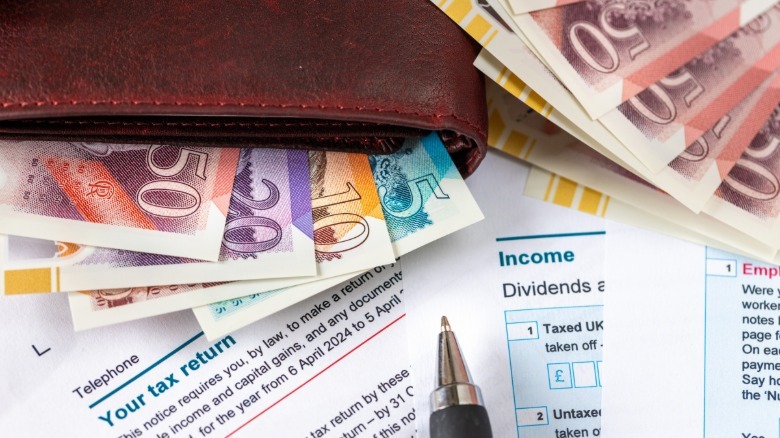
It's not going to be a surprise to most people that Starbucks, like other corporations, uses every legal route possible to reduce the taxes it pays. But in 2012, Reuters found that in the U.K., Starbucks had paid only £8.6 million in taxes over the previous 14 years. In the three years before the Reuters investigation, the company paid £0. Despite telling investors that the company was doing well and being profitable, the company claimed it was not making a profit at all. Some years, it even claimed that it was operating at a loss. In 2024, it was again called out for taking so many deductions that its 2023 British taxes were extraordinarily low, considering its income of £548 million.
Tax experts noted that the U.K. Starbucks' payments of royalty and licensing costs were what cut down the company's initial profits. If Starbucks had legitimate costs that were more expensive than the amount of money the company brought in, then it would be able to claim no profit or operate at a loss. And there are no claims that the company actually broke the law. However, the low amounts of taxes it paid have been singled out as being against the U.K.'s national interest, and its low taxes due to the huge royalty and licensing payments in 2023 were held up as an example of how those specific costs could prevent a country from receiving its share of the company's profits via taxes.
5. It was accused of poor ethics and labor practices
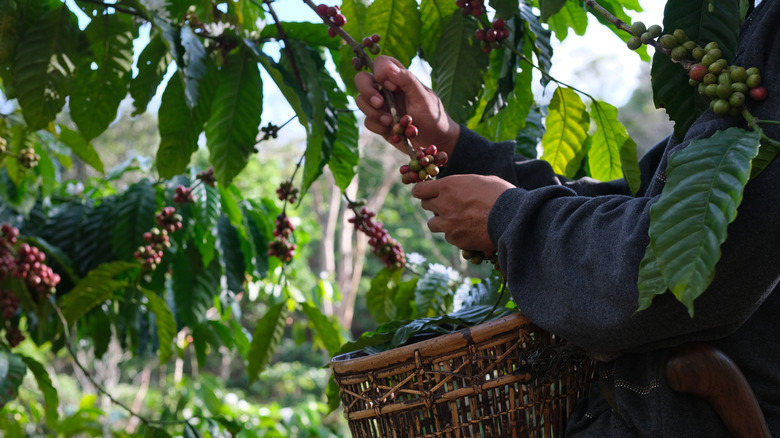
Starbucks has long positioned itself as committed to ethical sourcing of its coffee beans and claimed that the company only works with farms that meet its high standards. However, in the past couple of years, activists have filed two different lawsuits against the company, claiming that it actually gets its coffee beans and tea leaves from farms that are rife with human-rights abuses and labor violations. The first lawsuit was filed in January 2024 by the National Consumers League, which claimed that Starbucks knowingly sourced coffee and tea from farms that didn't meet the "ethical sourcing" that Starbucks claimed on its packages. The second was filed in April 2025 by a group called International Rights Advocates; this lawsuit focused on eight Brazilian workers who claimed that Starbucks was sourcing coffee from a co-operative that had kept workers in extremely poor conditions. The group claimed that Starbucks was in violation of anti-trafficking laws.
Starbucks, of course, called both cases without merit. However, a number of suppliers who've worked with Starbucks in the past several years have come under fire for horrifying working conditions. One such case in 2022 resulted in the rescue of 17 people in Brazil. Starbucks uses a third-party organization to verify that suppliers meet its standards, but at least one of those third-party organizations has also been the subject of two lawsuits in 2021 and 2024 that claimed its certification processes were deceptive.
6. Boycotts occurred due to the Israel-Palestine conflict
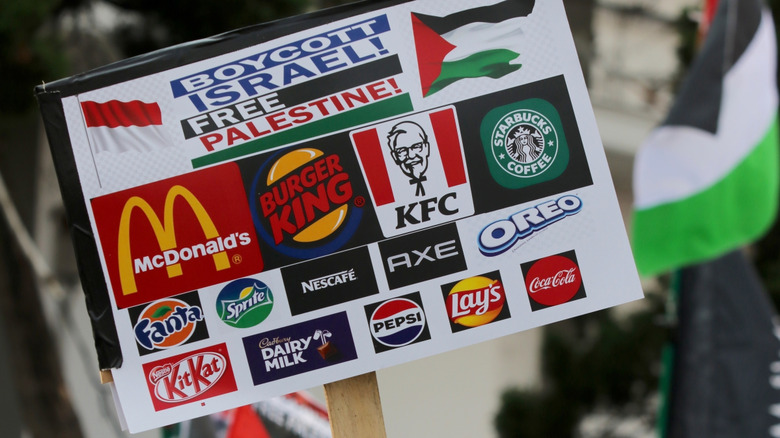
Shortly after Hamas attacked Israel in October 2023, the union that represents many of Starbucks' employees posted a pro-Palestinian statement on social media. By mid-October, Starbucks had filed suit against the union for trademark infringement and claimed that the post led to its employees being harassed by customers. Shortly after that, the company posted a statement on its website claiming that both Starbucks and its previous CEO (who left the company in September 2023) did not provide financial support to the Israeli government or military. It also stated that the company did not get involved in politics. It posted two additional statements in December 2023, repeating that it did not provide financial support.
None of this was enough to shield the company from criticism from customers and employees on both sides of the conflict. Pro-Palestinian activists have repeatedly called for a boycott, claiming that Starbucks supports genocide, while other customers have boycotted the company because of its lawsuit against the union. Some have wished that Starbucks would get involved and send aid to Gaza. Other customers have boycotted the company because of the union's pro-Palestinian post and, in at least one store, confronted staff over the perception that Starbucks was anti-Israel. By the way, there are no Starbucks locations in Israel; the company used to have some but pulled out of the country over 20 years ago due to what the company said were operational issues and philosophical differences.
7. A new uniform policy prompted employee complaints
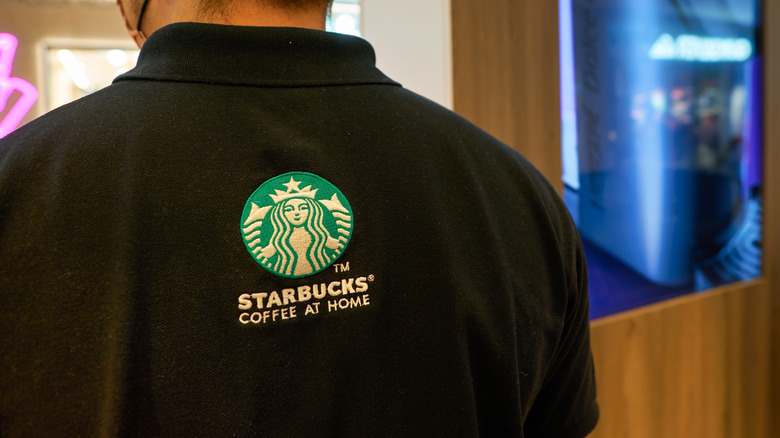
In April 2025, Starbucks announced that it was revamping its dress code. Previously, Starbucks employees could wear T-shirts of any color plus pants that were either brown, navy, or gray. Now employees are restricted to wearing only black shirts plus black, khaki, or blue denim pants. The company claims this is solely to make the uniforms more consistent and simpler to follow. For anyone who's worked a retail job that required specific colors, this might not sound like such a huge deal.
However, it was a big deal to employees. The new dress code meant that many of the clothes people were wearing for work were no longer acceptable. They were required to go out and buy new outfits, which for full-time workers could add up to a rather large bill. Another issue was that Starbucks claimed that it had given employees two shirts to wear for the new uniforms. However, the union that represents many Starbucks employees said in May that they had not yet received. Additional comments online complained that two shirts weren't enough for people who worked more shifts. Workers at about 100 stores walked off the job on strike in protest, and workers in three states sued Starbucks in September, claiming that state rules required Starbucks to reimburse workers for the cost of the new clothing.