

The Difference Between Michelin-Starred And 'Michelin-Recommended' Restaurants
Restaurant reviews, recommendations, and mere notices of a place's existence can be weirdly hard to parse. Even some supposedly proper restaurant reviews aren't always a source of accurate information. It often falls on the consumer to try and divine whether a publication actually paid the tab for a real deal review visit, whether it did so anonymously as is best practice, and, disturbingly, whether they actually sent anyone to assess a place at all. So you really can't blame readers for getting it wrong sometimes, including when it comes to the nuanced gradations of Michelin acclaim. After all, what really is a Michelin-starred restaurant compared to any other Michelin-recommended spot?
Fortunately, Michelin's honors are more scrutable once you learn its lingos and logos. Top spots are literally starred with the illustrations to match. A smattering of others are just recommended, as though by a particularly knowledgeable friend. All are said to have been evaluated by Michelin's famously secret inspectors.
Michelin, the tire company with the spectral mascot, has also been producing hospitality guides since 1900. These guides were, brilliantly, intended to increase road travel and thus sell more tires. By 1926, extra special places were noted with a single star. And, after a few more years, the three star system (one for very good, two for excellent, and three for exceptional) that Michelin still employs today was put in place. Michelin adds its lower value recommendations to the guide all year long. And the privileged few, which do not necessarily even have to have been included among those incremental guide updates, might ultimately be anointed with the precious sparklers in a ceremony that typically takes place around autumn.
Separating Michelin stars from recommendations in the wild
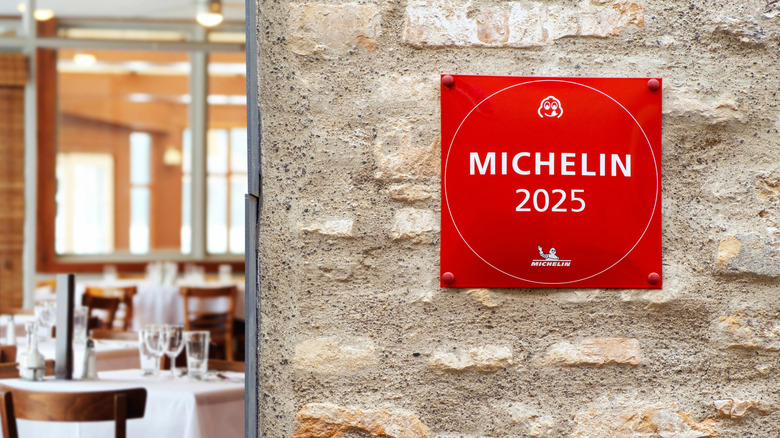
While you might expect a more cerebral rendering, Michelin stars actually more closely resemble a six petaled flower. Many operations bestowed with the distinguished honor flaunt the fact via rarefied red plaques. If a place has a Michelin star, it probably is not going to obscure that unique recognition.
To use one big, small example, as of October 2025, New York City is home to 71 Michelin-starred restaurants, a number that typically changes annually as the guide is updated to account for changes in local restaurant landscapes. Another 82 restaurants have received the Bib Gourmand recognition, which signifies good food at more reasonable prices. You'll presently find these august institutions among 371 total notables listed on Michelin's website, including a majority that are absent the brand's formal regalia. Those 218 Michelin-recommended restaurants reside in a town that numbers around 20,000 eateries, depending on how you count, so while they're not starred, the status is certainly still worth noting.
All the rigamarole can be a little bit eye-rolling, but it can also be beneficial to restaurant-goers. Not every night calls for, say, Manhattan's two-starred Chef's Table at Brooklyn Fare and its triple-digit prices. But it might just be the right time for a stop by Michelin-recognized See No Evil, where you can grab a pizza for a lot less dough while retaining a little bit of formal acclaim.