

The Depression-Era Struggle Meal Sauce That Replaced Marinara
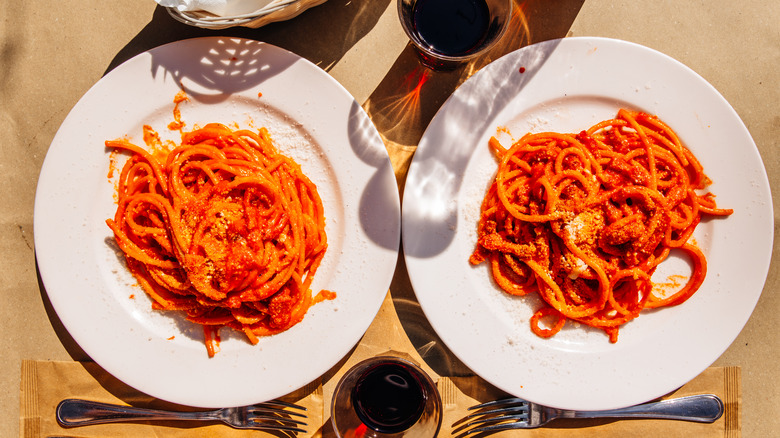
We all have at least one. Nacho chips with shredded cheese microwaved until hot and chewy, instant ramen perked up with mayo, and beanies and weenies — these are all examples of the struggle meal. Now, what is a struggle meal? At the most basic level, it is a meal that can be made with inexpensive, easily obtainable ingredients. Many of us, at one time or another, have had to rely on struggle meals to get by. And, as is human nature, these crafty, somewhat off-kilter meals tend to stick with us far beyond necessity. Take, for example, the humble but delicious meatloaf, which has roots in Depression-era cooking, or the crafty and sweet mock apple pie.
Then, there are those struggle meals that have, over the course of more prosperous years, fallen by the wayside. These are dishes that might be served at your grandmother's house, foods that are a bit rough around the edges and may require an open mind to try. One such struggle meal? Ketchup spaghetti. Yes, you heard that right. There was once a time, during the Great Depression, when ketchup was used as a substitution for tomato sauce. This recipe has largely faded into obscurity. However, it does remain a comfort food for some, some of whom have shared their family's unique take on the hodge-podge dish.
Why use ketchup for pasta?
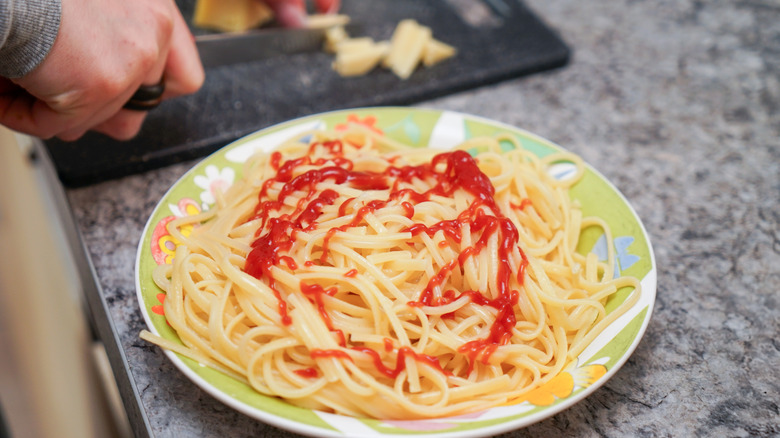
Now, why was ketchup spaghetti so popular at the time? It largely came down to expense and convenience. Making a marinara sauce using fresh ingredients is labor-intensive. These were often hard to come by, expensive, or just not compatible with the needs of the average American during the Great Depression, a time of mass migration and struggle across the country. For this reason, more people gravitated to low-cost, pre-packaged, and shelf-stable foods. This is where ketchup and pasta come in.
Both of these foods were typically readily available and incredibly cheap, and combining them did taste somewhat similar to tomato sauce and pasta. Ketchup, for what it's worth, was also often added to hot water to make a tomato soup of sorts. Making ketchup spaghetti really is as simple as boiling pasta and adding ketchup, or at least it can be. But, as humans are wont to do, many recipes for this dish have a few steps and added ingredients that help round out the dish. Audrey Hepburn, for example, had her own recipe for ketchup pasta that involved a good bit of cheese to add complexity. Other recipes call for boiling ingredients such as onions in your pasta water to give more depth of flavor, and mixing in butter to give your sauce a richer base.
The ketchup pasta tasted round the world
In the United States, ketchup spaghetti is now a bit of a culinary artifact. While there are some in the states who still like to treat themselves to a bowl of ketchup sketti every so often, it is, by and large, more of a punchline than a widespread dish. And this is a real shame because, despite its off-putting reputation in the States, ketchup pasta has seen a more welcoming reception on a global scale.
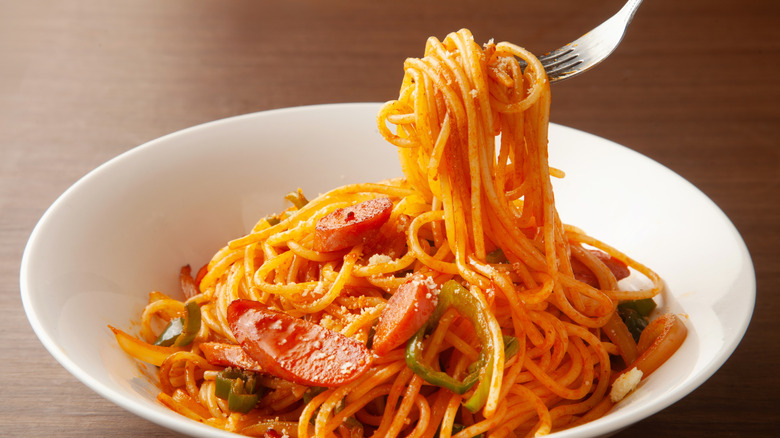
This is perhaps most evident in the Japanese dish called Napolitan. This dish was first made by a Japanese chef during the years following World War II, in an attempt to recreate the spaghetti and tomato sauce often served on American military bases. There was one problem: tomato sauce was scant to be found in Japan. So the chef got crafty and used what he had on hand, which happened to be ketchup. He combined ketchup with peppers, sausage, pasta, and other ingredients to make the dish, which is still quite popular.
Haiti, an island nation in the Caribbean, also has a ketchup-based pasta dish called Haitian Spaghetti. This pasta dish is typically served at breakfast, and is similar to Napolitan in that it has a base of ketchup, spaghetti, sausage, and pepper. However, Haitian spaghetti also includes epis, a flavorful seasoning base used in many Haitian dishes. In this meal, ketchup serves a similar purpose as in Napolitan, as a tomato base for a pan sauce. However, ketchup isn't strictly necessary for Haitian spaghetti. Some recipes call for tomato paste, so you can make it with or without the condiment. Though we dare say that ketchup does add a certain tangy goodness that isn't easily replicated.