

Why It's Crucial To Understand How To Read A Bourbon's Mash Bill When Cooking With The Spirit

We may receive a commission on purchases made from links.
Whether you're new to bourbon or you're an experienced enthusiast, you may find the spirit's culinary versatility truly astounding. Use it in your next marinade or even lend some depth to your next banana bread — there seems to be no bounds to using bourbon in the kitchen. However, just as you want to choose the right bourbon for drinking, so too should you pick the proper bourbon for cooking. But do you really need to go into the nitty gritty of understanding a bourbon's mash bill? Our expert in Southern cooking kindly asks that you do.
Hannah Taylor, author of "Measure with Your Heart," knows the wonders of cooking with bourbon better than anyone. When asked if a bourbon's mash bill matters that much when used for cooking, she responds with an enthusiastic yes before relating an exclusive and enlightening analogy: "A bourbon's mash bill is like its personality: Some lean sweet with more corn, others are spicy from the rye, and a few carry that soft, bready note from wheat. When you're cooking, say, stirring bourbon into a pan sauce or whisking it into a glaze, that personality shows up in the background. A high-rye bourbon might give your sauce a little kick, while a wheated bourbon will melt in softer and sweeter." The personality of your dish matters; therefore, so does a bourbon's mash bill.
Understanding a bourbon's mash bill
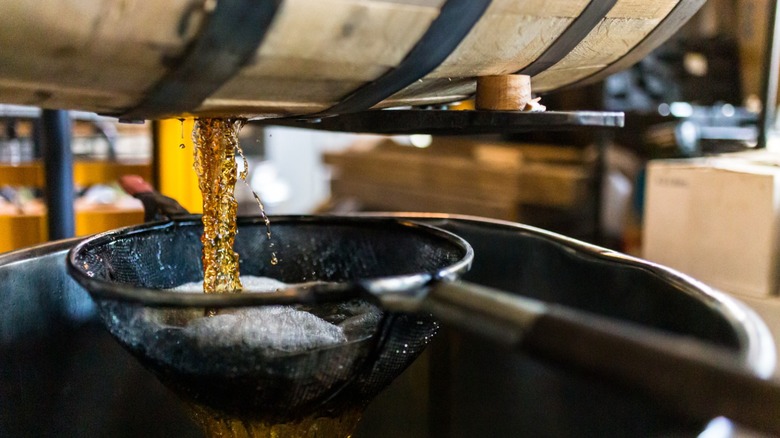
Bourbon is a strange category of whiskey. On one hand, you'd think all the strict regulations would create a spirit that's pretty homogeneous from bottle to bottle. But, on the other hand and in spite of these restrictions, there's a whole spectrum of bourbon flavor profiles to compare with one another. Delving into a bourbon's mash bill is one of the keys to understanding this balance of familiarity and diversity.
A mash bill is just the term used for the combination of grains in a particular bourbon, usually complete with percentages of each grain. All bourbons, by law, must be made from at least 51% corn. Many distillers use more than 51%, but after that it's really open season on which other grains you can use. Nevertheless, some grains have become go-to options. Usually, rye, wheat, and barley are used in conjunction with corn to produce a certain combination (or "mash") of ingredients.
It's these secondary ingredients where much of the personality that Hannah Taylor alluded to is developed. If rye is the second ingredient, and it appears in a decently high volume, the bourbon inherits some of those spice notes. Meanwhile, a wheated bourbon is sweeter and subtler on account of using wheat as its second grain instead of rye. In this way, Taylor's advice stands: The bourbon you should choose depends on what you're cooking. Fortunately, the mash bill is super-easy to understand when read this way.
Which bourbons pair with which flavors?
Since there's a fairly sizable degree of variation from one bourbon to the next, it can be beneficial to know how each bourbon might best be used. You wouldn't want a soft, wheaty bourbon to get lost in a complex dish, for example. Thankfully, Hannah Taylor has you covered by breaking down the different flavors that complement certain bourbons with distinct personalities.
With high-rye bourbons, such as Four Roses or Old Grand-Dad — two "bottom shelf" bourbons that are worth the buy — Taylor suggests pairing rye's assertiveness with ingredients that can stand up to it. "I love pairing them with bold flavors that can dance with that spice instead of hiding from it," she says. "Think black pepper steaks, chili flakes in a glaze, or even a molasses barbecue sauce. Sweet and smoky flavors balance rye's bite beautifully."
Meanwhile, wheated bourbons, such as Maker's Mark and venerated Van Winkle selections, "are softer, rounder, almost like a warm biscuit on a Sunday morning," per Taylor. "They shine with buttery, nutty, and creamy flavors, [such as] pecans, brown butter, caramel, or even vanilla. They don't try to take over the recipe, they just melt right in." This is saying nothing of that sometimes-present earthy-and-nutty barley note, which Taylor recommends with "roasted mushrooms, coffee, chocolate, [and] even herbs like thyme and rosemary." Understanding a mash bill, then, is kind of like a cheat sheet to some amazing cooking.