

The Safety Reason You Might Want To Think Twice Before Drinking Non-Alcoholic Beer On Tap
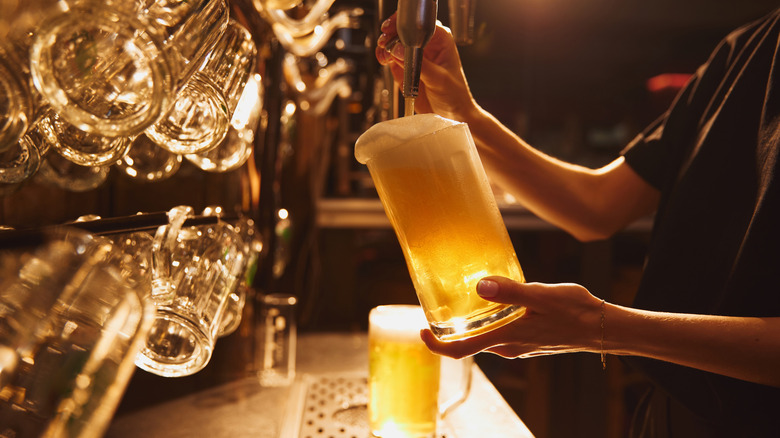
Despite non-alcoholic (NA) beer being quite expensive, the drink is getting increasingly popular. There are several reasons for this including a general lowering in alcohol consumption among younger generations. However, the social environment around drinking is still high in demand, which is why you're likely to see non-alcoholic beer in more and more drinking establishments. Though not as common, it's possible to come across the brew being served on tap as well.
While many may be tempted by the idea of getting a fresher NA brew on tap, this is not always the best idea. The freshness of the beer you get on tap depends on how old the keg is, how it's stored, and the condition and cleanliness of the piping and the beer tap nozzle. The fact that NA beer doesn't have alcohol, which helps hinder bacterial growth, makes it particularly susceptible to bacteria growth. In fact, when we spoke with four experts about red flags to watch for when buying beer, Mark Tumarkin, a retired liquor distributor, stated: "I would not buy a non-alcoholic beer on draft, for that very reason, there's no alcohol in that beer to protect [against] a dirty line."
A dirty line doesn't just negatively affect the flavor of the beer; it can also cause illness in extreme cases when enough bacteria is able to accumulate. NA beer itself is quite a delicate product that should be handled like any other perishable food. Therefore, even if the beer tap and piping are clean, ineffective storage of the beer can result in it getting spoiled or in the growth of harmful bacteria.
Alcoholic beer isn't necessarily free from germs either
In some instances, non-alcoholic beer is first brewed like regular beer, and then has the alcohol removed through a sophisticated process. However, beer can still have up to 0.5% alcohol and be labelled as non-alcoholic. However, this negligible quantity of alcohol doesn't do much to help with preservation. In fact, even the approximately 5% of alcohol that regular beer has isn't enough to give it disinfecting properties. Per the Center for Disease Control and Prevention, the recommended concentration of ethyl alcohol to be used as a disinfectant is between 60% and 90%. Ethyl alcohol is also the type used in alcoholic beverages, but unless you're using beers with the highest ABV in the world, your brew is unlikely to have any disinfecting properties and may still be susceptible to bacterial growth in the beer tap.
Fortunately, beer contains another layer of protection from bacteria — hops. This essential beer ingredient, which gives beer much of its signature bitter flavor and aroma, also works to slow down the growth of bacteria. While still not a disinfectant, hops do help raise the shelf life of the drink. However, beers with less bitterness and lower alcohol levels can be more fragile and are best consumed as fresh as possible. Not all drinks on tap are this susceptible to spoilage. Soft drinks are more processed and generally contain more preservatives and stabilizers to increase their shelf life.