

How Much Time It Really Takes For Alcohol To Cook Off In Your Food
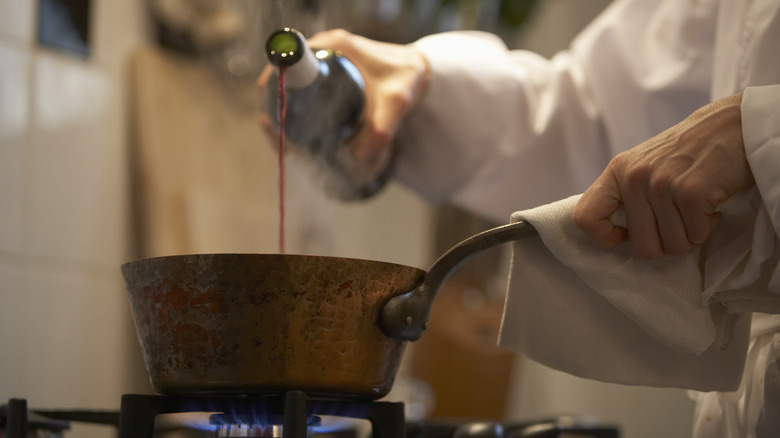
From the iconic pairing of vodka and tomatoes for a luscious sauce to the many ways to infuse liquor into baked goods, alcohol transcends its purpose on bar shelves to one in the kitchen. Whiskey works wonders to bring out the best flavor in caramelized onions, for example, and cooking with mezcal imparts a bold smokiness, adds depths of complexity, and a Mexican-inspired twist to dishes. Alcohol also comes in handy when deglazing a pan of flavor-rich fond to incorporate these mini pockets of flavor into the rest of the dish. We could go on making the case for how spirits can enhance your culinary ventures, but cooking with any type of alcohol begs the question: How long does it take for the alcohol to properly cook off?
Not allowing ample time for the alcohol to cook off is a guaranteed recipe for a disastrous dish (and the biggest blunder you can make when cooking with wine according to Alex Guarnaschelli). Avoiding this catastrophe depends on how the alcohol is combined into the recipe and the cooking method. For instance, according to a study performed by the U.S. Department of Agriculture's Nutrient Data Laboratory, simply stirring alcohol into a hot liquid retains 85% of the alcohol content, baking for 25 minutes without combining it with other ingredients retains 45% alcohol, and simmering or baking a mixture with alcohol for two hours can still leave about 10% alcohol behind. So, the longer you cook, the more alcohol cooks off. While some residual ethanol may remain in the mix, when combined with other components of the meal, it's unlikely to impair your faculties.
Is it possible to cook off all the alcohol?
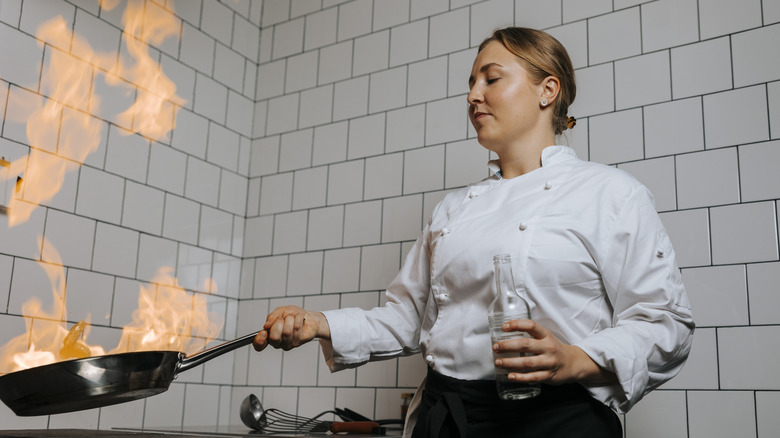
Pure, unadulterated ethanol has a lower boiling point (173 degrees Fahrenheit) compared to water (212 degrees Fahrenheit). If you were to heat up pure ethanol to its boiling point, all the alcohol would be cooked off. But who out here is cooking with pure ethanol? The wine and spirits we're familiar with in the food and beverage world contain other components, such as water and sugar, that make the "cooking off the alcohol" process a tad more complicated. As the ethanol concentration decreases from these elements and other ingredients in the recipe, the interaction between the ethanol molecules becomes less straightforward. The water holds on to the ethanol, some of which, despite having reached its boiling point, remains in the mix. The more non-alcoholic ingredients in your recipe, the more difficult it is to cook off the alcohol.
That said, if you want to minimize the alcohol levels in a final cooked dish, a few techniques can assist with the task. One is to bring the boozy ingredient to a boil separately before adding it to the rest of the ingredients. Another — according to a 2017 study via the National Library of Medicine — is to cook a mixture containing alcohol with a lid on; researchers found this increased the evaporation and resulted in a significant loss of ethanol. The general rule of thumb when cooking with alcohol is to cook with caution and eat responsibly. Of course, cooking with alcohol is not mandatory; you can always experiment with non-alcoholic spirits, wine, and beer.