

How Brisket Wrap Liquid Works Compared To Spritzing
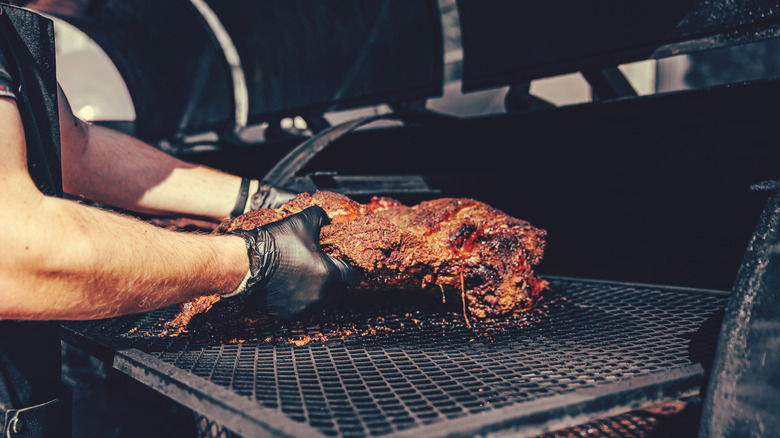
It might not be the first thing you think about when you're enjoying a decadent plate of smoked meats, but there's a lot of tricky science that goes into cooking meat low and slow. For example, the key to smoking a tough cut of meat like brisket is to give it the time it needs for connective tissues to break down so the meat can become tender without burning or drying out. Unfortunately, according to barbecue expert Scott Thomas, owner of The Grillin' Fools, "fire inherently dries things out. This usually presents itself in the form of the seasoning/rub on the outside of the brisket being mealy and dry." That's why many pitmasters choose to add some kind of moistening component into the mix, typically in the form of spritzing, wrapping, or a water pan.
Spritzing involves regularly spraying meat with liquid as it cooks to add flavor and help counteract the drying effects of heat. The downside, Thomas says, is it "tends to evaporate off pretty quickly." That's why he prefers a water pan, which keeps the humidity high as its contents evaporate. Wrapping, on the other hand, is a more direct method of surrounding your brisket in liquid. This helps steam the meat and accelerates tissue breakdown. In Thomas' opinion, "wrapping is much more effective because the meat is fully enclosed. Thus, there isn't any moisture loss."
Pros and cons of spritzing
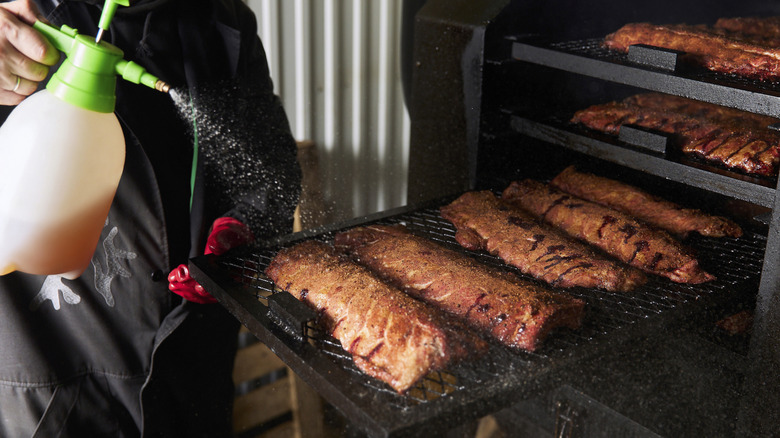
Whether you're smoking brisket or grilling steak, spritzing your meat in regular intervals helps keep it moist and flavorful, especially if you use a liquid concoction more interesting than plain water. "Beer is very common, but so is wine or even whiskey cut with some water," Scott Thomas advises. Other popular choices include apple cider vinegar, straight-up apple cider, or beef broth. "All of these can have seasoning mixed in with them to kick up the flavor profile a bit," he adds.
However, Thomas says "the one flaw with this method is that the spritz tends to evaporate off pretty quickly. Thus, it requires opening the chamber more often than is ideal to keep the cooking process rolling." Thomas stresses that for spritzing to be effective, it needs to be done every 15 to 30 minutes. "If [you're] only spritzing once an hour, don't bother. Go with a water pan or just wrap it." Additionally, you risk spritzing the fat and disrupting the rendering process. That's why "a water pan or water pot is a better method in my book," he says. Using a water pan just means placing a pan full of liquid in your smoker to stabilize its temperature and create steam. "As the liquid evaporates, it ups the humidity in the chamber and keeps the rub from getting mealy," Thomas explains. Keep in mind that "the liquid doesn't have to be water. Beer or cider vinegar work great."
Pros and cons of liquid wrapping
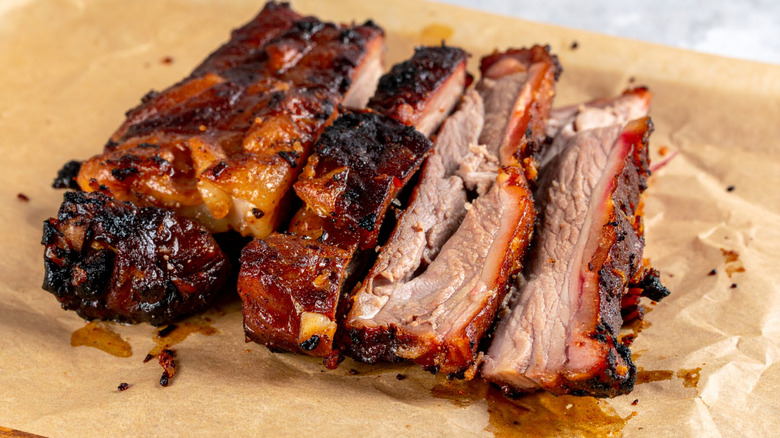
Wrapping is a great way to keep your brisket moist with minimal effort or interruption to the cooking process. Simply fold your brisket "in either foil or peach (or brown) butcher paper, along with some sort of liquid," Scott Thomas says. "What this does is hyper-accelerate the breakdown of connective tissue as the meat steams inside the paper or foil while retaining moisture and adding flavor." This method can also help speed up the time it takes your brisket to cook. "Wrapping a brisket can turn a 12-hour cook session into a seven-to-eight-hour session," he says. When it comes to smoking, there's no need to be a martyr. "There are people who wear the fact that they were lighting their grill at 1 a.m. or 2 a.m. the night before as a badge of honor. I'm not one of them. I'll wrap and get the extra sleep," Thomas says.
"The downside to wrapping is it wrecks the bark," Thomas says. "Bark is the combination of the seasoning, heat, smoke, and fat rendering out of the meat to make the most flavorful part of the protein." Because liquid is no friend to bark, Thomas explains it's a mistake to rest the brisket in the wrap. Before the resting stage of cooking, he emphasizes that "it's better to remove the brisket from the wrap and put it back on the grill to firm up that bark."