

How Much Did A Hershey's Bar Cost When It First Came Out In 1900?
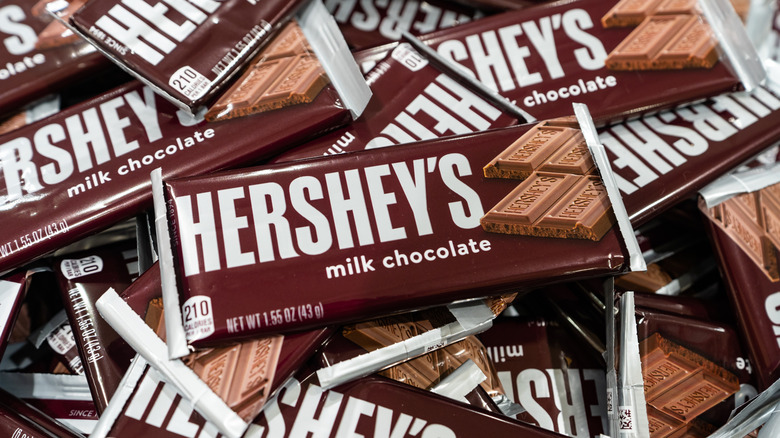
The Hershey's bar, the go-to chocolate for making that traditional campfire treat, s'mores, has been around for more than 125 years. For nearly half of that time, starting in 1900 when the Pennsylvania-based company first launched its landmark treat, it could be had for 5 cents, which is the equivalent of a little more than $2 today. Milton Hershey, the company's founder, helped transform chocolate from an extravagance enjoyed by the wealthy into an everyday treat for average Americans. He did this by devising a formula for his shelf-stable candy bar that allowed him to use fresh milk and industrial manufacturing techniques.
Amazingly, the price remained 5 cents for decades until 1969, when the company doubled it to 10 cents due to the rising cost of cocoa beans and other ingredients. Previously, the company had given in to shrinkflation, making the bars smaller to keep the candy at the original price (although the brand also made the bars slightly larger from time to time when ingredient costs went down). The change was national news and had columnists decrying it as the end of an era in America. But when the company doubled the price, they also made the bars much larger, going from three-quarters of an ounce to an ounce and a half, a sweet trade-off for fans.
Chocolate changes beyond price
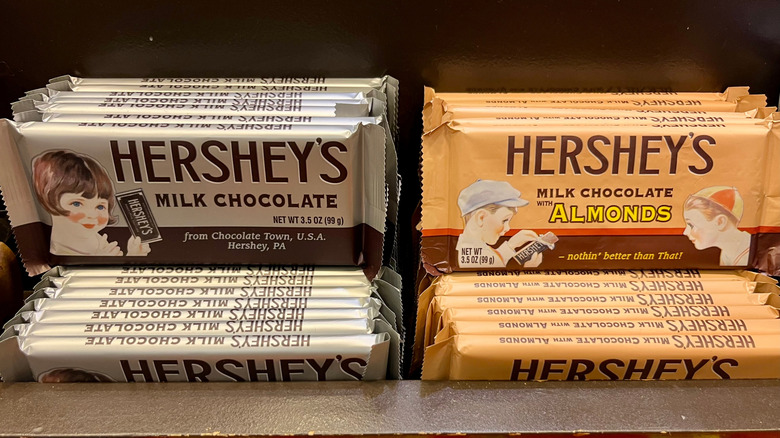
The price of a Hershey's bar, which today sits at about $1.80 for the 1.55-ounce size, isn't the only thing that has changed about these famous candies over the years. Before the iconic dark brown wrapper with the bold Hershey's lettering across the front, there were a variety of different label designs. The first had gold lettering on white paper and featured the image of a cow and a cocoa bean. Hershey's also used a foil inner wrapper for much of its history (with a large time gap between World War II and 1984) until 2003, when it replaced both the foil and paper wrapper with a film wrapper to better ensure freshness.
Inside that wrapper, there have been changes as well. When Milton Hershey first developed his milk chocolate bar, it used cocoa liquor (cocoa butter and solids) from cocoa beans, condensed milk, and sugar. These days, the company also adds soy lecithin, an emulsifier that allows manufacturers to use less of the expensive cocoa butter, and PGPR (polyglycerol polyricinoleate), a synthetic emulsifier. The ingredients list also includes natural flavor, but doesn't explain exactly what that is. Today, the company makes around 373 million Hershey's Milk Chocolate Bars a year and is the largest chocolate maker in North America, with about $11.7 billion in annual sales, and it all started with a 5-cent candy bar.