

Your Pyrex Baking Dish Could Be Vintage. Here's How To Tell
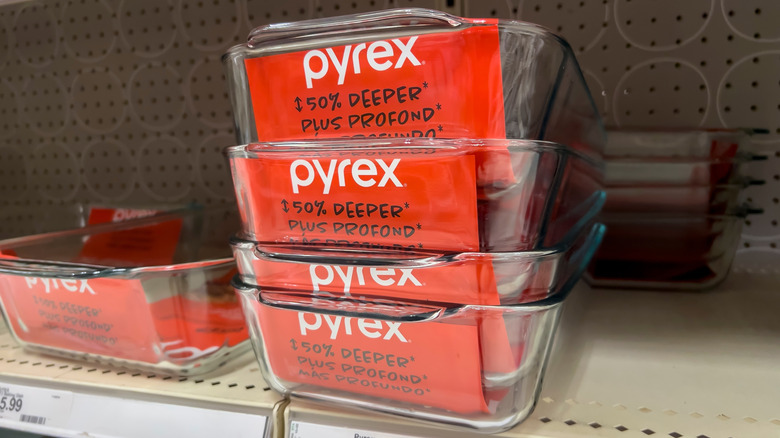
We may receive a commission on purchases made from links.
Pyrex, the brand that has changed home cooking forever with its innovation, has been in the game since 1915. If you've picked one up but you're unsure of its origins, there are different sets of clues to tell whether it's vintage. Checking the backstamp is a good way to start. Found at the bottom of your dish, you might find the logo that can easily answer the question. If all the letters in "Pyrex" are capitalized, it's an indication that it's likely a vintage dish. But that's not always the case, as the company shifted to a lowercase branding in the last leg of the '70s, so some lower-cased models might be vintage.
So, to be certain, look for more clues. The word "patent" above the logo and the date May 27, 1919 below it indicate that it was produced anywhere from 1919 to 1924. Meanwhile, a trademark symbol (®) coupled with "TRADE MARK" and the words "MADE IN U.S.A." surrounding "PYREX" indicates it was made around 1950, whereas any metric measurements on the dish can be found in pieces produced in the mid-1970s or later.
Another way to help figure out whether it's vintage is by checking for the model number, which should contain three or four digits, like 015 and 1063. This will allow you to easily look up the model online so that you can better confirm the date of production. However, do note that the oldest version of the colorware won't have model numbers.
The importance of knowing whether your Pyrex baking dish is vintage
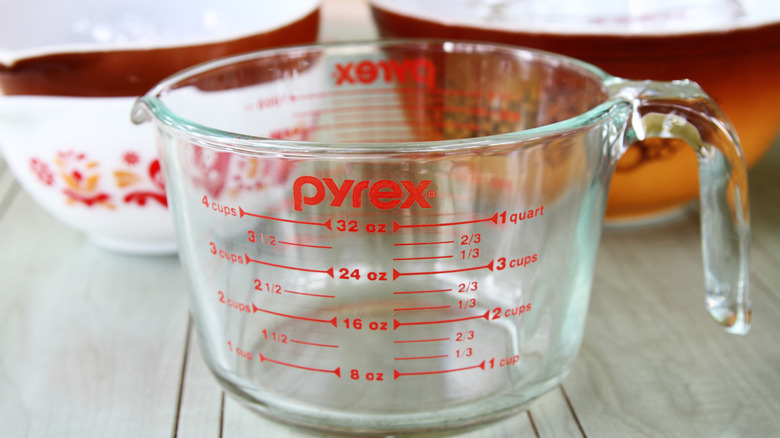
One obvious reason to determine whether your Pyrex is vintage is its potential monetary value. For instance, as of the time of this writing, there's a vintage square Pyrex Milk Glass with blue flower design and round edges up for sale on eBay for $800. If you were able to spot the same model at a secondhand store for a few bucks, the return on your investment can be substantial. So, authenticate your vintage Pyrex; who knows, you might've stumbled into a goldmine. But if you're a collector with no interest in reselling, you'll still have a valuable piece that you'd be proud to display. Plus, if you're someone who appreciates the artistry of vintage cookware and loves interesting designs and patterns, this knowledge can help you identify which ones are worth your investment.
It also has something to do with quality. For instance, vintage models are made with borosilicate glass, which was well-regarded for its thermal shock resistance. So, even if, say, you heat the dish in the microwave and wash it with cold water immediately after, it's less likely to crack. Choosing something made of borosilicate glass is especially important if you're doing high-heat cooking. Newer models are made with soda-lime glass and aren't as durable in the same scenario, so it's important to treat them with more caution. For example, putting it in a toaster oven might cause it to shatter. It might be due to its affordability that the brand switched to this material, but we don't know for sure. Nevertheless, knowing the rough estimate of the production date of your baking dish can help with its preservation — and teach you how to handle it better.