

I Tried All Of The Argentinian Steaks From Trader Joe's. Here's The One You Should Never Pass Up
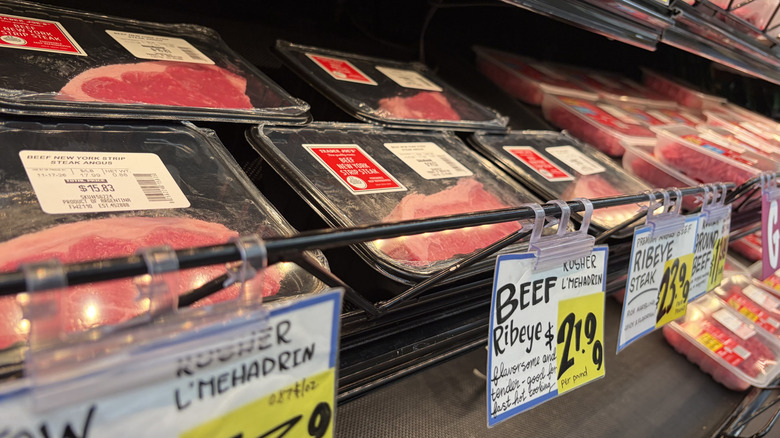
It's no secret that Argentina is home to some of the best steaks around. The country is lush with grasslands, which means that free-roaming, grass-fed cows yield beef that is a major flavor upgrade from their grain-fed counterparts. Argentinian steaks are also cut based on texture, as opposed to American steaks, which often pass through several different muscles and tissues in the name of creating a uniform cross-section. The result are cuts of beef that are exceptionally tender, deeply savory, and a true treat for the steak enthusiast.
Thankfully, you don't need to splurge on international plane tickets to taste some of these supposedly top-tier steaks for yourself. Trader Joe's, the beloved, eclectic grocery store chain with more than 650 locations across the United States, also sells steaks directly sourced from Argentina, according to the steaks' packaging. At my local Trader Joe's, I found three of them — a ribeye, a New York strip, and a twin pack of filet mignons — and quickly became curious about how they would stack up against each other.
After procuring the steaks and cooking and sampling them under nearly identical conditions, I'm happy to report that I have some answers. Keep reading for the lowdown on Trader Joe's selection of Argentinian steaks, as well as my take on which one you can't pass up during your next shopping trip.
Methodology
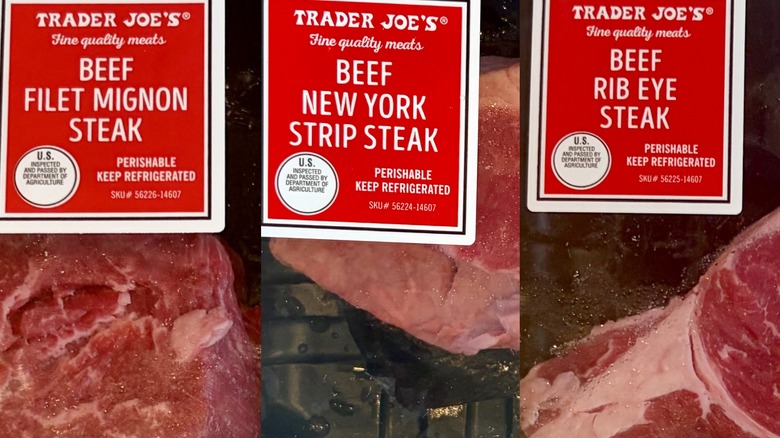
In order to ensure that each Trader Joe's Argentinian steak had its fair chance to shine, I sourced each of my steaks within two days from the same Trader Joe's location in Washington, D.C. I chose steaks with similar sell-by dates to control as best as I could for freshness during taste testing.
Before cooking each steak in its own separate, clean pan (I opted for shallow, stainless steel pans), I patted each one dry and seasoned them liberally with a 1-to-1 mixture of salt and pepper. I brought the pans to high heat with a modest amount of avocado oil in each, and then seared each steak on one side until it developed a thick enough crust to unstick itself from the pan. I didn't want to rely too much on my gut when gauging internal temperature, so I used a meat thermometer to ensure that each steak had reached 130 F, the ideal temperature for a medium-rare cook. Finally, I let the steaks rest for five minutes before tasting them because, as any steak-lover knows well, it's a major mistake to cut into meat right away.
Each of these steak cuts has its own unique ratio of fat to lean meat, and it would be unreasonable to expect the same level of marbling from a filet mignon as I would a ribeye. As such, I instead evaluated the steaks based on their tenderness and umami flavor.
Trader Joe's Beef Rib Eye Steak
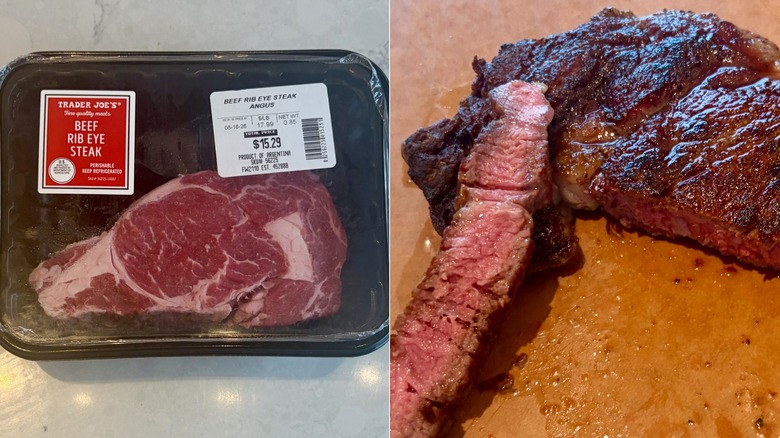
Unfortunately, the Beef Rib Eye Steak came in last out of all the Argentinian steaks. But not only did it fail in that category, but when comparing all eight of these Trader Joe's steaks, the Argentinian Beef Rib Eye came in dead last. Yikes.
This came as a shock to me — not only did I expect top-quality flavor and texture from an Argentinian steak, but ribeye also happens to be one of my favorite cuts of beef on the market. When I first prepared it, its considerable amount of fat marbling and the glistening crust that it quickly formed was encouraging, but my hope immediately vanished when I cut into the steak and saw what seemed like hundreds of tiny threads of sinew — tendon fragments that remain after cooking and compromise the beef's tenderness.
Not only was this ribeye tough from sinew, but its flavor also left much to be desired. It had a sulfurous odor and taste that had me checking the sell-by date multiple times (and seeing each time, to my disbelief, that it was still exceedingly fresh). No part of the eating experience of this steak was enjoyable, and for a ribeye, which is usually deliciously rich and savory from ample fat and tender lean beef, there truly is no excuse. At least it served as evidence that not all Argentinian steaks are worth the splurge.
Trader Joe's Beef New York Strip Steak
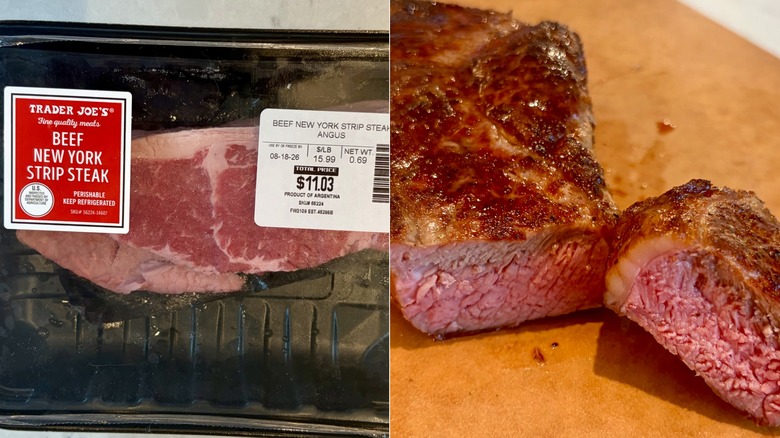
The first thing that differentiates the Trader Joe's New York Strip Steak from its other Argentinian peers is the presence of larger-than-life fat caps on both sides of the cut. Although this means that you will have less edible lean beef after the trimming and cooking processes, these caps lend plenty of juiciness to the steak. And, as the least expensive per-pound steak choice on this list, you can be a bit more comfortable sparing the extra loss. The rest of this steak is extremely lean, so make sure to leave some of the fat intact to soak in as it renders.
Although this is a thicker cut, and, as such, it is slightly tougher than others, its flavor leaves no room for criticism. It is deeply beefy and satisfying, developed a crispy crust in the pan without dying out, and did not have a trace of the pesky sinew found in the ribeye.
This strip steak, which is one of the more budget-friendly steak options available at Trader Joe's (and the one with what appeared to be the least amount of marbling out of all three Argentinian steaks I found), far exceeded my hopes. Between a blast of umami flavor and a luscious layer of mouth-melting fat, this Trader Joe's steak lives up to the quality expected from its country of origin.
Trader Joe's Beef Filet Mignon Steak
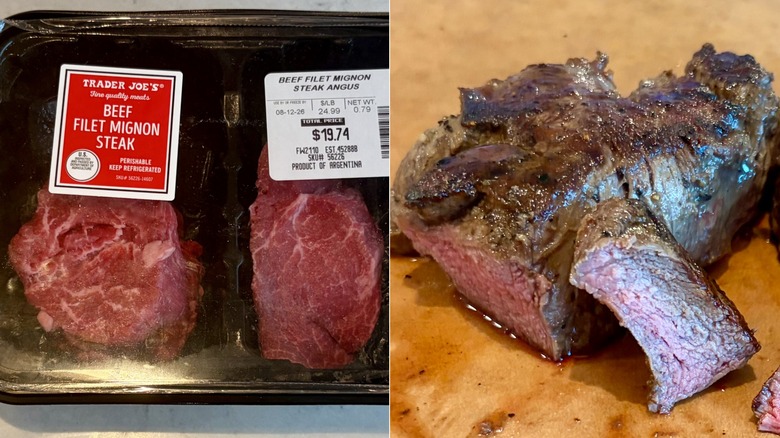
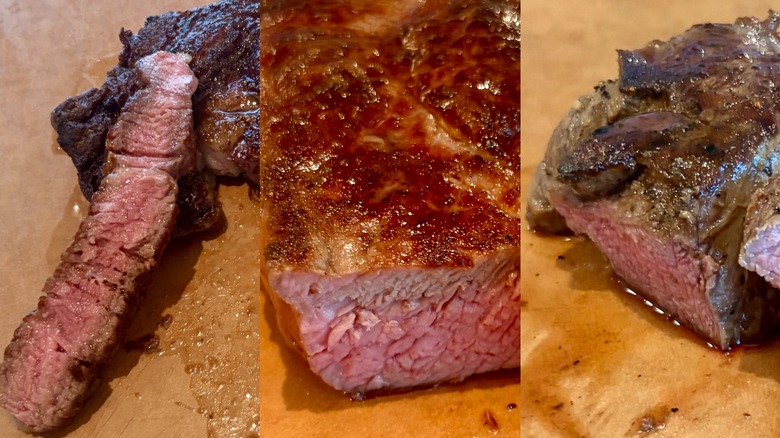
As the most expensive Argentinian steak I found at my local Trader Joe's, I knew that the Beef Filet Mignon Steak had plenty to prove. But rest assured — it delivered in every respect. In spite of the fact that I (regrettably) overcooked the steak and sliced it with an insufficiently sharp knife, it was by far the most tender and moist cut out of the three.
As soon as I put a knife through one of the filets, which came in a pack of two, it began releasing a mind-blowing quantity of fragrant juice, to the point where I wondered if I had undercooked the steak before I hit the disappointingly light pink center. I can only imagine just how juicy it would have been if I had successfully achieved a medium-rare.
This steak was slightly more mild in flavor than the New York Strip, but it boasted no shortage of savoriness. In spite of the overcooking, the filets also cut like butter, and they were just as tender when chewing. Unlike the other two steaks on this list, for which I repurposed the leftovers in sandwiches, tacos, and chili, there was no other option for the filet mignons than to eat them on the spot. When I think of the phenomenal flavor and mouthfeel that is characteristic of an Argentinian steak, these Trader Joe's steaks are the ones that best fit the bill.
Pricing and availability
Each of these steaks were purchased from the same Trader Joe's location in Washington, D.C., where the Beef Rib Eye Steak sold for $17.99 per pound, the Beef New York Strip Steak sold for $15.99 per pound, and the Beef Filet Mignon Steak sold for $24.99 per pound. The ribeye cooked and sampled for this review was $15.29 at 0.85 pounds; the New York strip was $11.03 at 0.69 pounds; and the twin filet mignons totaled $19.74 for 0.79 pounds.
Although all three of these steak products are listed for sale on the Trader Joe's online store catalogue, it's important to remember that pricing and availability of these specific cuts, as well as the country from which they are sourced, will vary based on store location, as well as on the weight of each steak. For more information on the availability and prices of Argentinian steaks at your local Trader Joe's, visit the grocery store's website. Online listings should also list per-pound pricing, which you can then use to estimate what you might spend on the steaks (ribeyes can average between 8 and 16 ounces, New York strips range from about 10 ounces to 18 ounces, and filet mignons each come in at around 8 ounces to 12 ounces).
The Trader Joe's Argentinian Beef Filet Mignon Steak is a cut above the rest
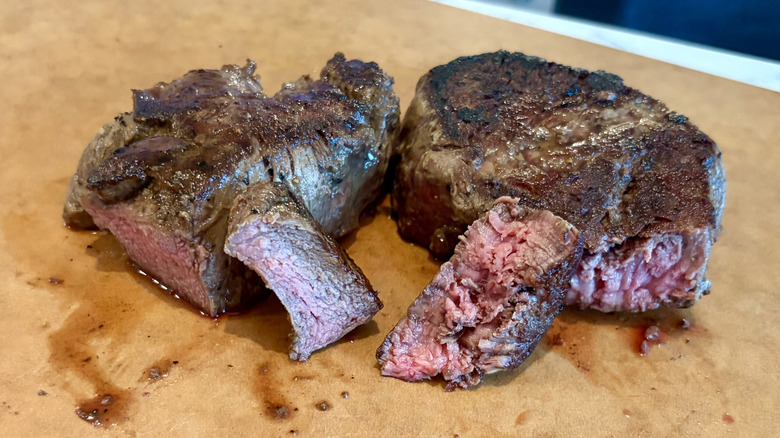
Perhaps you might have predicted this, but when it came to this selection of Trader Joe's Argentinian steaks, there was one clear winner: the Beef Filet Mignon. In spite of my relatively poor cooking and cutting jobs, it far surpassed the texture and flavor of the other two cuts on this list.
To the skeptics that think filet mignon is overrated or a waste of your money, I challenge you to stay loyal to your opinion after trying a bite of the Argentinian variety from Trader Joe's. Although it's on the more expensive side, it is still far cheaper than a restaurant steak dinner while still offering a restaurant-quality tasting experience.
Across the three Trader Joe's Argentinian steaks, quality was disparate, to say the least. While the filet mignon was nearly perfect, the ribeye was nearly inedible with its tough texture and alarming sulfurous flavor. Let this guide serve as a lesson to not simply purchase any Trader Joe's steak simply due to it country of origin — instead, be sure to prioritize fresh, high-quality cuts, whether or not they hail from the steak capital of the world.