

The Iconic Japanese Convenience Store Food Anthony Bourdain Once Called 'Pillows Of Love'
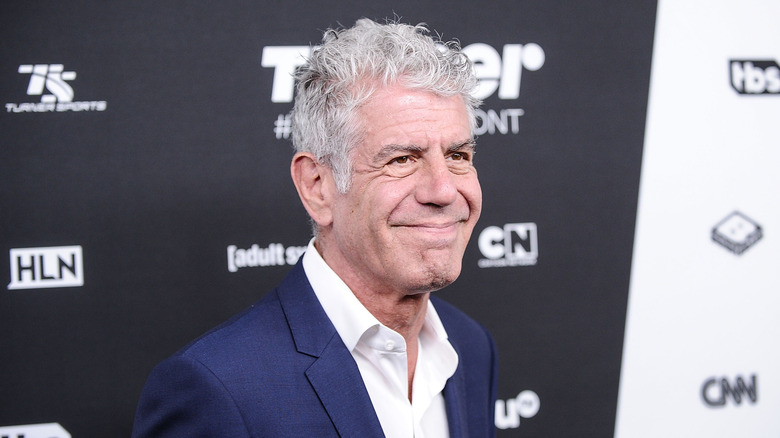
When you think of the type of food Anthony Bourdain loved, your mind probably doesn't go anywhere near "convenience store sandwich". But on his visits to Japan, Bourdain developed a love for one local specialty: Tamago sando, a Japanese egg salad sandwich sold in convenience stores (called konbini) in the country.
Bourdain particularly gravitated towards the chain Lawson (although the sandwich is also widely available in other major konbini chains like 7-Eleven and Family Mart). In a season six episode of his CNN series "Parts Unknown", he declared that Lawson has an "unholy grip" on him: The fact the sandwich comes from an enormous chain (contrary to Bourdain's more usual focus on local, hidden gems) seems to make it a guilty pleasure for him (a "shameful secret", in his words on the show). With their fluffy milk bread (crusts removed) and tangy egg salad, the cloud-like texture of the sandwiches made Bourdain describe them as "pillows of love".
That wasn't a one-off bit, either. A few years earlier on the show's second season, Bourdain also raved about Lawson during a visit to Tokyo, calling the sandwiches "unnaturally fluffy, insanely delicious, incongruously addictive", also tweeting a picture of the neatly-wrapped Lawson sandwich, sold at the time for just 240 yen (around $1.50). Bourdain frames the sandwich as a sort of marvel of food engineering: Its mass-produced nature definitely doesn't fit his standard vibe, but Bourdain does also appreciate cheap, accessible food, a description that definitely fits the tamago sando, at least in Japan.
What makes the tamago sando so special?
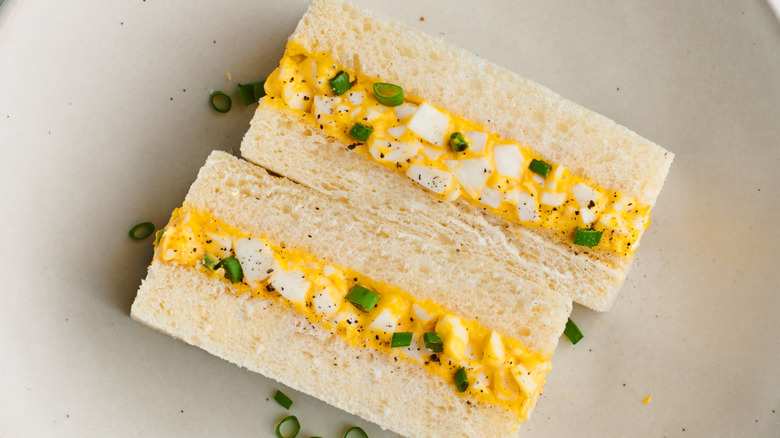
The tamago sando resembles American egg salad sandwiches, but it's the details that make the Japanese one special. It uses a sweeter milk bread called shokupan (crusts removed to make it as soft as possible). The eggs are hard-boiled and mashed, with extra yolk for flavor. The x-factor comes from the use of Japan's Kewpie mayo in the sandwich: A yolk-heavy mayo flavored with vinegar and MSG, it gives a unique umami tang.
The sandwich goes back to when Western-style bread and sandwiches were brought to Japan in the 1600s through Portuguese and Dutch traders. The egg salad version appeared around the 1800s or early 1900s (although Kewpie mayo came a few decades later), first in Japanese tea houses, before becoming a near-ubiquitous convenience store staple. It's not clear why Bourdain specifically loved the Lawson version, but reviews suggest it's well-balanced and with a distinct eggy flavor, compared to competitors' versions.
If you can get Kewpie mayo and a fluffy bread that's close to shokupan (try specialty Asian grocers or bakeries), it's possible to recreate tamago sandos for yourself. For the full convenience store experience, 7-Eleven started selling one in the United States in 2025. That said, you might need to book a flight to get the "real" one, as tasters noted that the American one keeps the crust, has less egg, and costs noticeably more (over $5) — but it gets the basics right.