

Forget Rods And Files: Sharpen Your Serrated Knife 10x Faster With This Basic Power Tool
The best way to sharpen most kitchen knives (not hone, which realigns the blade edge after sharpening) is by using a whetstone, but serrated blades — like bread knives and steak knives — are a different beast. Consisting of a series of scalloped, concave blades separated by pointed teeth, serrated knives can't be pushed across a stone, and using hand files and honing rods instead can take time and physical work. But if you have a Dremel or other rotary grinding tool, you may already have a much faster, accurate solution on hand: Attaching a conical or cylindrical diamond burr bit.
It may seem like it's not as big a deal for serrated blades to be sharp the way it is for, say, a chef's knife or paring knife. But when you're trying to slice — rather than tear through — crusty artisanal bread, a roast, or thick-skinned tomatoes, you'll quickly find out how much it matters. The beauty of using a Dremel with the right attachment is that the grinder's motor does the hard work for you, and the bit allows you to control the angle. Basically, you run the Dremel over each individual scallop blade at its existing angle for a second or two until it's sharp. Keep the tool on a low speed setting and use a light touch: the edge is thin, and too much heat can discolor the steel. Polish the burrs off the backside, and you're done.
In contrast, a tapered honing rod or ceramic rod does do this detailed work well and they fit different serration sizes, but they're slow. Electric knife sharpeners are fast, but they work by honing the smooth, non-serrated side. With this technique, you're essentially thinning the backside of the knife to make the blades seem sharper rather than sharpening the scalloped blades themselves.
Diamond bits on a Dremel allow for precision sharpening of serrated blades
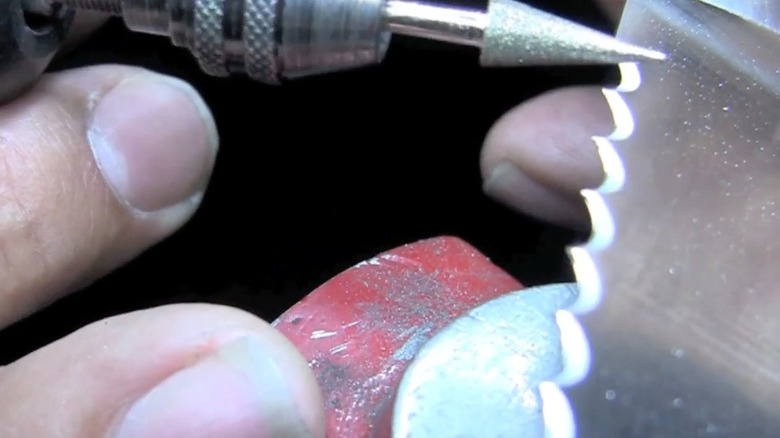
The beauty of using a handheld rotary grinder like a Dremel is the speed, particularly if you're sharpening a lot of knives at once. You don't need to clamp the blade down or fire up a belt sander, and one big advantage is that you're able to see the angle you're working at. Often with a ceramic rod, you're looking at the smooth face of the blade while you work "blind," making matching the angle a somewhat risky matter of experience. You may find that wearing a headband magnifier makes this detailed work easier to see. The tradeoff for that speed is that a rotary tool removes metal far faster than a rod, so a slip can nick a tooth or reshape a scallop. Go slowly, especially the first time.
Hold the knife on a flat, stable surface. Then run the tapered or cylindrical diamond bit smoothly in and out of each scallop. Depending on the size of your bit, you may also need to run it back and forth across the scallop. While it's easier to match the angle with a conical bit, they seem to be a bit harder to find. Either way, each knife will take under a minute. If it's been a while since the last sharpening, it may take a second or third pass to get a proper burr on the backside.
Once you're done, you should have a tiny burr or sliver of metal along the smooth backside of the knife. If you have a ceramic rod, you can run the backside lightly over the rod to push the burr up. Alternatively, you can use a bench grinder fitted with a bristle brush or cotton buffing wheel, or even the bristle brush attachment with your Dremel tool, though it may take a few passes depending on how powerful your motor is.