

The Unexpected Way Wendy's Sources Its Tomatoes
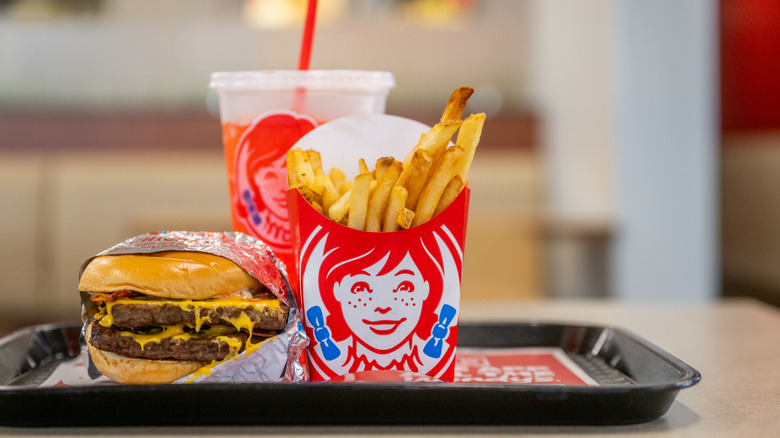
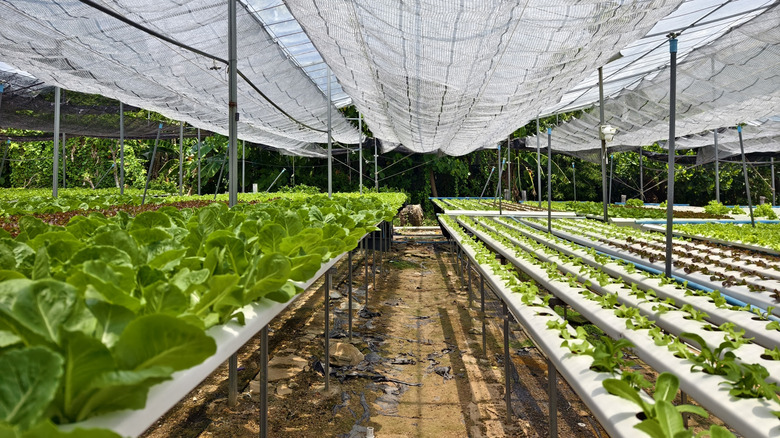
The future is hydroponic, or at least that's what Wendy's is betting on. That's right: the fast food mainstay, known for its baked potatoes and toppings-stacked burgers, has spent the past few years shifting its tomato sourcing to be entirely hydroponically grown. This comes as part of the chain's fresh produce initiative, which is aimed at increasing the sustainability and freshness of the veggie ingredients used in its U.S. and Canadian locations. For the uninitiated, hydroponic farming involves growing crops using a water, mineral, and nutrient blend in place of soil farming. This farming method requires much less land area, and it involves a more controlled growing environment.
Wendy's first announced its plans to shift its sourcing of tomatoes to hydroponic farming methods in 2018. As of 2019, the chain has completely switched to greenhouse, hydroponically farmed tomatoes for both U.S. and Canada locations. And in 2020, Wendy's began sourcing all lettuce supplied to Canadian locations from greenhouse farms. This lettuce is farmed without the use of pesticides. The hydroponic tomatoes do use pesticides, but only as a final recourse. Ladybugs, rather than chemicals, are the first line of defense at these facilities. These are big changes indeed, but what impact have they had on product quality and public perception? Well, those changes might not be so large-scale. We've done some digging into social media, and the responses are mixed, to say the least.
A mealy problem and a lukewarm response
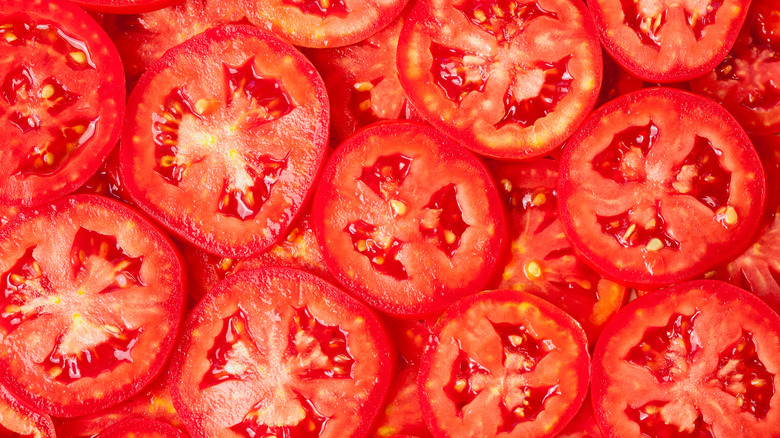
Though Wendy's tomato change-up was partly inspired by a push for sustainability, there were also other motives afoot, at least according to Liliana Esposito, a representative for Wendy's. In a 2018 statement made to The Wall Street Journal, Esposito noted that bad tomatoes were simply a fact of the restaurant business. According to her, "The biggest complaint you get about a tomato in any restaurant is that it's orange and translucent in the middle." This is because many tomatoes sourced by restaurants and other large-scale vendors tend to be plucked when green for easier transport (red, mature tomatoes are much more vulnerable to splits and bruising). Wendy's new greenhouse and hydroponic tomatoes are now vine-ripened, meaning they've fully matured before picking, thus, at least theoretically, resulting in a better taste.
But what do Wendy's diners have to say for the new, improved tomatoes? Well, not a lot, actually. The shift in tomato sourcing doesn't seem to have had all that big of an impact on customer opinion, at least not if you look online. On the r/Wendys subreddit, several users within the past few years have complained about tomato quality in particular. In a Reddit 2024 thread, one user even noted that "From Alaska to Texas there is ALWAYS something wrong with the tomatoes." Well, that's certainly not promising. Another Wendy's user posted an account of their Wendy's visit to TikTok, noting their grandma's habit of bringing her own tomatoes to use as toppings for the burger chain's sandwiches. Again, not exactly a promising response from customers.
Benefits beyond flavor
This is not to say that Wendy's switch to hydroponic tomatoes hasn't had any benefits. In fact, there is one benefit to this growing method that is particularly timely. The food-recall-palooza of 2026 has raised the hackles of many cautious diners. The ongoing cyclospora outbreak, for one, left many diners confused and in search of cyclospora-safe fast food options. Then there is the E. Coli outbreak in frozen blueberries and Salmonella contamination in eggs. These are just a few of the many food recalls that have dappled the grocery scene in 2026. The causes behind these recalls and outbreaks vary from case to case, of course. But it is worth considering how hydroponic crops might be shielded from some of these contaminations.
Hydroponic farming does away with one of the biggest vectors for contamination: soil. Contaminants such as cyclospora are found in soil or animal waste. Since hydroponic farms don't use soil and have facilities that often include regularly cleaned water supplies, they might be a better source if you're looking to avoid certain foodborne illnesses. However, hydroponic farming doesn't remove all risk. In fact, the specific levels of humidity needed for hydroponic farming can actually encourage the growth of some pathogens. So, yes, to a certain extent, Wendy's hydroponic produce might be less vulnerable to certain outbreaks of pathogens occurring at traditional farms. It is by no means free from all risk, but it does provide a more controllable growing environment that allows farmers to better prevent foodborne illness outbreaks. And pathogen-free food is always a plus.