

Where Do McDonald's Burger Buns Come From?
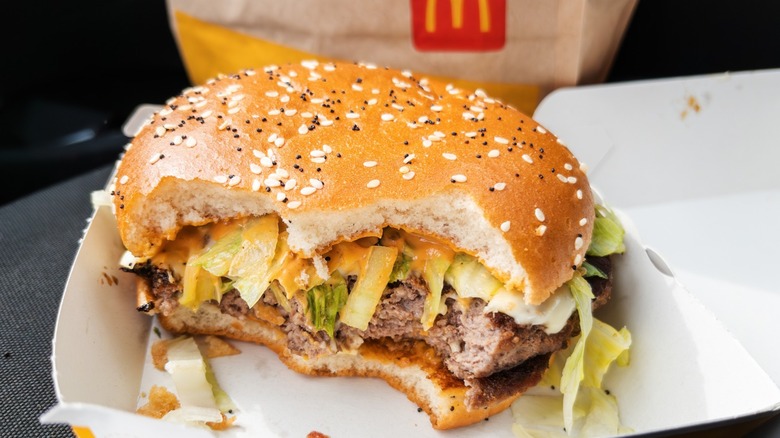
McDonald's is nothing if not a famously successful hamburger seller. The fast food king does not release official sales figures, but previous estimates peg it at nearly 6.5 million burgers a day or around 75 burgers a second. Obviously, a huge part of McDonald's' success is the speed and convenience with which those burgers are served — that efficiency is basically the core business model that Ray Kroc leaned on when expanding the burger restaurant into the franchise empire it is today — but the other part is that, well, the burgers just taste good. McDonald's uses USDA-inspected, 100% beef patties sourced from a couple of longtime external vendors, and if you're wondering about the buns themselves — they also come from a network of trusted suppliers.
Interestingly, for as popular as the fast food chain's burgers are, none of McDonald's bun suppliers are listed alongside its beef, chicken, and produce suppliers on its main website. Instead, it's on a subsite that the company details several U.S. bun suppliers: Aspire Bakeries in California, C.H. Guenther & Son in Texas, Klosterman Baking Company in the Midwest, and food-supplying giant Conagra Brands. Illinois-based Turano Baking Company is also listed as a product supplier, but it's unclear if this specifically includes buns. It's also unclear if this is the full list of McDonald's' hamburger bun suppliers or just a partial one. Either way, the company has made it clear that all of its suppliers must comply with its food quality and safety standards.
Buns don't go directly from the bakery to each restaurant
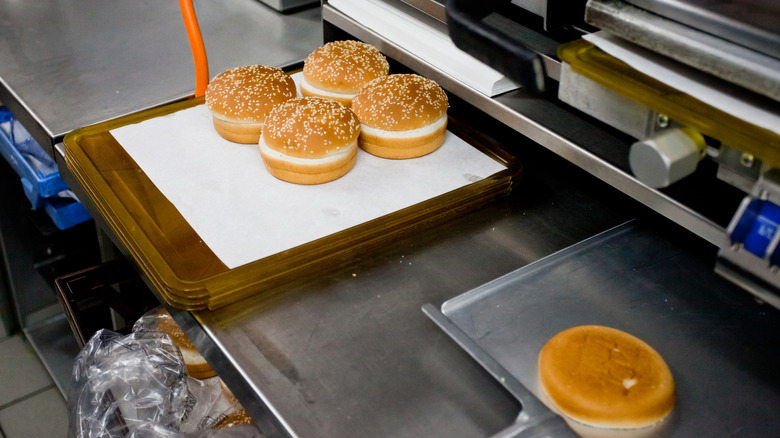
Despite having a network of bun suppliers around the country, none of it is likely to be shipped directly to the restaurants. For those familiar with typical major franchise setups, it probably comes as no surprise that, like McDonald's' other ingredients for its menu, the buns go through designated distribution centers first, where they're shipped to the locations that need them. But, for those worried about freshness, the company has stated multiple times that it uses temperature-controlled trucks to ensure food doesn't spoil before reaching its destination. It's unclear exactly what this means for bread products, but it's unlikely the buns are kept in sweltering temperatures during transit.
What is interesting, though, is that McDonald's doesn't fully own and operate its own distribution chain. Instead, it relies on partners from the North American Logistics Council (NALC), which includes members of various food supply and distribution businesses. Relying on outside partners is common practice for large businesses like Mickey D's, but, for comparison, the opposite is true for growing competitors like In-N-Out, which oversees its ingredient supply and distribution (burger buns included!) in-house. That could be why many customers see In-N-Out as more affordable and consistent than global franchises like McDonald's.
McDonald's has different bun suppliers for its locations all over the world
Some people who've tasted McDonald's items both in and outside of the United States have noted on social media that the U.S. versions just taste different, and not necessarily for the better. While there are many potential reasons for this — such as different food ingredient standards — a simple explanation, at least for the burgers, could be the likelihood that an entirely different network of bun suppliers is used abroad. In China, for example, Bimbo QSR, XH Supply Chain, Tyson Foods Inc., and Zidan serve McDonald's as major suppliers, while McDonald's locations in India teamed up with a food research lab to offer a multi-millet bun (made with several varieties of millet) meant to be a nutritious alternative to the chain's standard offering.
Not all of the suppliers are necessarily different, though. In 2023, C.H. Guenther opened a U.K. location solely to make McDonald's products, including a whopping 1.1 million burger buns a day to help meet local demand. That's a lot of bread!