

Never Use A Mashed Potato Recipe Again With These Ratios From Alton Brown

The mere idea of a mashed potato recipe can start to seem kind of silly when you consider the classic comfort side's most basic form. Sure, these spuds are great gussied up with things like increasingly rich, fatty forms of dairy, flavorful little extras like garlic, or even more transformative mashed potato enhancers like bacon. But, when you boil it down, all that great mashed potatoes really require is the spuds themselves, any complementary cooking liquid, and a couple of the seasonings that you probably already have in your pantry. So a ratio, rather than some unending quest to find the one true best mashed potato recipe, can actually be more helpful for your next batch. And the Food Network veteran, Alton Brown, has a terrific one to replicate.
Brown's mashed potatoes do follow the standard conventions — ingredient quantities, cooking times, and serving suggestions — but with the caveat that a basic ratio is better than a strict recipe. And the formula that follows might even be simpler to remember than the usual routine. Brown calls for a 2:1 ratio of russet to red potatoes by weight, and a quarter cup of dairy per pound of those. So, for example, that can amount to four russets and eight reds, totalling four pounds of potatoes, plus a cup of dairy. You can then add seasonings to taste and, as garlic maximalists everywhere will appreciate, as many alliums as you wish.
Recreating Alton Brown's mashed potato ratio at home
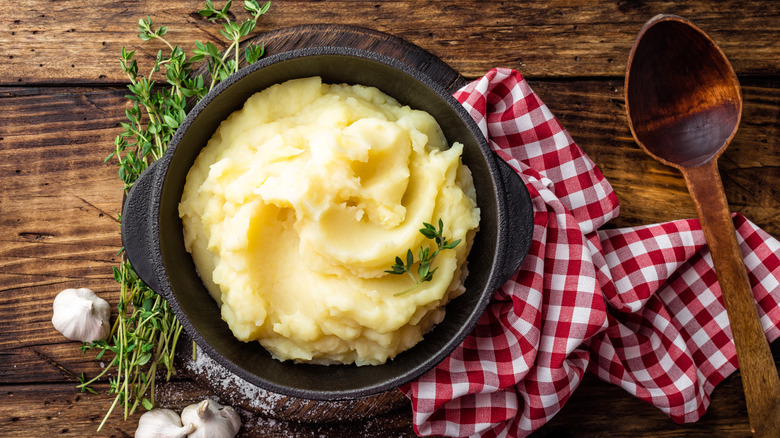
While the specificity of Alton Brown's reds and russets will help to put lingering recipe devotees at ease, you can also use the potato variety of your preference, provided it comports with your eventual liquid proportions. So if, say, you're using a pound of something like Yukon Golds alone instead (they are one of the best types of potatoes for mashed spuds, after all), you'll still eventually add that quarter cup of dairy according to his configuration. Brown's particular blend combines low fat buttermilk and heavy cream, but you can use just one or the other, or even half and half. That, plus little more than a few shakes of salt, have created many a satisfying heap of mashed potatoes, but there are still a couple things you want to keep in mind before you pile them on a plate.
Although their very name implies an opportunity to work out a little frustration in the kitchen, you never want to make the mistake of overmixing your mashed potatoes. You want them smooth and fluffy; two textures that will deflate into a stiff, gluey mess should you apply too much elbow grease. That's also why you should never use small appliances as a shortcut when making mashed potatoes. The power in your beater, blender, or food processor will whirl them way past their ideal doneness. A handheld device like a dedicated masher or even a big fork is as better a bet as Brown's mashed potato ratio for making a better dish.