

The Underrated Indian Spice To Add To Your Pantry For Big Flavor
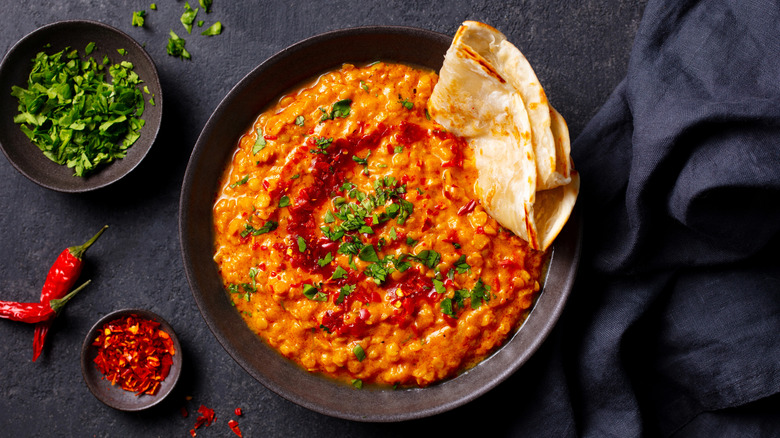
On the market for a new spice to add to your repertoire? Consider the curry leaf, which comes from a tree in the citrus family that's native to parts of India and Sri Lanka. Despite the name, it has no connection to curry powder — a spice blend derived from European colonialism that's heavy on pepper, turmeric, and cumin.
Curry leaf is a whole other flavor: It has a citrus taste that's sometimes described as sitting between lemon and orange, but with some herby notes (anise is one go-to comparison here) and a small hint of pepper when it's cooked. It's a little like a fragrant, citrus-tinged relative to bay leaf, although a closer match would probably be lemongrass or lemon balm (a leafy herb from the mint family) as it gives a bright, aromatic kick. When raw, the leaves can be rather intense and bitter, so it's usually recommended to cook them, which shifts them towards a mellower and more approachable citrus taste.
Curry leaves are most prominent in southern Indian food, where they feature in classic stewed lentil dish daal, tamarind and lentil curry sambar, and in coconut chutney. (Speaking of chutney, a good simple starter dish to try out curry leaf is karipatta chutney, which mixes it with tamarind, ginger, and jaggery, an unrefined cane sugar.) This isn't the only place you'll find curry leaves: They're also common in Sri Lankan cooking, and sometimes pops up in cuisines from Myanmar, Malaysia, Singapore, and Cambodia.
How to use curry leaves and where to get them
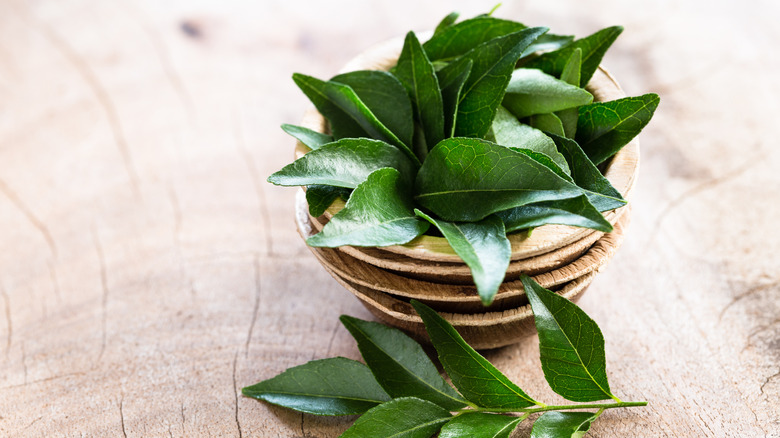
Since raw curry leaves can be intense, it's more common to cook them before eating or adding them to a recipe. One standard method is a technique called tadka. The leaves are dropped into hot oil or ghee (clarified butter) and fried for around a minute until they're fragrant and a little crisp. Spices like mustard seeds or cumin are among the typical additions. Then, that oil or ghee is used for building dishes like a daal or a curry. You can also use those fried leaves as a garnish or just put them in dishes for the flavors to absorb like bay leaves, but as long as the stem is removed, there's no need to remove them before you serve a dish.
If you want to play around with them, know that curry leaves pair well with mustard seeds, chiles, and asafoetida, a spice from the celery family known for its umami flavor and somewhat intense smell. This is a classic combination of ingredients in south Indian cooking, with all three often fried in oil, like mentioned above.
If you're looking for curry leaves in the United States, you may need to go beyond your typical supermarket. Although some Whole Foods locations reportedly sell them, a more reliable bet is probably an international or Indian grocery store, or looking on Amazon. Fresh curry leaves are considered optimal, but be warned that they only last a couple of weeks in the fridge. However, you can freeze them and throw them into recipes without thawing.