

What Happens To All Of The Unsold Food At Kroger?
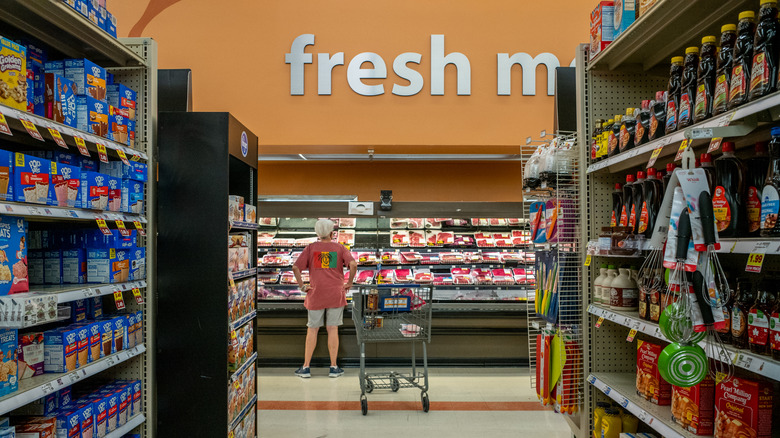
Supermarkets have to handle a lot of expired food they can't sell, from day-old bread to canned soup that's past its "best by" date but still totally safe to consume. America's oldest grocery store chain, Kroger, is no different: The chain acknowledges that around ⅓ of food produced in the United States goes to waste. And while the supermarket doesn't appear to publicly state how much of its own food goes unsold, it does seem to have a fairly robust program for ensuring that unsold food isn't thrown away.
That program is called Zero Hunger | Zero Waste, and Kroger launched it in 2017. It covers a fairly wide range of different types of food beyond just shelf-stable goods, including baked goods, meat, dairy, and produce. When products are first approaching their best-by date, they typically get discounted and put in markdown sections in Kroger stores. If they don't sell from there, the Zero Hunger | Zero Waste program dictates that they're sent to food banks and other hunger relief groups that will distribute them. This happens through a nonprofit foundation that Kroger created in 2018, the aptly titled Zero Hunger | Zero Waste Foundation. Kroger claims that it has given away nearly 4 billion meals and overall directed some $1.8 billion worth of food and funds toward hunger relief (per its 2025 Responsible Business Report). As a notable bonus, Kroger also has a program to recycle food scraps that can't be donated: The supermarket sends them to be composted or turned into animal feed, and claims that 97% of its stores participate in this program.
How does Kroger stack up against other supermarkets?
Kroger's food waste program started out with a so-so reception, partly for a lack of transparency: A 2018 report gave Kroger a C grade. That was below Walmart, which received the highest score (still only a B), while Albertsons and Ahold Delhaize (the parent company of Food Lion and Giant) were at the same C-grade level. Big names including Publix, Costco, and Trader Joe's were further down at D.
Yet the company improved over time: A 2021 report card by FoodPrint gave Kroger an "A" for its food waste practices, alongside Walmart and Ahold Delhaize. They all came well ahead of Costco, Publix, and Trader Joe's. These lower-graded companies don't seem to just throw things away: Costco's leftover produce policy aims to keep 80% of its food waste from landfills, while the other two have active food waste programs. However, they apparently don't publish enough verifiable data to earn a top grade.
Kroger's shortcomings appear to be about the rigor of its program. As of 2019, it had the program running in all of its 2,800 stores, but enforcement seems to vary from store to store. For example, in 2025, one store drew some media attention for a Reddit post showing boxes of donuts that were apparently going to be thrown away; another story claimed to show similar issues with the deli section of a particular Kroger store. However, there don't seem to be large numbers of such stories, suggesting that they may just be isolated failures in an overall solid food waste program.