

What Happens To All Of Costco's Leftover Unsold Produce?
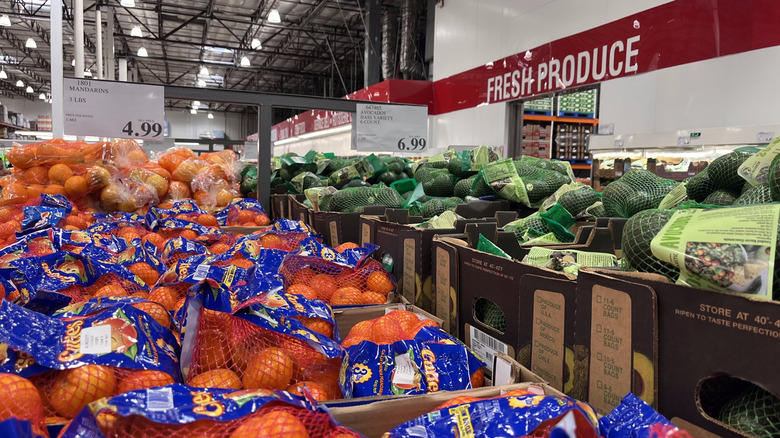
According to ReFed, a nonprofit working to reduce food waste, the United States produced 70 million tons of surplus food in 2024 — that's 29% of total food production. Many people may wonder what grocery stores really do with expired food. For produce that doesn't sell at Costco, the retailer has a few useful things it does with the leftovers.
Costco has a waste reduction program guided by its Sustainability Commitment, includes a 2019 goal to divert 80% of its food waste from landfills. Similarly to restaurant chains that donate leftover food, Costco finds ways to share its unsold produce with those who need it. What doesn't sell is used in four main program categories: donations, new products, animal feed, and recycling. Costco donates unsold food in partnership with Feeding America, The Global FoodBanking Network, and local food banks. In Costco's 2025 Global Waste Report, the company noted that it had donated about 76,000 tons of food to U.S. food programs alone. A Redditor in an r/Costco thread backed this up: "I volunteer several days a week at a food pantry. Costco delivers to us twice a week. They're incredible!"
While Costco doesn't always offer breakdowns of what it does with its produce in particular versus other types of food, the brand's 2025 Annual Sustainability Report noted that about 74% of the food it donated in the United States was composed of the following nutrient-rich categories: produce, grains and bread, and dairy and protein. Within that breakdown, 46.9% of the donations were produce. The report also noted that the brand successfully kept 82.8% of its food waste from landfills that year, exceeding the goal it set in 2019.
How Costco and the U.S. combat food waste
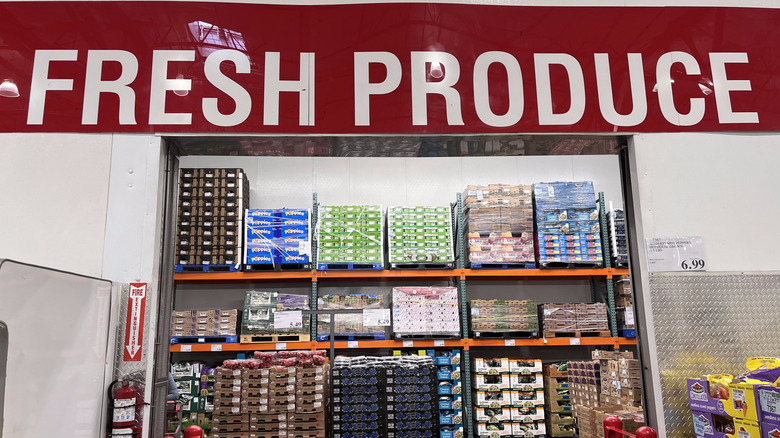
Reducing food waste is built into the way Costco operates. Costco uses the EPA Wasted Food Scale, a hierarchy of steps for handling food waste, to guide its decisions in diverting leftovers from the landfill.
Aside from donations to food banks, food that can still be used in-store can become new products, such as chicken salad made from day-old rotisserie. The 2025 global waste report noted that over 12,000 tons of animal feed were donated to animal rescue programs, zoos, and farms. Other food waste is recycled to be used as fertilizer, turned into biofuels, converted to electricity, or composted. In 2025, about 12,000 tons of leftovers became compost and 16,000 tons were converted to useful products by anaerobic digestion.
While there are certainly tips for individuals to reduce food waste, people who want to donate perishable items like produce will be doing so under different rules than grocery stores and large companies. In one Reddit thread about donating fresh produce, one person shared, "I looked up 5 different food banks near me and they all forbid dropping off perishable items. Sigh." Some food banks don't have proper refrigeration to accept produce and other perishables from individuals. However, operations like Feeding America work with retailers and farmers to accept donations of produce and supply it to their clients. As Costco partners with Feeding America, among other food banks, it is able to donate fruits and veggies to the people these organizations serve.