

The Hands-Down Best Time To Plant Onions In Your Garden
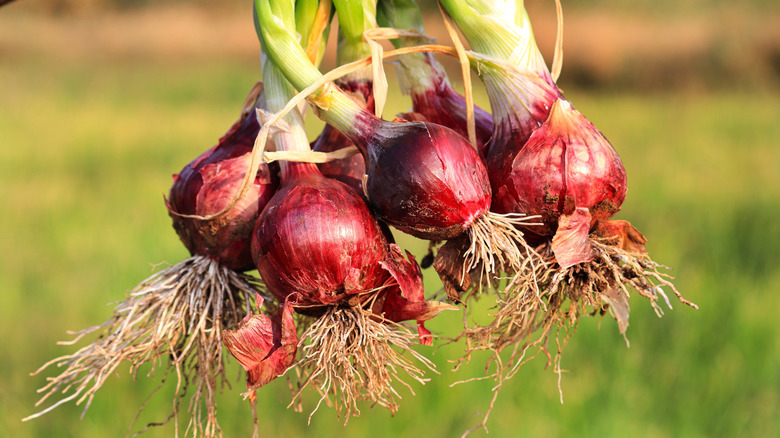
Onions are great vegetables to grow, even for beginners, and for much of the United States, the best time to plant most types of onions is in early spring when the ground has thawed. More specifically, it's in the cooler months such as March or April that many crops grown for their roots — such as onions — tend to thrive. But it helps to understand this a bit more intuitively, rather than circling a particular date on the calendar. The idea is that the ground should be workable rather than frozen. Onion seed germination becomes more reliable once soil temperatures rise above 40 degrees Fahrenheit. (Onions can germinate in colder conditions than this, but the process may be a little slower or stunted.)
If you're reading this at a time when spring is already a distant memory, there is still good news — some varieties of onions are specifically grown as overwintering onions. What that means is that they're planted late in the season so that they survive the winter, and resume growing the following spring. In some parts of the country, such as in Utah, these can be seeded around mid-to-late August for a harvest in June or July the following year.
Where you live changes the onion-planting calendar
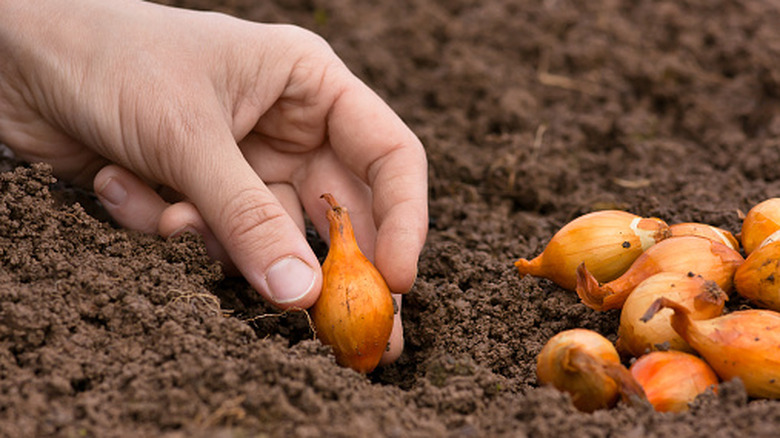
The reason we can't definitively give one perfect onion-planting date is because onions actually respond to day length. Onion varieties are split into short-day, intermediate-day, and long-day onions according to how many hours of daylight trigger them to start forming bulbs. Short-day onions begin bulbing with around ten hours of daylight, intermediate varieties at around 13 hours, and long-day varieties will bulb when they get more than 14 hours of sunlight of every day. With that in mind, a gardener in the south will have a very different onion schedule than a gardener up north.
This is why short-day onions are generally grown in southern parts of the United States, while long-day varieties are better suited to northern states. And then, rather conveniently, the intermediate-day onions sit somewhere in the middle. So before you start planting onions yourself, you need to check both the onion variety you're working with, and that variety's respective recommendations for your particular region. Once you've figured that out and your onions are safely in the ground, don't expect an enormous bulb to appear overnight — onions can take roughly three to four months to reach maturity, depending on the variety.
Once you have them, however, that's when the fun really starts. Pickle red onions to elevate a salad or caramelize yellow onions until they melt in your mouth. After spending months in the dirt, they deserve it.