

The Potato Didn't Come From Ireland — Its Origins Are Far More Unexpected
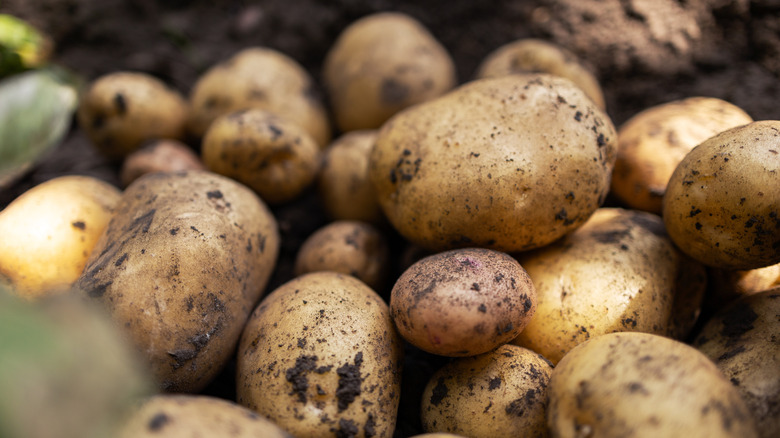
Misty cliffsides, a small gathering of sheep dappling the green, thick wool sweaters braided into patterns that armor against the chill, and a hearty plate of royal corned beef with potatoes (perhaps some lovely colcannon) served up at the local pub alongside a pour of thick, black Guinness. What country are we talking about? It could be no other than Ireland. Of course, the picture just painted is an idealized, if not slightly fantastical portrait. And yet, it registers. But let's zoom in on one aspect: potatoes. That simple, tuberous vegetable, so hearty, comforting, and quintessentially Irish — or is it? What if I told you potatoes weren't Irish at all? Well, they aren't, not in the least. Okay — that's not entirely true. Potatoes have been cultivated in Ireland for hundreds of years, and that cultivation has had a massive impact on both Ireland and its diasporas.
However, the potato as a vegetable is not Irish in origin. As with so many other foods, such as tomatoes and corn, potatoes actually come from the Americas. Potatoes were first cultivated around Lake Titicaca, which straddles Bolivia and Peru. These tubers, which are members of the nightshade family, were initially grown by Incan communities around the Andes mountains, and they particularly thrived thanks to the area's altitudes and many microclimates. The Spanish conquistadors brought potatoes from South America to Europe in the 1500s, during which period they were considered a bit of a novelty. Ireland was one of the most enthusiastic adopters of the root veggie, which is one of the reasons it's so associated with the nation today.
The importance of potatoes in the Andes
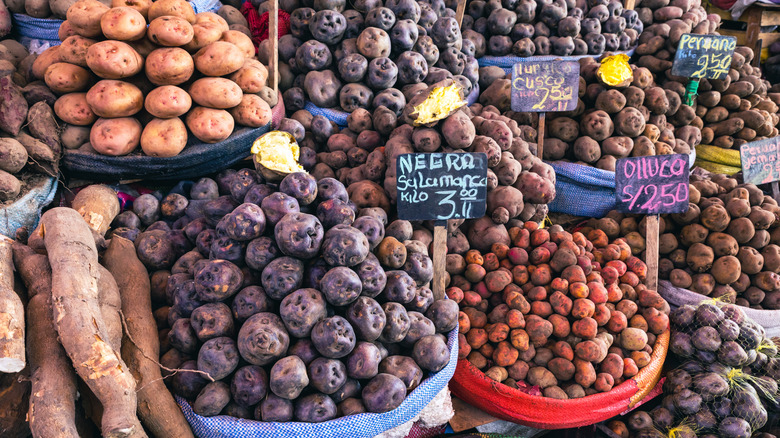
Long before potatoes became an Irish go-to, they were a significant part of Andean identity in pre-colonial South America. After all, it was the Andean people who domesticated the potato in the first place, and they still grow many different varieties of tubers. Potatoes from the Andean region of South America help to sustain many populations in a climate that is notoriously unsteady. For thousands of years, people within the region have cultivated the potato, and it has made an imprint — not just in a culinary context, but on the DNA of those in the area. Recent research has found that many people in the region have DNA markers linked to better starch digestion. Potatoes and potato cultivation have literally made a biological impact on the region.
The potato, in its many colorful forms, is not just a dietary but a cultural staple to many in the region. Both during the Incan empire and up until today, Quechua-speaking communities in the Andes have continuously cultivated many varieties of potatoes grown not just for eating, but for medicinal and cultural purposes. The key to this sustained, enduring prevalence of potatoes in this region, which spans over 8,000 years, is part a commitment towards genetic diversity in the types of potatoes grown by these communities. Thousands of varieties of potatoes are grown in the Andes, and this has helped protect the area from certain types of agricultural disasters experienced by potato farmers in other parts of the world, such as Ireland in the 1800s.
Ireland's relationship with potatoes

Ironically, Ireland's association with the humble potato is directly opposed to the crop's ties to sustaining life the Andes region of South America. Ireland became known for potatoes through a blight that spelled out disaster for millions of people who relied upon the tuber for food and commerce. It's the Irish potato famine that wed the vegetable, perhaps forever, to the nation. The irony is that potatoes were, for a time, a great boost to the health and livelihoods of so many Irish people. The crop's hearty nature and ability to grow in otherwise inhospitable environments made it a common choice in the country, and it helped to offset disease, famine, and economic hardship.
This all changed, of course, with the famine. Right before it hit, in the mid-1800s, Ireland's population hit 8 million strong. Then, in 1845, a mold known as Phytophthora infestans began to overtake the island's potato crop, causing mass starvation and economic collapse. The famine resulted in over a million deaths, many of which were caused by starvation. Additionally, over a million Irish citizens left the country in search for a better life. Still, even nearly two centuries on from the famine, it remains a defining moment for the nation, and all of its diaspora.