

In 2026, American Blended Whiskey Is Finally Getting The Attention It Deserves
For years, American blended whiskey has been considered an inferior product to other categories, like bourbon, and not without reason. Historically, it was made using various adulterants. Even today, U.S. federal law allows blended whiskeys to incorporate up to 80% neutral grain spirits along with additives like flavoring agents. But there's a growing group of innovators who over the past few years have been transforming the category, and 2026 seems to be shaping up to be a breakout year for blended whiskey.
"After Prohibition, 'blended' became a dirty word in America. We never accepted that premise," Ari Sussman, the whiskey maker for Whiskey JYPSI, told Chowhound. Whiskey JYPSI, along with brands like Proof and Wood, Traveller Whiskey, and Barrell Craft Spirits, among others, have been creating award-winning blends that take the best straight whiskeys from various distilleries to craft spirits that are greater than the sum of their parts. And consumers are catching on.
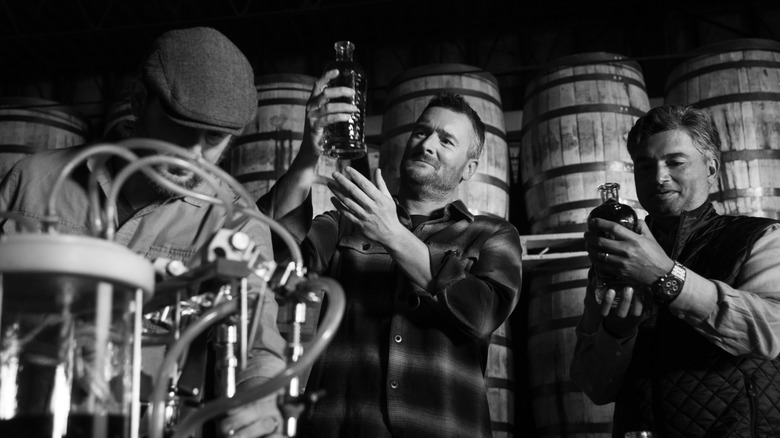
"2026 is looking to be a major year for growth in the American blended whiskey category because whiskey drinkers are more adventurous than ever," Harlen Wheatley, the master distiller for Buffalo Trace Distillery, said. While Buffalo Trace is famous for its award-winning bourbons, Wheatley, who has been the master distiller there for more than 20 years, worked with Grammy Award-winning musician Chris Stapleton to produce the blended Traveller Whiskey.
How blenders work their magic
While blended whiskey, at its best, is by nature a blend of various whiskeys, as Harlen Wheatley points out, nearly all whiskey expressions, barring single-barrel or single-cask releases, are blended. "Blending is an art form that is critical to making great whiskey, but is perhaps underappreciated... even straight bourbon is blended to achieve a desired taste profile," he said. Unlike Buffalo Trace, many producers of American blended whiskey aren't distillers, but rather blenders and finishers, sometimes called non-distilling producers, or NDPs.
One of these is Proof and Wood, which Dave Schmier founded in 2015 after selling the brand Redemption Rye that he'd cofounded. The company sources whiskey from more than 20 American distillers and various Canadian distillers that are then blended and finished to produce unique bottlings. "Blending gives us an enormous palette of flavors to choose from, we can choose whiskey from many American distillers, as well as some international whiskey," he said.
For Ari Sussman, crafting a better whiskey is the goal, whether that means contracting a distillery to produce a spirit using heirloom grains or hunting down a whiskey that gives the mash bill an unexpected element. "The advantage is a far bigger palette — different grains, ages, distillation styles, warehouses, barrels, maturation histories," he said. "It's like cooking — being a great chef isn't necessarily about growing the tomatoes, it's knowing what belongs together and why."
American blended whiskey in 2026
As proof of the caliber of blended whiskeys these and other brands are producing, just look to recent spirits competitions and reviews. Proof and Wood took home the title of Best American Blended Whiskey at the World Whiskey Awards America 2026 for its limited-release Curated Seasons 2024 Extraordinary Blended Whiskey, made with aged Canadian whiskey and American corn, light, and rye whiskeys. The newest release from Whiskey JYPSI, which garnered major awards for its previous expressions, is the Legacy Batch 3: The Declaration, which contains Indiana rye aged 8 and 12 years finished in apple brandy barrels from the distillery at George Washington's Mount Vernon, and Canadian corn whiskey aged for as much as 25 years.
This year, Traveller Whiskey's multi-award-winning Blend No. 40 was joined by its Full Proof expression, bottled at 121 proof. "We're so proud to be part of the ongoing conversation around American blended whiskey and to help showcase the artistry of blending to a broader audience," Harlen Wheatley said.
Whether 2026 turns out to be the year that American blended whiskey gets its due remains to be seen. Dave Schmier said that it's impossible to predict the category's future, but he has seen some interesting releases this year. While blended whiskey is often associated with some of the worst whiskies on the shelf, he believes today's producers are proving the category can also produce some of the finest. Likewise, Ari Sussman believes there are signs of a shift in the market. "Whether 2026 is the year, I couldn't tell you. But blending is being recognized as a craft in its own right in a way that it previously had not," he said.