

What Does An A5 Beef Grading Mean For Wagyu And Kobe Cuts?
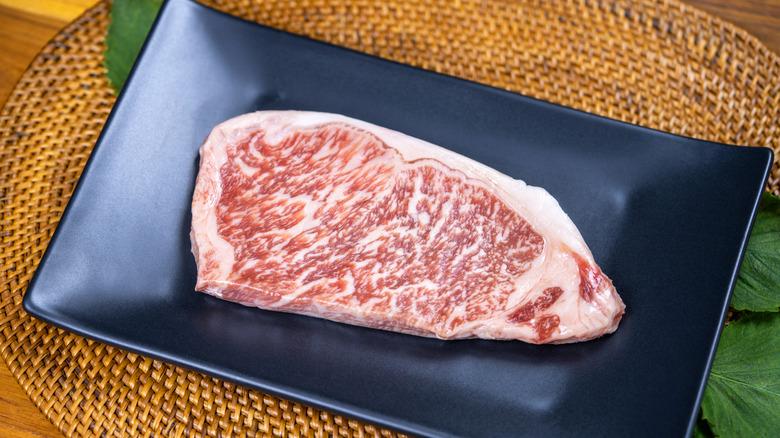
Steak shouldn't be confusing. But if you've ever come across wagyu, known as Kobe beef when it's from the right part of Japan, you might have noticed the wagyu grading system and been understandably confused about what A5 means and whether its superiority is all just a marketing ploy — but it's (mostly) not.
The grading system was designed by the Japanese Meat Grading Association to describe the yield and quality of the meat. The letter grade uses letters A, B, or C to refer to the yield, or amount of usable meat on the cow, with A being the most usable meat. The number, which can range from 1 to 5 (5 being the best), is determined by things like fat marbling, fat standard, color, firmness, and texture. Combined, they determine the overall grade of the beef, with A5 being the absolute highest quality of an already high-quality meat. It's the crème de la crème of the steak world, which is why you want to cook wagyu carefully to avoid ruining it, especially given the hefty price tag.
The grade is a signal that it has a high concentration of intramuscular fat (marbling). In wagyu, that fat is high in monounsaturated fatty acids, which have a lower melting point, making the meat buttery and decadent. A5 wagyu is the pricey steak you find at a high-end steakhouse. It's even more expensive if it's real Kobe from Japan's Hyogo prefecture. Lower-graded wagyu may not deliver the same richness and flavor you'd get from A5, but if you manage to find it, it also probably won't have the same price tag.
What to know about wagyu vs. Kobe vs. regular steak
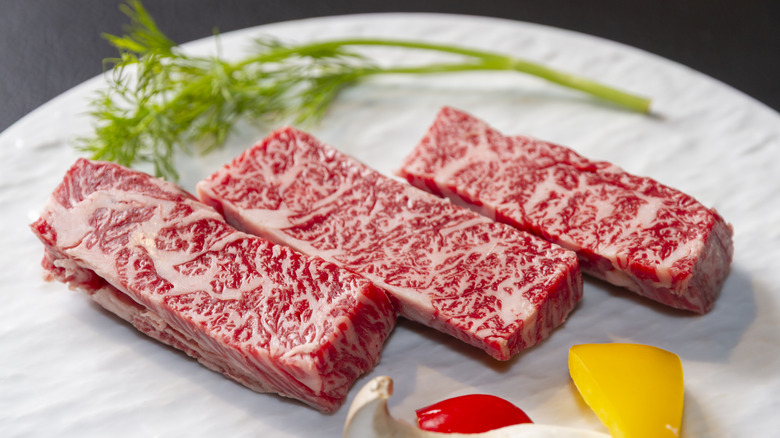
When you compare a regular ribeye to an A5 wagyu steak, they barely look like they're from the same food group. Wagyu looks more like a cut of fat marbled with meat rather than a cut of meat marbled with fat, which is what you're getting with a regular ribeye. When that wagyu is Kobe, you're getting a whole new level of decadence, with generations of breeding behind the quality of the meat.
That's because Kobe beef is a specific type of wagyu beef from prized cows (so all Kobe is wagyu, but not all wagyu is Kobe). Wagyu is simply a term for a specific group of Japanese cattle with a genetic tendency to grow fat in the muscle tissue. They can be Japanese Black, Brown, Polled, and Shorthorn genotypes. Kobe specifically refers to the Japanese Black cows from Tajima in Japan's Hyogo prefecture that have descended from a specific line of cattle.
True Kobe beef can only come from Japan due to its lineage requirements, but America produces Kobe-style beef, aka American wagyu, from the same Japanese wagyu cows crossbred with American cows, though they may sometimes be crossbred with American Angus. But even purebred American wagyu differs from Japanese in some ways. For example, American beef isn't graded the same as Japanese beef. In the U.S., wagyu is graded like all other beef, using the USDA grading system, which doesn't go into nearly as much detail as the Japanese Meat Grading Association. However, the U.S. Department of Agriculture's Agricultural Marketing Service may provide certification that beef has the proper lineage and quality to be called Kobe-style in the U.S.