

What's The Average Lifespan Of A Propane Tank For The Grill?
We may receive a commission on purchases made from links.
Most of us who grill regularly have run into an unfortunate problem from time to time: an unexpectedly empty propane tank. While most grills have an indicator that shows you how much propane is left in the tank, knowing the average lifespan of a tank can help you know when you'll need to pick up a new one, even if you forget to check how much propane you have left.
A 20-pound tank , which holds 5 gallon of propane, can provide 18 to 20 hours of cooking time. If you grill once per week, you can expect your propane tank to last you about four months, if not more. If you're firing it up more frequently (or you're cooking items like ribs that require more than an hour on the grill), you'll need to adjust your expectations for tank longevity accordingly. If your indicator shows the percentage of propane left in the tank, you can multiply it by 20 to get an idea of roughly how much cooking time you have left (for example, if your tank is 50% full, you have about 10 hours to go).
If you have a gauge that shows a red, yellow, or green indicator, you'll want to pay attention when it turns yellow, as that means you're nearly out of fuel. If you'd like a more exact idea of how much propane you have left in your tank, you might want to consider purchasing a sensor that connects to your phone, like the SENSO4S Wireless Propane Tank Gauge Sensor on Amazon, so you can see precisely how much fuel is in your tank.
How to make the propane tank for your gas grill last as long as possible
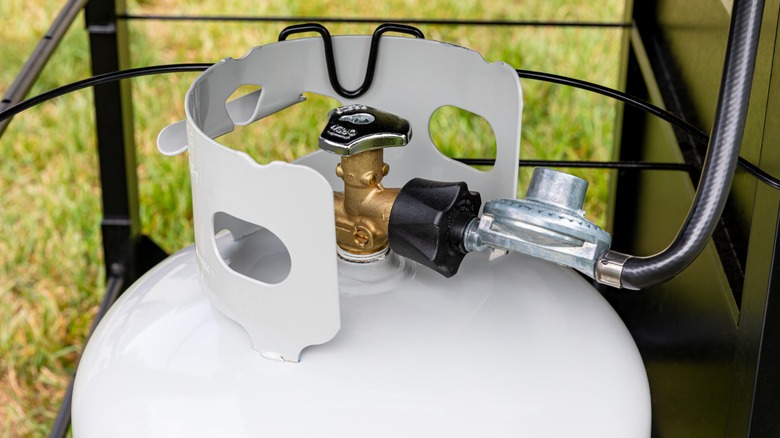
Of course, there are a few things you'll need to consider when figuring out how long your tank will last. If your cooking sessions are über-long (for example, you're keeping the grill on all day as you're refilling a buffet table at a summer party), you'll burn through fuel faster. The amount of propane you use while you're cooking also matters. When you crank up the flame on your gas grill, you're going to use more fuel than if you were cooking at a lower temperature. Grill size plays a role, too — if you have a smaller grill model for tight spaces, you'll use less propane than you would with a larger grill.
Thankfully, there are a few things you can do to help extend the life of your propane tank. First, inspect your grill. An older grill may have degraded parts, causing you to use up more propane, and if that's the case, either replace them or find out which grill type is best for you and buy a new one. You'll also want to make sure that you tightly turn off the propane valve each time you finish using your grill. This doesn't just stop propane from going to waste — it's also important for safety, as leaving the tank's valve in the open position creates a serious fire hazard.