

How Much A Lobster Dinner Cost In The '60s
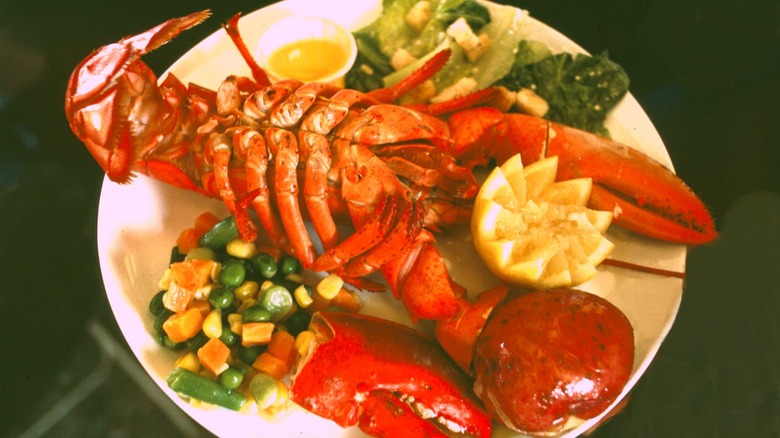
If you've been out for a lobster dinner lately, you know it can be pretty pricey. Even in Maine, where more than 80% of these tasty crustaceans are harvested, you can pay between $23 and $35, depending on factors like the season and the type of restaurant. You'll pay even more if you live further away, over $45 per pound at some upscale restaurants. Perhaps you're longing for a time when lobsters were a little cheaper — say, in the 1960s. In that decade, depending on where you lived and the particular year, you could gorge on a lobster dinner for as little as $2.50. If you were farther away, say, in Minnesota, you'd pay something closer to $4.50.
Before you get up in arms about how great things were back in the day, we have to adjust this price for inflation. When we do, the price differences aren't that stark, but it was still cheaper 60 years ago. That $2.50 lobster dinner from Mike's Ship-A-Hoy in Long Beach, New York, from 1960 (per a Facebook posting of the original menu) is equivalent to $28.22 today. And that $4.50 lobster from the Lobster House in Spring Valley, Minnesota, based on the original menu, would cost the equivalent of $50.80, which is still cheaper than $45 a pound. There are several reasons lobster is one of those foods that were once seen as cheap but now cost a fortune.
Why lobsters are more expensive today
Lobster was once so cheap and plentiful, it was considered food only fit for people experiencing poverty. In the 17th century in the colonies, lobster was served to prisoners who quickly tired of it. By the Gilded Age, in the late 19th century, lobster had become a delicacy and prices slowly began to rise. While there have been some fluctuations, the price has mostly continued to go up. The reasons for this revolve around several factors.
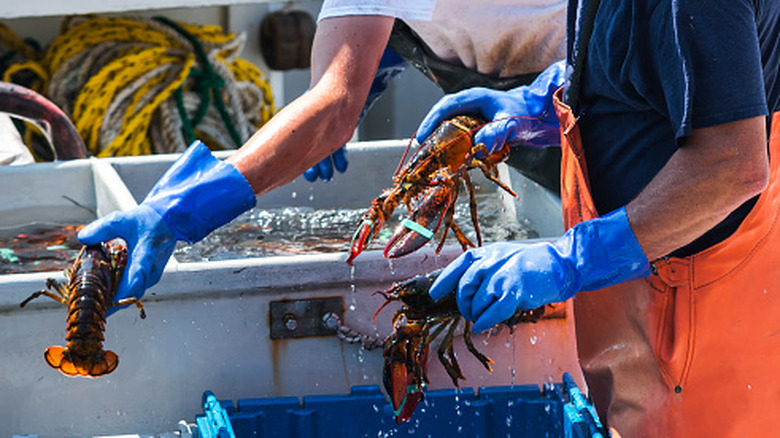
All lobsters are wild-caught because they can't be farmed, like salmon or shrimp, for instance. That means someone has to go out and catch them, which is a hard job. Then, there's the problem with the population of lobsters that are available to catch. For the last four years, Maine lobster fishermen have hauled in fewer lobsters than in the past, partially due to overfishing. Relatedly, in order to preserve the lobster fishery, there are strict rules in place around which lobsters can be caught and sold, including size limits as well as protections around egg-bearing female lobsters. Finally, there's the problem of transportation. Lobsters must be shipped live because their meat is highly perishable.
That's why your lobster dinner is so expensive today. And if you're looking for a lobster roll, you're in for an even greater shock with prices even hitting $50 across New England. So go ahead and get up in arms over how prices have gotten out of hand, while (hopefully) tucking into a lobster dinner or lobster roll at a reasonably priced restaurant.