

Pinot Noir Vs Merlot: What's The Actual Difference?
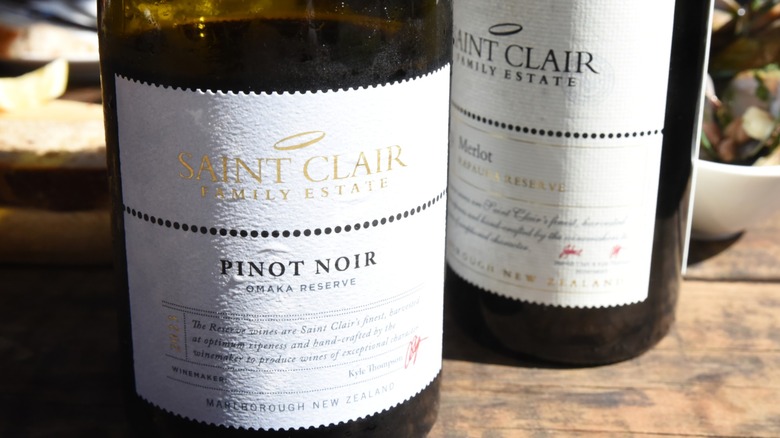
Perusing the wine list at a restaurant can become overwhelming pretty fast. Sure, you probably know your colors, and that red wine and beef are a (scientifically) perfect pairing. You may even know that pinot noir is excellent when paired with rich poultries like duck. But choosing between seemingly similar selections like pinot noir and merlot is trickier. For all of their shared ubiquity, merlots and pinot noirs tend to be quite different once uncorked. So it can help to remember that a pinot noir is typically a little lighter than a merlot in a few different ways.
In general, a pinot noir has a lighter rouge hue than a merlot, with a lighter body to match. Body is the weight the liquid has in your mouth, though you should be able to see those differences in the glass before tasting. That's because lighter-bodied wines like pinot noir leave less of a trace compared to fuller-bodied wines like merlot, which tend to cling to the glass a bit more after you've swirled or taken a sip and are typically a darker ruby-like red. While they're both fruit-forward, just what flavors you identify in a pinot noir versus a merlot will likely further diverge.
Pinot noir and merlot are both fruit-forward, dry wines in different ways
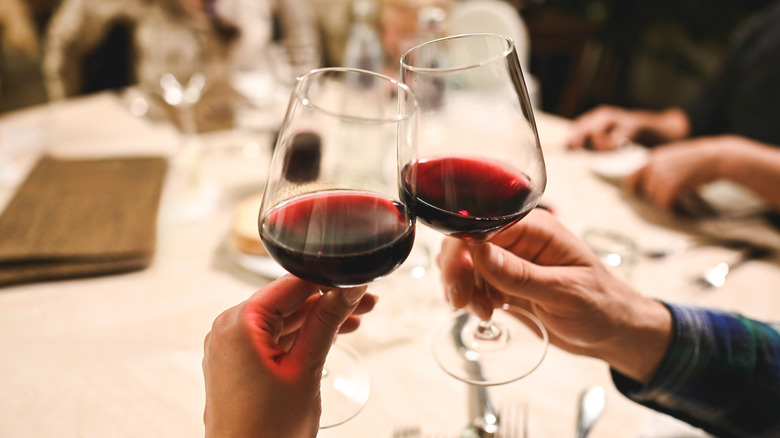
Pinot noir and merlot are both classified as dry wines, which in the wine world means they're not sweet. That seems a little confusing since we tend to associate a lot of fruit flavors with sweetness. But both the pinot noir's and the merlot's fruitiness are subtle. They're also somewhat different. You'll probably pick up notes of cherry and raspberry in a pinot noir. In fairness, a merlot might have some of those same notes, but it also has some unique darker elements, like plum, black cherry, blackberry, and even fruitcake. This can, admittedly, sound a bit precious in pixels, but these subtle nuances are part of what makes a wine-tasting so much fun. It's like a flavor hide-and-seek with alcohol.
Were you at a proper wine tasting, a restaurant with a particularly studied beverage program, or even your oenophile friend's place, a pinot noir and a merlot would even be served at different temperatures to perform to their full potential. Pinot noir is at its best when served at a lower temperature than the comparatively toasty room temperature most folks assume all red wines desire. If you have a wine refrigerator, set it to somewhere between 55 and 60 degrees Fahrenheit for optimal results. Merlot performs best just a bit closer to typical room temperature, ideally at between 60 and 68 degrees Fahrenheit.
At the end of the day, both are great with a steak. But this is also as good a time as any to remind you that you don't always need to focus your wine pairings on traditional protein guidelines, whether you're sipping a pinot noir, a merlot, or almost any other vino variety.