

Why Your BBQ Brisket Falls Apart When You Slice It And How To Stop It For Good
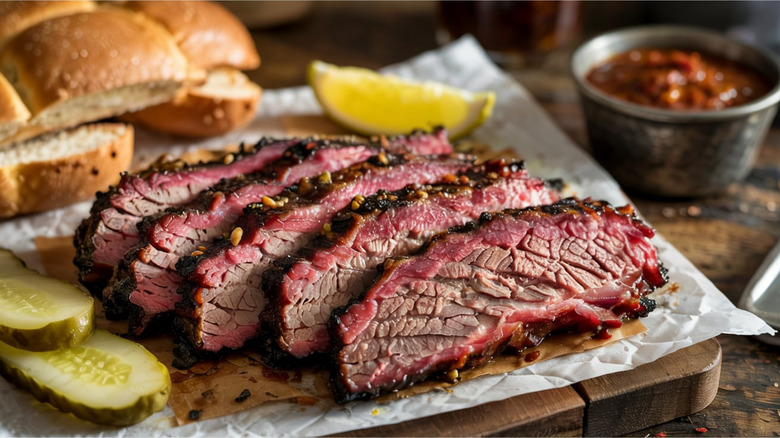
The work does not end once you've expertly trimmed your brisket, cloaked it in a dry rub, and ultimately barbecued it low and slow for several fragrant hours. The final step, once you give the beef a rest, is carving what should be a beautifully tender hunk of meat. But there's still no guarantee that you'll be able to cut cleanly through. If your brisket has been falling apart when you slice it, you're probably using the wrong knife, and compensating for dullness with too much pressure, which will cause the meat to fall apart as you try to slice it. A sharp, serrated knife, instead, is the closest thing to carving insurance that you're going to come by for slices that stay together all the way to the plate. How you use the utensil will also have an impact.
With any luck, your brisket will have developed a nice, hearty bark while it was cooking. This flavorfully smoky exterior crust is tougher to break through than the yielding meat beneath. So you'll need a properly sharp blade to breach this delicious shield without applying the kind of pressure that makes the protein vulnerable to the dreaded shredding. You want the knife to move gently through the meat without having to start hacking or throwing your own weight into it. Choosing a tool that's sharp and serrated will keep you from this fate. You will also need to cut against the grain not once, but twice, to finish the job. Fortunately, it only takes a moment to optimize your brisket with this two-pronged approach.
More knife work for better brisket
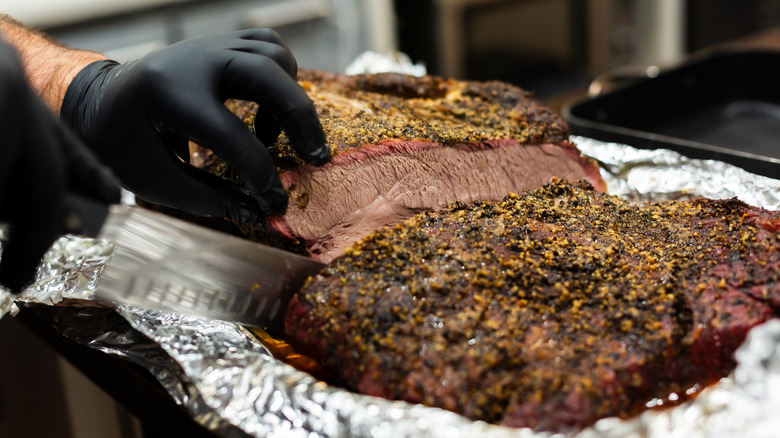
This is probably not the first time that you've been advised to cut your meat "against the grain." But it might be the first time you've had to do it twice for one hunk of protein. Because a whole brisket consists of two muscles, the point and the flat, it has two grain directions to identify. Before you do so much as add your dry rub to the uncooked brisket, you should examine its sides to find what appears to be a seam. That line of fat is your guide to exactly where you want to separate the point from the flat when all is said and done. Bark and even seasonings will ultimately obscure the surface, so commit its position to memory, or even take a photo before your brisket hits the barbecue to reference later. When you don't cut against the grain, you can end up with chewier meat due to uncut fibers. It's just too easy to avoid.
It is highly unlikely that you will separate the point from the flat perfectly the first or tenth time, but getting them apart at all enables you to cut each piece against its own grain, which also helps to prevent any stringy bits. Once you've broken down the brisket, you'll also be able to see its grain directions more easily. You want to cut through the grain, not with it. In other words, if the grain appears to be oriented from left to right when your meat is lying flat on a cutting board, you want to slice not in that direction, but perpendicular, from the top down. Do so with your sharp, serrated knife, and you'll have brisket slices to rival any pitmaster.