

What Happens To All The Leftover Food On Cruise Ships?
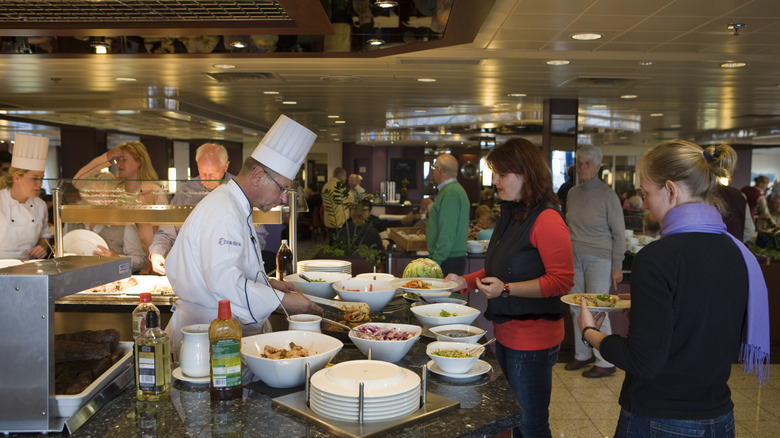
Cruises aren't for everyone, but whether you love them or hate them, there's no denying that they are known for their excess of, well, everything. But especially the food. On a typical cruise you can find plenty of food, all the time. But what happens to the leftovers? And not just the leftovers you leave on your plate. It's just not realistic for a cruise ship to be able to calculate exactly how much food it will need for each sailing so that there is both enough for the entire ship and zero waste at the end of the voyage.
It takes a lot to feed the masses on a floating city. Royal Caribbean's Icon of the Seas, which currently holds the crown as the largest cruise ship in the world, carries 7,600 passengers and over 2,000 crew members at full capacity. That's a lot of mouths to feed, and there are a lot of additional variables involved, such as all-you-can-eat (and totally hackable) buffets and any number of potential disasters that can keep a ship at sea much longer than expected. If you think that all the uneaten food is distributed among the crew to eat free of charge, think again. All prepared food leftovers, including any expired food, is disposed of.
As for how that food is disposed, it is an issue that the cruise industry has invested a lot into figuring out. Small moves, like getting rid of chocolate buffets, have helped reduce waste on a micro level, but on a macro level, modern technology is used to break down most food waste so it can be safely discarded or recycled into fuel, so that there is less effect on the environment.
Modern technology has changed the way cruise ship food is disposed
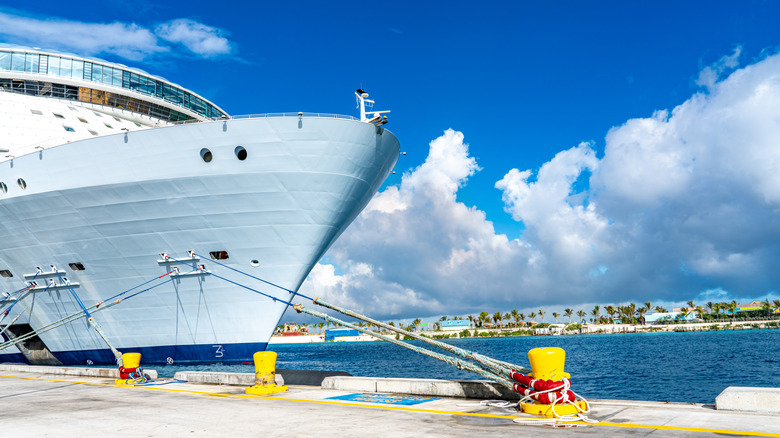
Ships dispose of recyclable waste when they return to port, but when it comes to food waste (like the leftover scraps, expired items, and all the food no one wants to eat on a cruise ship), cruise ships often dump their waste at sea. But before you let that gets your hackles up, you can rest easy knowing that modern processes and advanced mechanisms like biodigesters and Micro Auto Gasification systems (MAGS) often turn that waste into something that is considerably less detrimental to the environment than in the early days of cruising, when trash was simply dumped in the water.
Biodigesters use anaerobic digestion, a process that uses microorganisms to break down organic waste into either gray water or fuel, is used on many ships. In order for the process to work, all waste processed in a biodigester must be organic. Cruise lines like Norwegian Cruise Line require all onboard waste to be sorted to make sure that only food waste is discharged at sea — all other waste is either recycled or properly disposed of.
Some cruise lines, like Royal Caribbean and Silversea Cruises, also use MAGS to turn food waste (along with a few other things), into useable energy to help power the ship. The Cruise Lines International Association (CLIA), which is the largest cruise trade association in the world, has developed a plan to increase sustainability and reduce environmental impact, and these food waste disposal practices are a step toward achieving these goals.