

I Tried And Ranked 8 Kirkland Signature Cheeses From Costco
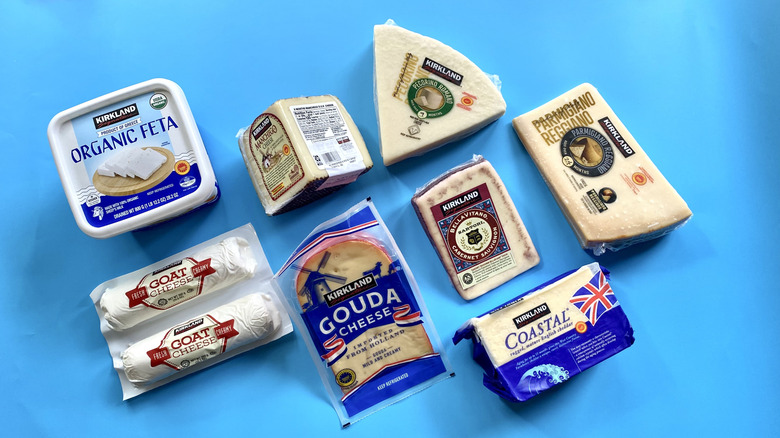
Costco's exclusive private-label brand, Kirkland Signature, has found its way into the cheese aisle, with an impressive lineup of both basic buys and imported high-pedigree options like Parmigiano Reggiano and Manchego. Buying cheese in bulk has its advantages, especially when you purchase it at a membership-only wholesale warehouse club like Costco. Compared to most grocery stores with cheese departments that only sell smaller selections of pre-cut cheeses, you're able to get bigger pieces at a significantly smaller price point per pound.
While you won't have the personalized hospitality and expertise of a professional cheesemonger at Costco, the heavily discounted prices make up for that small setback in service — especially if you already know what you want to buy and what to avoid. If you're hesitant to make one of these purchases, I will gladly offer my help as your cheesy advisor in this article. As a Certified Cheese Professional accredited through the American Cheese Society and an assistant manager of a specialty foods department, I definitely know a thing or two about purchasing (and eating) cheese. And as a Costco Gold Star Member, I have personally shopped at the warehouse to buy cheese for large catering events and for my own household meal prepping. Along with a few friends and family members, who are self-described cheese enthusiasts, see how we decided to rank eight different Kirkland Signature cheeses from worst to best.
8. Kirkland Signature Organic Feta
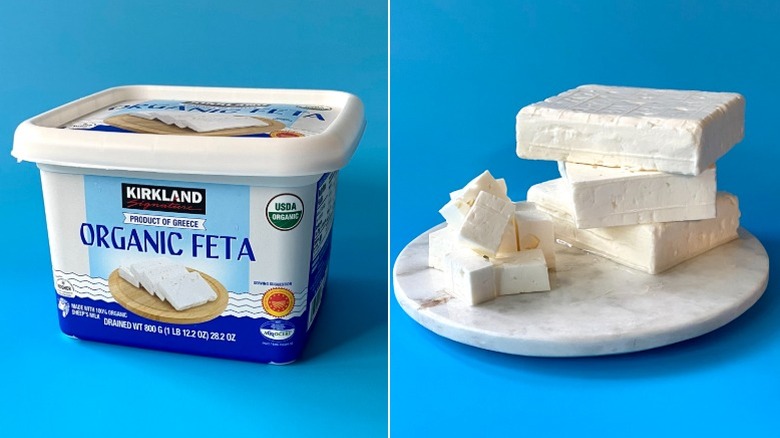
For anyone who wants to buy blocks of feta in bulk to use in recipes like skillet dinners, melon skewers, or crunchy air-fryer snacks, you might want to think twice before purchasing Kirkland Signature's Organic Feta. Feta can be sold in a variety of formats, from pre-crumbled in tubs to vacuum-sealed in individual packages. It can be made with milk from a cow, sheep, goat, or a blend. The Kirkland Signature feta is organic, kosher-certified, and made with 100% sheep's milk, in blocks (totaling a drained weight of 1 pound, 12.2 ounces), packed in salt brine, and sold in a large tub. Imported from Greece, it holds a Protected Designation of Origin (PDO), meaning the producers must follow strict regulations honoring production methods, ingredients, and place of origin.
While this feta boasts some serious creds, its taste was the true test of enjoyability — and that's where my taste-testers and I agreed on some concerning setbacks. This feta was excessively salty, made even saltier by brine storage. We also thought the smell and taste were so aggressive and sour that they came off as nearly rancid. This is due in part to the higher levels of fat, protein, and lactose in 100% sheep's milk compared with those in cow's or goat's milk cheeses. Especially in younger, fresher cheeses like feta, the cheese will have a more piquant and gamier taste and aroma. If this sounds like something you might enjoy, take the bait and make your purchase — but we think this particular style might be objectionable to anyone accustomed to milder flavors.
7. Kirkland Signature Gouda
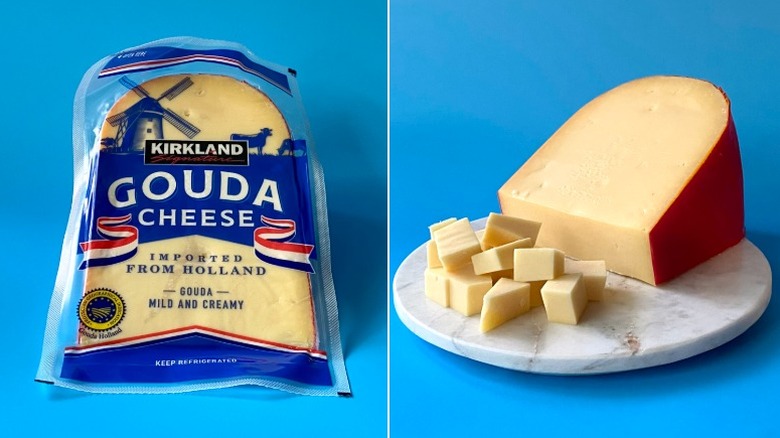
Kirkland Signature's Gouda doesn't have much of a personality. The wallflower at the Costco party is quiet and doesn't want to interrupt all the fun with its blandness. One of my taste-testers described the cheese as being boring and forgettable, and I couldn't agree more.
Imported from Holland with Protected Geographical Indication (PGI) certification, Kirkland Signature's Gouda has terroir-specific authenticity on its side that supports its value. And, at a little under $6 per pound, I was able to buy a 2-pound hunk for less than $12. The price point is insanely low — so low that I would find any excuse to use a mindlessly mild cheese like this in my kitchen.
Young goudas are perfect melting cheeses, and as long as you combine them with more flavorful options, like an aged cheddar or an Alpine-style cheese like Gruyere or Fontina, I could see the potential of this gouda in casseroles like macaroni and cheese or breakfast strata. Even the pros at Murray's Cheese recommend combining cheeses for the best grilled cheese sandwich. This gouda does have some potential. It just needs a little nudge from its more vivacious counterparts.
6. Kirkland Signature Sartori BellaVitano Cabernet Sauvignon
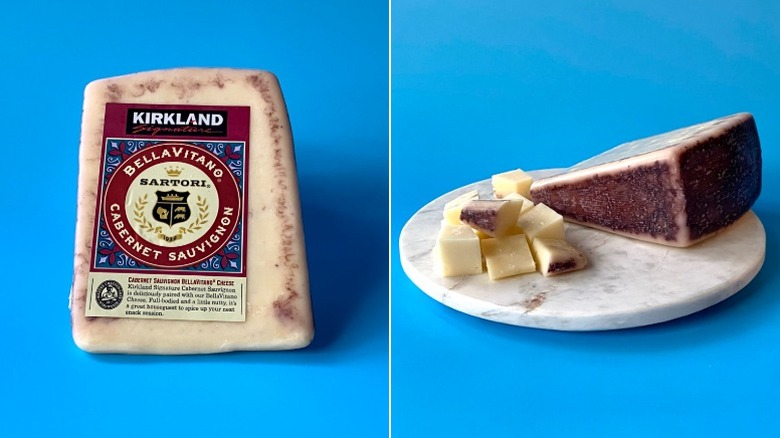
Sartori Cheese is a Wisconsin dairy legend, a popular cheese producer brand carried by many grocery store retailers. Their BellaVitano line includes price-friendly wedges featuring the same cheese base, a flavor hybrid of parmesan and cheddar, that is washed or rubbed in an ever-changing, ever-circulating lineup of different ingredients.
Throughout my career as a cheesemonger, I have cut and sold hundreds of pounds of Merlot, Espresso, Balsamic, Black Pepper, Tomato Basil, Herbes de Provence, Raspberry, Rum, and many others from the BellaVitano line. While my customers have always driven top sales for BellaVitano cheeses, and while my fellow taste-testers would disagree with me, I'm personally not a big fan. And that includes Kirkland Signature's Sartori BellaVitano Cabernet Sauvignon.
Similar to the other BellaVitano cheeses, the base cheese for the Cabernet Sauvignon had a weirdly stiff, waxy consistency. And the excessive sweetness of the base cheese tasted even more cloying when combined with the red wine wash, which tasted more like a sugary grape juice than a deep, robust wine. However, my vote was one against three, since my tasting companions enjoyed this one. They all liked the occasional crunch of the crystalline bits and thought the cheese's sweetness was well balanced by the saltiness and the subtle "funkiness" from the red wine wash. And for only $7.99 per pound (a mere fraction of the cost per pound compared to other grocery stores), my silly arguments against this cheese just might be futile.
5. Kirkland Signature Pecorino Romano
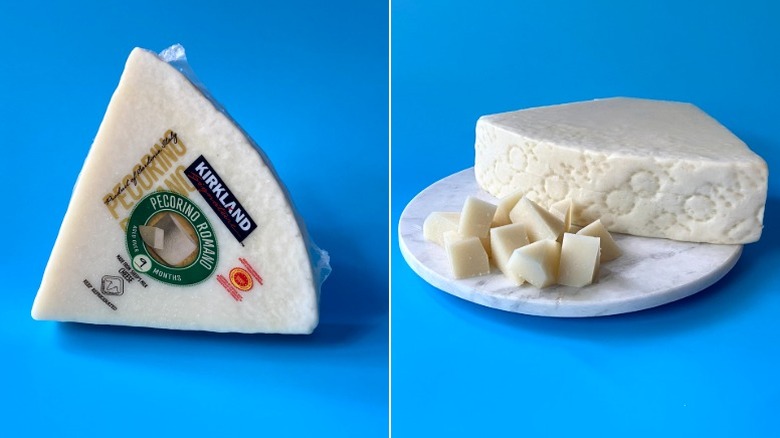
"Subtle" is not part of Pecorino Romano's vocabulary. Its bite is just as strong as its bark! This super-salty, super-abrasive, and super-in-your-face Italian cheese speaks the language of boldness. Sharing those same qualities, the imported Pecorino Romano cheese from Kirkland Signature has the piquancy and pungency most cheese lovers intentionally seek in this type of hard-aged cheese. Like all Pecorino Romano with a Protected Designation of Origin (PDO) certification, Kirkland's selection is made exclusively in Italy from 100% sheep's milk.
Aged for over nine months, the cheese matures with a concentrated saltiness and a brittle, yet still moist and soft, texture. When applied with a disciplined hand, it's ideal as a finishing touch, finely grated over different dishes. This was further proven when I sampled larger cubes of Kirkland's Pecorino Romano to my unsuspecting taste-testers, all of whom unanimously agreed that it's far too strong to enjoy on its own as a snacking cheese. If you want to serve a sheep's milk cheese on a charcuterie board, save the Pecorino Romano for grating and opt for a far more approachable Manchego.
4. Kirkland Signature Goat Cheese Log
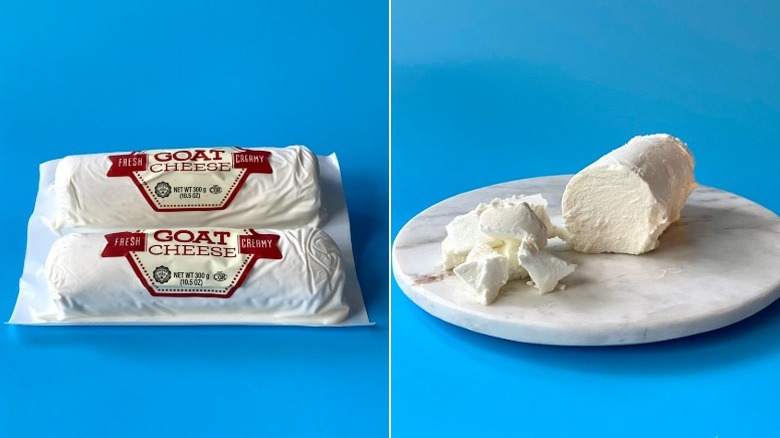
I spent less than 10 bucks on two hefty 10.5-ounce portions of Kirkland Signature's Goat Cheese Logs, and what a win for my personal finances. But would such a cheap cheese taste ... fine? While I was a little skeptical, my negativity vanished in an instant. Many cheaply produced fresh chevre logs often have an excessively tangy, barnyardy taste and a chalky consistency. Not the case here. The goat cheese was lusciously thick and creamy with a smooth, rich paste. It was soft enough to spread easily on a cracker or piece of bread, yet stiff enough to cleanly break into large chunks. And the bright, zippy, lemony flavor was a refreshing delight.
The two-pack format is a smart purchase for the multi-tasking home cook. Use one for crumbling over salads, pastas, pizzas, and soups, and save the other for your next house party as one of the most cost-effective Costco finds to build the ultimate charcuterie board. You might fool even the most discerning guest when you reveal that, no, you didn't buy the chevre from a local farm fostering a small herd of grass-fed goats. You bought it at your local Costco!
3. Kirkland Signature Manchego
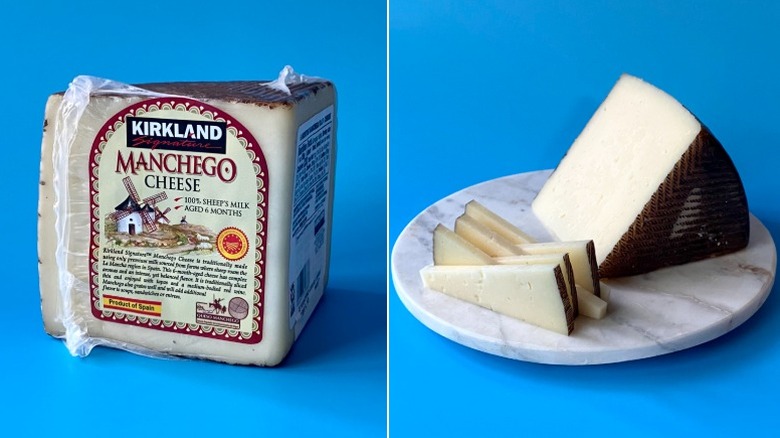
Everyone's favorite Spanish sweetheart on the charcuterie board, a cheese beloved by professional chefs and serious home cooks, Manchego is a widely likable sheep's milk option available in various ages of maturity. I include Manchego on most cheeseboards I build, since its flavor is pleasingly balanced, it's easy to cut, and the triangular pieces can be arranged in different ways. The next time I'm curating a board for a big crowd, I'm definitely buying the reasonably priced 6-month Manchego from Kirkland Signature.
Costco's cheese boasts Protected Designation of Origin (PDO) certification, adhering to the country's stringent production standards rooted in years of cheesemaking traditions and respect for the local terroir. Made with 100% Manchega-breed sheep's milk, the milk must be sourced from certain provinces within the La Mancha region in Spain.
With a few holes and gaps speckled throughout the cheese, the slightly spongy appearance certainly doesn't translate to the texture. The semi-firm consistency is supple, smooth, and creamy. The gamey sheep's milk flavor was not overpowering at all, and was rather sweet and subtle. My fellow taste-testers were obviously happy with this one: among the platefuls of cheeses I served to them for this tasting, this was the only one they finished completely.
2. Kirkland Signature Coastal English Cheddar
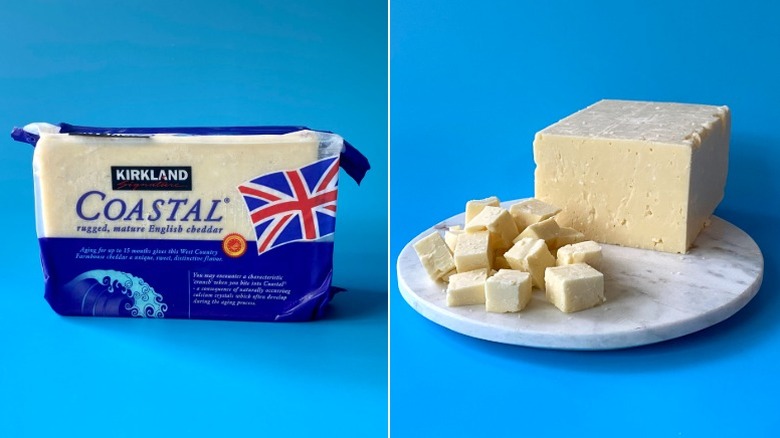
I love when the actual texture and taste of a cheese perfectly match how it's advertised on the label, with no B.S. or empty promises. Exactly as described, Kirkland Signature's PDO-certified Coastal English Cheddar is both rugged and mature with a "deeply rich, intense flavor, creamy texture, and smooth finish with subtle, sweet top notes." As mentioned on the label, there are occasional crunchy, crystalline bits scattered throughout the cheese due to the 15-month aging process.
I was impressed by its sweet-and-tangy backbone, a unique profile that set it apart from other Kirkland-branded cheeses. It also wasn't too salty, which made it easy to snack on bite after bite. I was just as entertained by its consistency, with an initial hard-aged dryness that quickly gave way to a creamy finish. Again, taking a cue from some of the serving suggestions directly on the label, I would present shards of this hefty block with a smear of whole-grain mustard, crusty bread, thick slices of salami, and a craft ale.
1. Kirkland Signature Parmigiano Reggiano
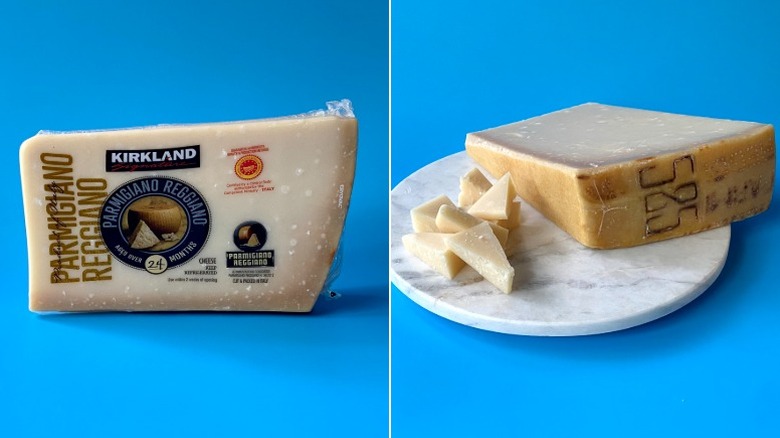
This is no generic shaker parmesan. Costco brings in Parmigiano Reggiano directly from the source: the Italian brand Formaggi Zanetti produces and selects the wheels sold to Costco. With a European Protected Designation of Origin (PDO) certification, Kirkland Signature's Parmigiano Reggiano upholds Italy's strict production standards. The cheese I bought was aged for over 24 months, an average maturation period for Parmigiano Reggiano. The 2-year aging process helps develop its granular, grate-worthy texture, scattered with crunchy tyrosine crystals. The intense yet not overwhelming notes of floral pineapple and lightly toasted cashews are the perfect counterbalance to the cheese's powerful saltiness.
At only $15.99 per pound at the time of writing this article, an imported Italian selection like this one is (no joke) a fraction of the price compared to other stores carrying the same style. Sure, you won't be getting peak freshness compared to when a cheesemonger like myself is hand-cutting a wheel right in front you. But I would still say for someone who often uses Parmigiano Reggiano in the kitchen, whether for grating, shredding, shaving, or serving on a cheeseboard, this is one of the most cost-effective and worthwhile cheese purchases at Costco.
Methodology
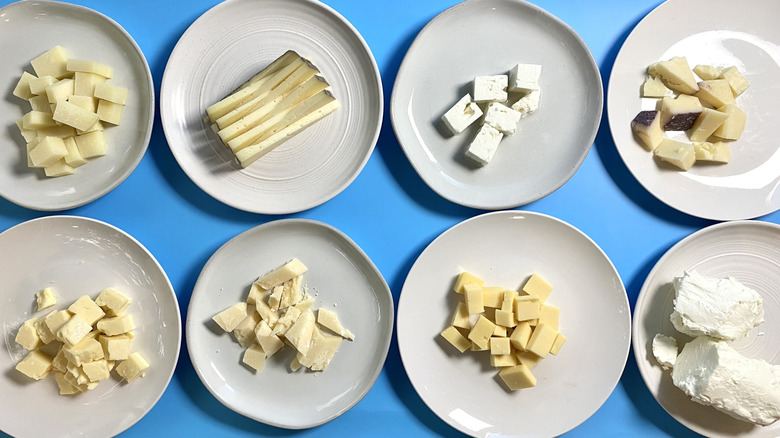
Drawing on years of work in the food industry, specifically cheesemongering, I already have pretty high standards for selecting, buying, preparing, and eating cheese. There was so much more besides how good the cheese tasted that went into my decision-making for this ranking. I carefully compared prices per pound across multiple grocery stores with the same or similar products. I also researched where each cheese was sourced and whether it had any credentials, such as organic or Protected Designation of Origin certification. I also looked at the nutrition facts to double-check the authenticity of the ingredients and make sure that, aside from typical milk, enzymes, salt, and expected flavorings, there were no unexpected ingredients like additives or emulsifiers.
Inviting a small panel of family and friends contributed to a fairer, better-developed final ranking. With their help, I was able to cast a wider net to gather more backgrounds and opinions beyond my own concentrated prejudices/favoritisms from years of working with cheeses similar to many in this taste test. I took their notes into serious consideration as I was finalizing the rankings. They were generously compensated with leftover cheese to take home.