

What Alcohol Should Be Refrigerated After Opening? Here's The Rule
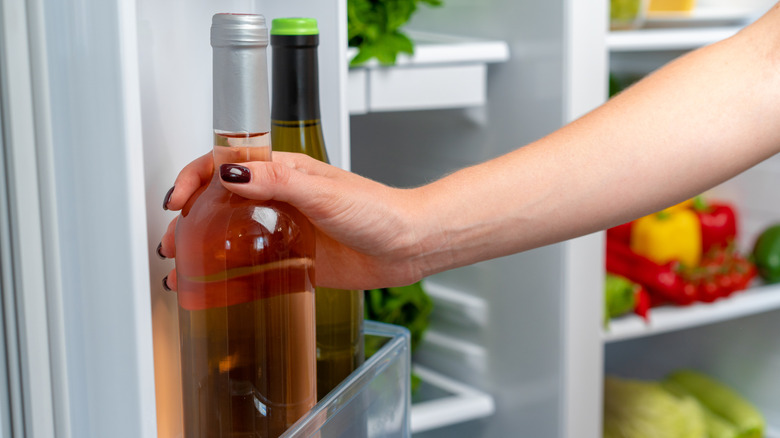
There's something pretty cool about having a home bar where you can display your collection of alcohol, but some of those open bottles may be going bad in front of your eyes. We're not talking about whiskey or other spirits. While oxidation can affect flavor over time, hard liquor doesn't technically expire. But, if you're storing open bottles of wine, vermouth or other fortified wines, and some liqueurs, you need to rethink your storage situation. The simplest rule to follow is based on alcohol by volume: If it's open and below about 20% ABV, it should be kept cold.
As mentioned, even opened bottles of higher-proof spirits can suffer when they come in contact with oxygen. Besides the destructive potential of air, lower-proof alcohol can also be affected by microbes. Yeast and bacteria can spoil the bottle's contents, changing its flavor and smell. In the case of wine and even vermouth, you eventually end up with vinegar, so keep them in the fridge. In general, we're talking about wine, hard cider, vermouth, mead, sake, sherry, aperitifs, such as Lillet, and other fortified wines. However, there are exceptions.
What kinds of alcohol to keep cold
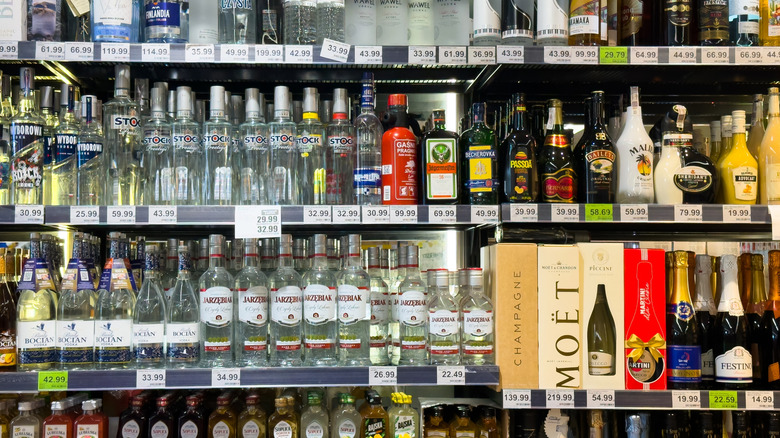
The reason you don't need to store whiskey, and other distilled spirits, in the fridge is that it has a high alcohol content (typically 35% ABV or higher), which inhibits microbial growth. If you're not sure what a bottle's ABV is, here's another rule of thumb: if an open bottle is a distilled spirit, such as rum, vodka, or whiskey, it doesn't need to be kept cold; if it's been fermented, but not distilled, such as wine, beer, or mead, toss it in the fridge.
Still, some types of alcohol fall somewhere in-between. Fortified wines, such as Port, tend to clock in around 20% ABV, but can be higher. Likewise, sherry can have a wide range and go as high as 22% ABV. However, it's still recommended that they be kept cold since they aren't as robust as distilled spirits.
Liqueurs can be a bit more tricky. They have a wide range of ABVs, starting as low as 15% and going as high as 30% or more. Parse this out on a case-by-case basis, but err on the side of caution to get a longer shelf life out of your booze. It may be time to do a deep purge of your fridge to make more room for all those open bottles.