

What Exactly Is Kombucha Anyways?

We've all heard about kombucha. It's a fermented drink that gives a vivacious sip similar to beer, but without the alcohol ... kind of. It's certainly popular among health buffs, but what exactly is it? Well, aside from going through a days-long fermentation process, the effervescent beverage is also characterized by its probiotic benefits for better gut health. So, if you're looking for a probiotic-rich addition to your diet that isn't yogurt, kombucha can be an appealing option. It's typically made with four ingredients: black or green tea, sugar, bacteria, and yeast. But before it becomes the fizzy drink that many either love or hate, kombucha starts as a sweet tea, with tea-leaf-soaked water and sugar as its base. After that, fermentation transforms it into kombucha.
The combination of yeast and bacteria that makes the fermentation process possible is called the Symbiotic Culture of Bacteria and Yeast, or SCOBY. The SCOBY takes the form of a slightly suspicious slimy, round chunk that has a rubbery texture and smells like vinegar. It's introduced to the sweet tea, where it stays for one to four weeks, depending on the desired potency. A more delicate kombucha requires a shorter fermentation process, while a bolder, more vinegar-forward batch takes more time. Warmer temperatures speed up the process of fermentation, while also making kombucha even more spritzy and packed with flavor.
How much sugar, caffeine, and alcohol is in kombucha?
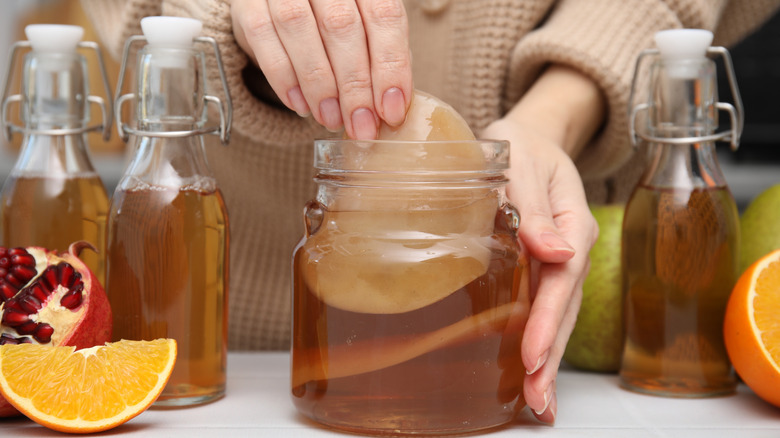
Since kombucha starts out as tea, it contains some caffeine. Compared to coffee, kombucha's caffeine content is much lower, though the amount depends on the fermentation process. Still, the caffeine content in a cup of brewed coffee is roughly equivalent to that found in six to eight cups of kombucha. Kombucha contains alcohol, too, which develops naturally during the fermentation process. But it's still not enough to get you drunk, as there's only around 0.5% alcohol by volume or less, which is why it's sold as non-alcoholic.
Meanwhile, kombucha can be high in sugar. That said, the fermentation process lowers this amount by breaking down some of the sugar before you drink it. The sugar content varies depending on the brand, as some are sweetened to make them more satisfying to the palate.
Overall, kombucha is a powerful drink. Other than probiotics, it also contains potent antioxidants because of the tea, and it can even be a worthy opponent to bad bacteria that can cause nasty diseases like E. coli. It's safe to drink kombucha daily, but too much of it can be hard on the digestive system, so it's best to enjoy it in moderation.