

Here's What It Means When Your Milk Carton Looks Bloated
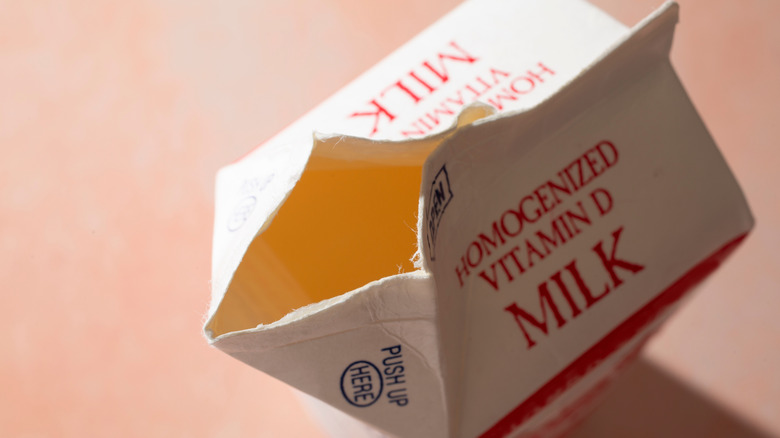
Have you ever seen a bloated milk carton? It certainly looks suspicious, and if you're like us, you might be wondering why it happens. Chowhound exclusively spoke with expert Meena Sriram – a product development and commercialization manager at Darigold, with a Master of Professional Studies in Food Science — to figure out the whys of it, and whether or not it's still safe to consume. Sriram mentions two main reasons: overfilling and microbial spoilage. "The seldom understood cause is an overfill of the carton that leaves very little headspace and the milk does not have sufficient space for thermal expansion," she said. "The carton may appear tight or rigid and slightly [domed]. However, the overfilled carton does not continue to expand over time, no gases are generated, has no off odors, and doesn't hiss when opened."
Meanwhile, microbial spoilage — which is when microorganisms cause food to go bad — can also be the culprit behind a bloated milk carton. "A bloated carton due to microbial spoilage... metabolize lactose and proteins in the milk to produce CO2, hydrogen, and other gases. This gas accumulation then causes the carton to bulge or expand," Sriram tells us. This could mean that it has been compromised somewhere along the supply chain, so it's best to throw it out. If you drink spoiled milk, you can contract food poisoning. So, other than bloated packaging, here are other signs to look out for that say your milk has gone bad.
Is your milk still safe for consumption?
Aside from a bloated milk carton, other red flags you can possibly spot before tossing it straight into the trash bin are changes in texture, appearance, and smell. "Visible curdling, clots, or separation is a big giveaway," Meena Sriram told us. Two other signs include "an unusual color or slimy texture which are associated with psychotropic bacteria, and [a] sour, yeasty, or sulfurous smell caused by spoilage organisms." Upon opening the milk, if it makes a hissing sound, you can also consider it completely spoiled, explained Sriram — even if the expiration date says otherwise.
But if you suspect that your milk has only gone sour, don't throw it out; you can use it to bake bread. You can even use it in soups to create a thicker consistency. Of course, we're not talking about using milk that has fully gone beyond-saving bad, especially if it has curdled. It's only safe to use before it tips into the spoiled category — just enough for it to develop mild acidity. There are also ways to extend the shelf life of dairy products if you prefer fresh milk through and through, including freezing it, which should make it last for up to three months.