

Are 'Curds And Whey' Just Cottage Cheese?

As a child, you no doubt heard about the plight of Miss Muffet, who was scared away from her snack by a spider. Mother Goose's nursery rhymes contain lots of antiquated language, which makes sense since they date back to roughly the 17th century. And while you may not have given it much thought, the curds and whey the nursery rhyme refers to is, in fact, an ancestor of what we know as cottage cheese.
Back in the day, curds and whey would have formed when milk was left to sour (or curdle). The solids became the curds and the remaining liquid was the whey. People learned to hasten or control that process by adding rennet, sour milk, or sour whey, ultimately leading to the evolution of cheese-making in general. Today, manufacturers make cottage cheese by adding similar cultures and enzymes to milk. After the curds form, they drain or rinse away the whey and may add some kind of cream or half-and-half and salt.
The case for cottage cheese and whey
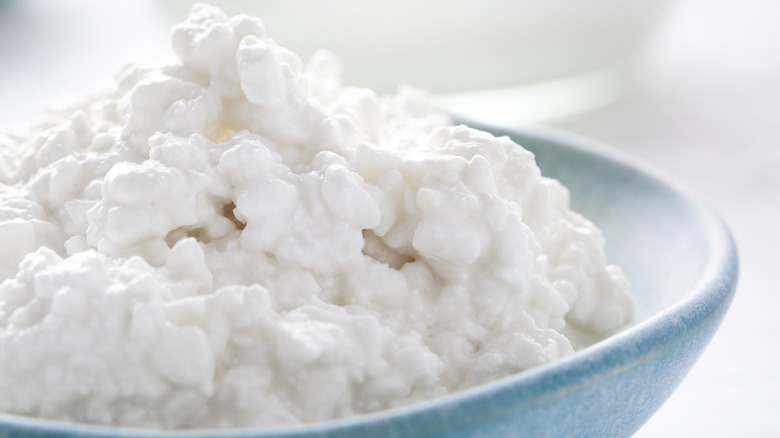
You can find different versions on store shelves, especially among the top-ranked cottage cheese brands, but if you want the ultimate control, you can make homemade cottage cheese using plain old vinegar instead of rennet. Start with low-fat milk instead of whole for lower-fat cottage cheese, or opt for an ultra-filtered brand like Fairlife for a high-protein version.
After it separates, the process looks very much like it would in the manufacturer's large vats. You drain the whey and rinse the curds if you want to mellow the acidity. You can continue tweaking the fat content by choosing among options like heavy cream, half-and-half, or tangy (high-protein) yogurt. You can even skip the salt if you'd like. Then level up your basic cottage cheese with unexpected pairings by whipping it with tahini, mixing it with your morning eggs, or using it as a protein-forward replacement for sour cream on a baked potato.
Speaking of protein, you may have seen whey popping back into the convo in its more modern form on a grocery store health aisle. Packaged as whey protein, this shelf-stable and easily digestible powder is derived from the very same liquid whey. Perhaps you can enjoy a whey protein-spiked smoothie as you sit on a tuffet of nursery rhyme fame (that's a low cushion, in case you're wondering). Just keep an eye out for any pesky spiders.