

It Was The First Canned Soda Brand — Now Hardly Anyone Remembers It
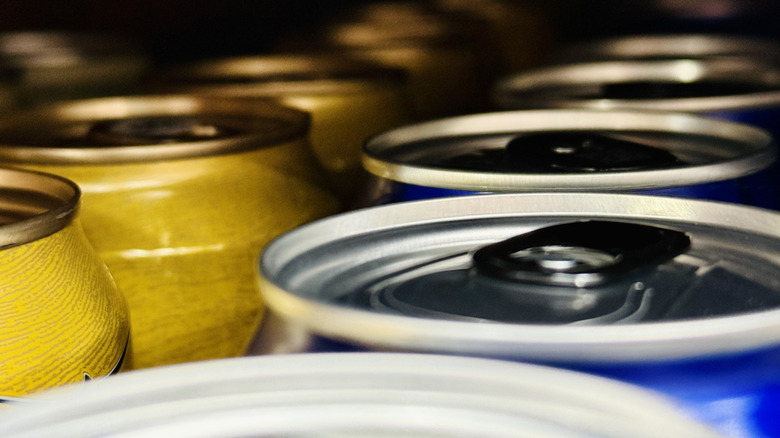
Unlike its still-going-strong rivals, Coca-Cola and Pepsi-Cola, the name Clicquot (pronounced Kleek-o) Club Company probably doesn't ring a bell today. But at one time, the soft drink company was considered the largest ginger ale maker in the world with a massive factory at its headquarters in Millis, Massachusetts, a suburb of Boston, and more than 100 other factories across the United States. Among its many achievements, it was the first company to sell its sodas in cans, although that particular first didn't actually go so well.
People had been trying to produce metal cans for beer and other carbonated beverages that wouldn't explode or leak since the early 20th century, but it wasn't until 1934 that the American Can Company perfected a working one. The can was first used for beer, Krueger's Finest Beer and Krueger's Cream Ale, in 1935. Later (some sources date it as 1938), the Clicquot Club Company became the first soft drink to use this new technology. The cans were unusual and featured a cone-shaped top sealed with the same kind of bottle cap found on glass soda containers. Still, there were problems.
Unlike beer, ginger ale was much more acidic and fizzier. The 100,000 cases of canned ginger ale that went out were prone to exploding or leaking, which prompted the company to abandon canned sodas. This was just one of the issues Clicquot Club would face before its eventual demise.
A soda that went from famous to forgotten
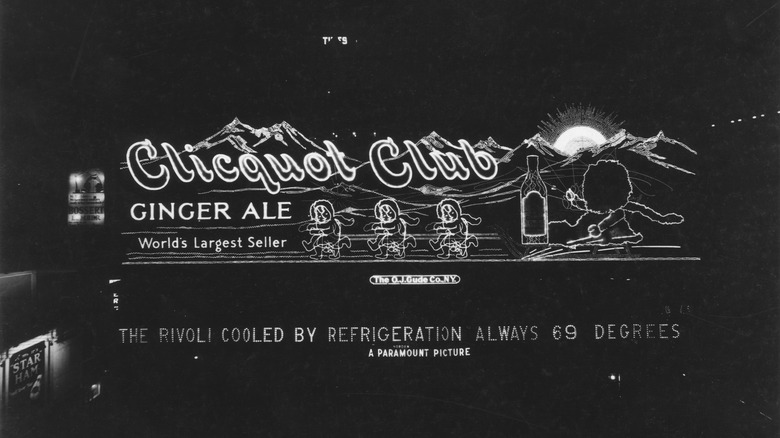
The Clicquot Club Company was founded in 1881 by Henry Millis and Charles LaCroix as a small soda maker in Millis, Massachusetts, and was named after the famous French champagne, Veuve Clicquot. When Horace A. Kimball bought the company in 1901, he helped usher in the brand's heyday. His son, H. Earle Kimball, who ran the business, placed ads in national publications like Time Magazine and in various newspapers. In the 1920s, Clicquot Club also had a giant electric animated sign in Manhattan's Times Square — purportedly the largest in the world at the time — and sponsored a syndicated radio show.
In its heyday, the Millis factory was so large that it had its own train station for transporting its products across the nation. From there, the brand was shipped globally and enjoyed everywhere from South America to the Philippines. Among Clicquot Club's range of soft drinks, its ginger ale was its flagship product. Ginger ale started out as a mildly alcoholic Victorian drink before its transformation into a popular soft drink, and Clicquot Club's version was the go-to brand, at least for a time. By the 1950s, following the retirement of H. Earle Kimball, the brand went into decline. In 1965, its rival Canada Dry bought the brand's parent company, Connecticut's Cott Beverage Corporation, and shut it down. While today you can still get America's oldest surviving soft drink, Vernors ginger ale (launched in 1866), Clicquot Club is just a memory.