

This Country Produces The Most Okra In The World Thanks To Its Tropical Climate
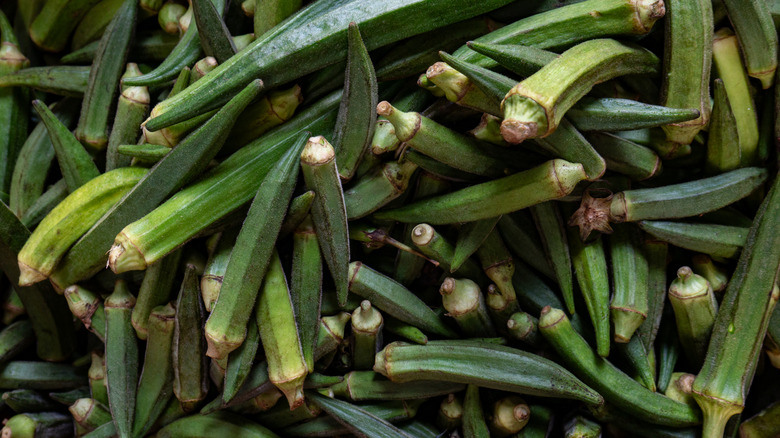
Okra is one of the most divisive vegetables there is. While some people love crispy okra fries, others tolerate it as the slippery vegetable floating around their gumbo, and many wouldn't touch it with a barge pole. However, while it feels like a somewhat niche food in parts of the United States, it is a everyday vegetable in other parts of the world. None more so than India, which according to the Food and Agricultural Organization of the United Nations (FAO) agricultural data, produces more okra than any other country.
India's ability to grow such a large quantity of okra comes down to its climate — the same reason it is also the country that produces the most bananas. Okra can withstand some seriously high temperatures, well above 90 degrees Fahrenheit, and it easily adapts to different soil conditions, too. This mean it grows perfectly in countries with long and hot summers. Okra is also a voracious grower that continues to produce pods throughout the season, which means farmers can keep picking the pods over and over, as opposed to only getting a few harvests.
In terms of its origins, okra likely originated in Africa. Then, it would have spread through trade routes into the Middle East, India, and eventually to the Americas. It just so happened that India's climate turned out to be ideal for large-scale cultivation, establishing the country as the center of okra production today.
India grows so much okra because people genuinely love eating it
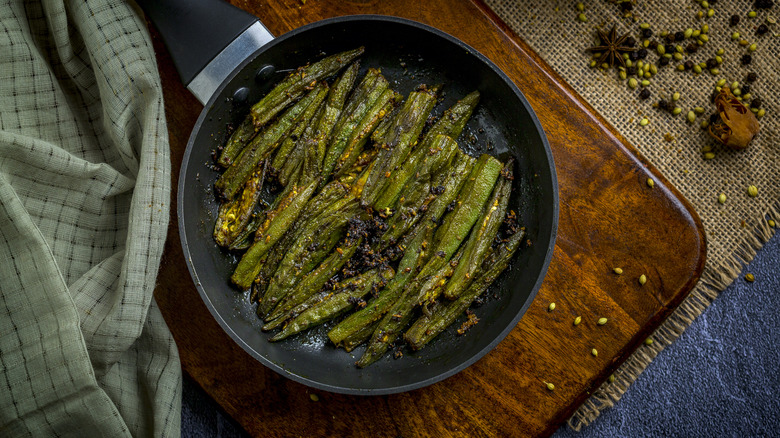
Okra's production numbers only tell part of the story. The other reason why India has such large scale okra production is probably because the country itself eats such large amounts of it. It's a bit of a chicken-and-egg situation. Do people eat a lot of okra because it grows so well, or do they grow a lot of okra because they enjoy eating it so much? The answer probably lies somewhere in between.
In India, okra is a common vegetable known as bhindi, and you'll find in stir-fries, curries, and even in side dishes (such as raita) that are served alongside main meals. In many Indian households, okra is a staple — much in the way Americans may eat potatoes or sweetcorn. Plus, India really nailed how to combat one of people's biggest grievances about okra: its slimy texture.
In India, okra is cooked dry, blasted with heat, or cooked with acidic ingredients like tomatoes or tamarind. This helps it stay firmer and more palatable. Similar to pickling okra, the end result is very different to the stewed and slippery version of it that Americans know. As a result, India can't get enough okra — just as much as the crop can't get enough of India's climate, leaving the rest of the world to get an estimated 60% of its okra from India alone.