

The Sneaky Reason Some Pork Bacon Shrinks So Much When You Cook It
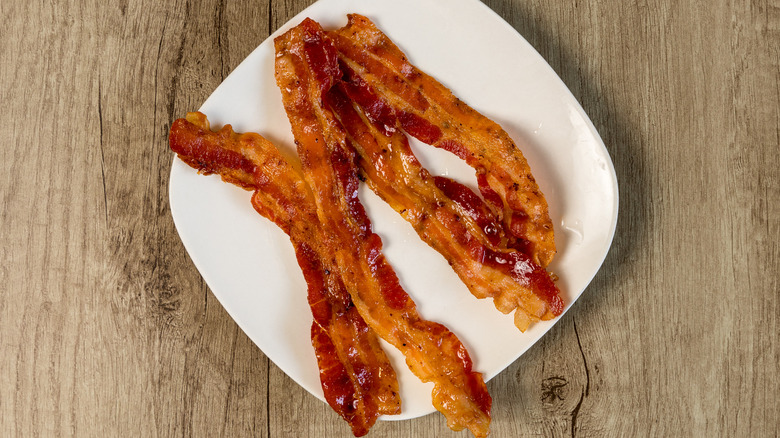
Frequent cookers of bacon may have noticed that bacon rashers shrink different amounts when cooking. Pretty much all will inevitably lose a bit of bulk, but some will shrivel up so much that you may feel a little robbed. There's a sneaky reason why this happens: It's called "injected bacon."
So, to explain this, we need to take a step back and look at how bacon is cured (and all bacon is cured, even so-called "uncured bacon"). You can dry-cure bacon, which means that the pork is rubbed with salt and sometimes other seasonings, drawing the moisture out. Because that moisture has been partly sucked out, dry-cured bacon will shrink less when you're cooking it. It's also sometimes considered "better" as it has a more concentrated flavor, and producers of "reputable," higher-quality bacon sometimes highlight that their bacon is dry-cured.
Then there's wet-cured bacon, soaked in a brine (salt and water); a lot of supermarket bacon is likely wet-cured. Then there's injected bacon, which is arguably similar to wet-cured but a brine (sometimes with seasonings) is injected or pumped into the bacon, often using an industrial-scale machine that can do this on a large scale. The reason is that this cures bacon faster than simply soaking it in brine. The injection means that the bacon is carrying more water than if it were dry-cured, which is then cooked off, shrinking the bacon more than its dry-cured counterpart, which has less moisture to lose. So basically, injecting means you're padding the bacon with salty water.
What to expect from brine-injected bacon
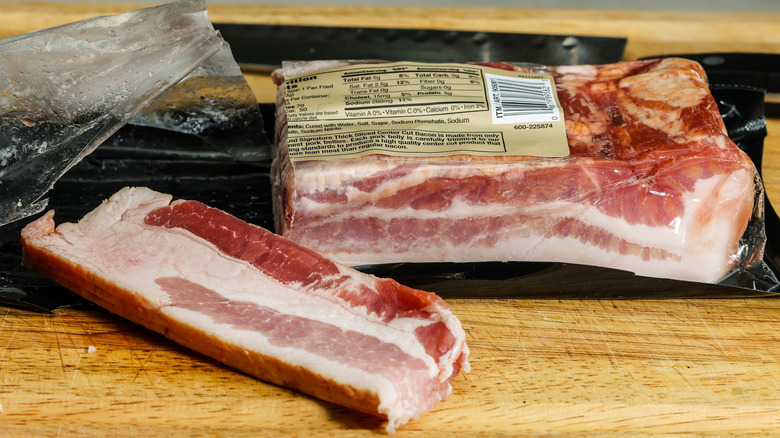
Injected bacon isn't a safety problem. After all, the injection is just salt and water, so you're dealing with the same ingredients as any other form of bacon. In terms of quality, dry-cured bacon arguably has a stronger and deeper flavor, while the injected version is usually associated with mass-produced supermarket shelf bacon — sometimes perceived as lower quality due to excess water and shrinkage. That said, some might argue that wet-cured bacon (and by extension, injected bacon) can be more evenly seasoned, although it'll generally have a milder flavor.
Turkey bacon is made differently from pork bacon, but it's also sometimes wet-brined, which makes sense since injecting brine into turkey is sometimes used as a method for cooking the bird in its non-bacon form. If you're hoping to avoid injected bacon, know that many supermarket brands don't explicitly list their curing methods on the packaging. However, the USDA states that bacon can be labeled as natural if it's "minimally processed" and doesn't include nitrates or nitrites as "direct additive curing agents." The best way to avoid injected, wet-cured bacon is to either test it in the pan (aside from shrinking, injected bacon may also ooze white brine while cooking) or shop for dry-cured.