

How To Spot Fake Wagyu Beef A Mile Away
So you're treating yourself to a special dinner — Wagyu steak, perhaps. Here's some bad news: If you're dining in the United States, the rules on using the term "Wagyu" are pretty loose, and restaurants and retailers can use the label for beef that from crossbred cows that may have only a small percentage of Wagyu genetics (and are often part or mostly Angus).
Fortunately, there are a few ways to figure out whether you're getting real Wagyu or the watered-down version. (For this article, "real" Wagyu is considered to be beef coming from a purebred Wagyu cow; these cows are mostly raised in Japan and Australia, although a limited number are raised in the United States.) The first place to look is the price tag. While there's no magic number for how much Wagyu should cost, know that the real deal is pretty expensive; the top grade can sell for over $200 per pound, and a 5-ounce steak can be over $100. An American-raised steak should be $80-ish. So, if the price seems too good to be true, it probably is.
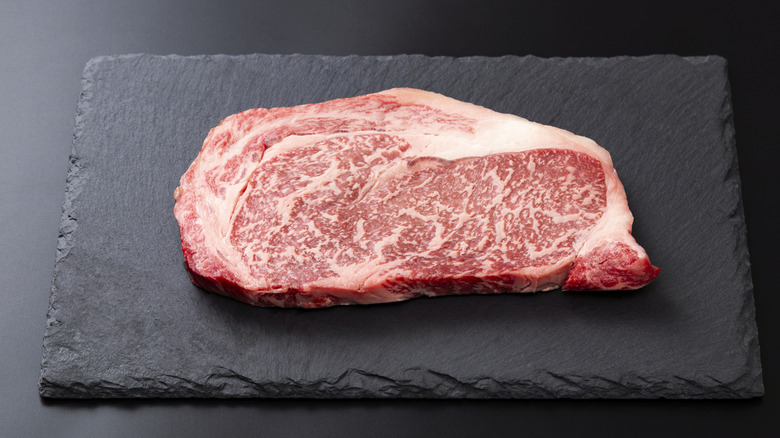
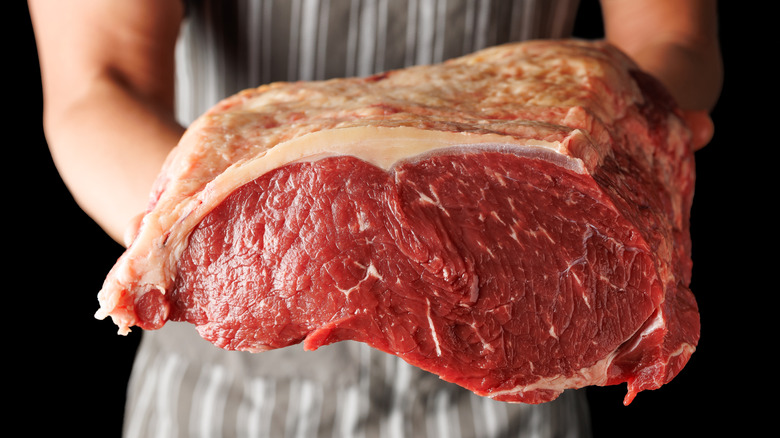
Next, try to get a look at the raw Wagyu. You want to see a lot of thin white marbling streaks (that is, streaks of fat) across the piece of meat, compared to standard steaks which may have a fat cap or thicker marbling streaks. Genuine Wagyu beef also tends to be more pink, compared to the deeper-red tone of other beef types.
Be prepared to ask questions too
While inspecting raw Wagyu should be fine in a retail store, asking to inspect a piece of raw Wagyu before ordering in a restaurant may feel overbearing (and it's anybody's guess whether many restaurants would let you stick your face up close to such expensive, uncooked meat before ordering). Fortunately, there are some other tricks to figuring out the legitimacy of that so-called Wagyu. You'll want to ask questions about the beef. You're looking for some reasonably specific answers about its grade and origin: There's a relatively complex grading system for Wagyu beef, and anybody selling the real deal should have a clear answer to this. As for origin, if you can get the name of a farm or ranch, that's a good sign.
If you're dealing with Kobe beef (a high-quality sub-category of Wagyu), you should also be able to get concrete documentation. Kobe beef is tracked extraordinarily carefully, so restaurants should be able to provide certificates of authenticity with a 10-number ID that confirms the origin. Plus, restaurants have to have a license to serve it, and there's only a few dozen in the United States that have it, so you can easily research if they're on that list. Top-level A5-grade Wagyu also gets these 10-digit identifications, so if a restaurant can't provide that, watch out. Finally, A5-grade Wagyu can only come from Japan — so any claim to serve U.S.-raised A5 Wagyu is a big red flag.