

Should All Your Baking Ingredients Be Room Temperature?
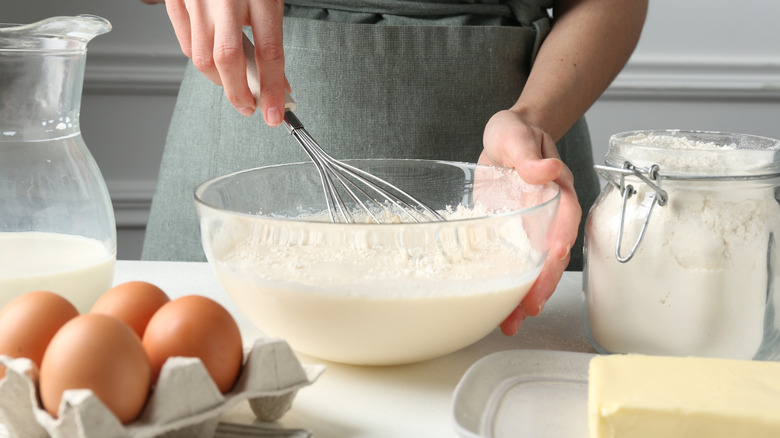
When whipping up a treat in the kitchen, it can be tempting to ignore admonitions to let your eggs, milk, and the like come to room temperature (about 70 degrees Fahrenheit). After all, you're eager to complete the project and get to that delicious end result! And does it really matter anyway? We asked Odette D'Aniello, owner of Dragonfly Cakes, to bring us up to speed on whether or not you really need to slow down your baking process in order to bring ingredients up to room temperature. D'Aniello is a third-generation baker with over 25 years in the specialty food industry, so she's definitely an expert in the field.
In short, her answer is that it depends. "I pay the most attention to temperature when I'm working with recipes that rely on emulsification or aeration," D'Aniello told Chowhound exclusively. Recipes that fall under this category include cheesecakes, buttercream, pound cakes — basically those that have a foundation of creamed butter and sugar. The structure of these types of baked goods is paramount, and it starts with a smooth emulsion.
D'Aniello goes on to explain exactly what an emulsion is. "When you cream butter and sugar, you're creating a base that traps air and evenly distributes fat," she says. "When you add eggs or dairy, you're trying to blend water-based and fat-based ingredients into a stable mixture." Because fat and oil don't mix well, creating optimal conditions for the emulsion will go a long way — in this case, making sure your ingredients are a similar temperature.
How to avoid curdling, plus some exceptions to the room temperature rule
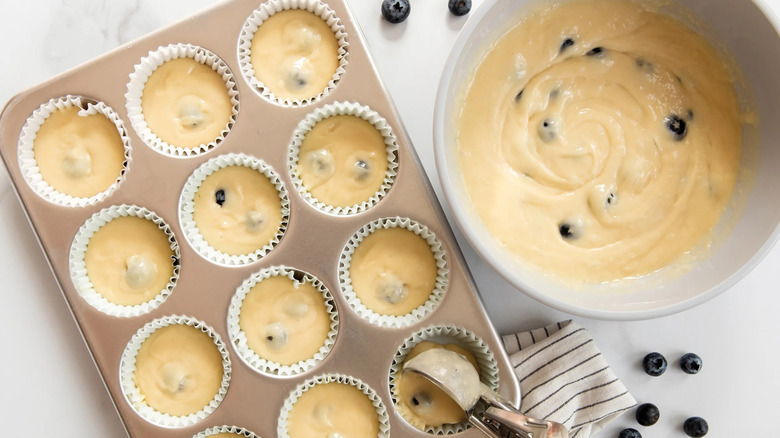
Odette D'Aniello warns that if you try to emulsify butter with cold eggs or milk, you risk the fat seizing and hardening into lumps. This will give your batter that characteristic — and generally undesirable — curdled look. It doesn't necessarily mean your product is ruined, but it may throw off the texture of your final product. "If your batter was cold and slightly broken," D'Aniello explains, "you'll often see a denser texture, uneven air pockets, or a slightly greasy crumb."
But not every batter depends on a potentially finicky emulsion. And for these, the temperature of your ingredients isn't quite as important. Batters for muffins and quick breads, for example, tend to be more forgiving. According to D'Aniello, "Those are typically oil-based or rely less on precise structure, so they'll still come together even if your eggs or dairy are a little cold."
"At the end of the day," she concludes, "I think of it this way: If the recipe is meant to be light, smooth, and 'fancy' (like a cake or buttercream), room temperature really matters. If it's meant to be rustic and hearty (like banana bread or muffins), you've got a lot more flexibility." Just remember, when bringing ingredients like eggs up to room temperature, you'll need to do it safely. Leaving products like eggs and milk at room temperature for too long can lead to potential health hazards due to bacteria growth.