

Why Milk Cartons Have Dimples On The Side
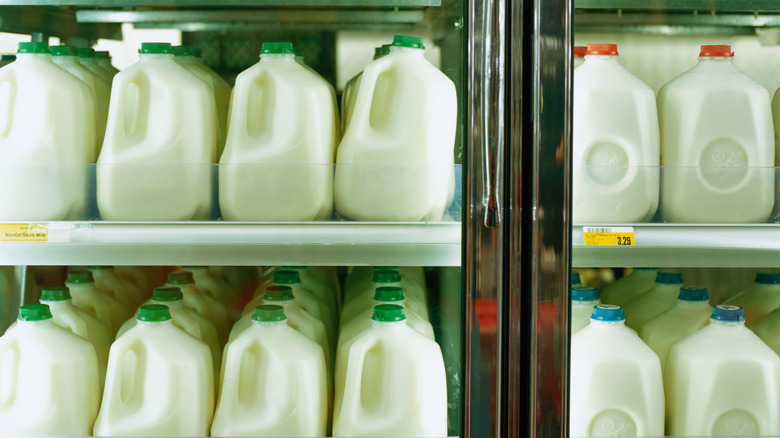
There are certain mysteries laid within the grocery aisles that seem unlikely to ever be solved. Why, for example, are the bags used for fruits and veggies so impossible to open? And why is some packaged ground beef red on the top and grayish in the middle? Okay, so these questions do have answers. Still, there is some cloudiness that persists. One grocery mystery that has confused generations of shoppers is that nearly universal indent found in plastic milk jugs. One theory posits that the dents are built into jugs in order to indicate when milk has soured: if those dents have gone from concave to convex, it's time to toss.
But does this theory hold any milk? No, unfortunately not. As much as internet theorists would like for this to be the case, it simply isn't true. So why are those dents there? For starters, these indents help improve the structural integrity of the jug, preventing it from breaking or warping due to shrinkage or expansion from temperature changes. For example, if you freeze your gallon of milk, you might notice that those indents pop out. The indents function as a valve for the expansion that happens during freezing, allowing the gallon to expand alongside its contents. Plus, these dents make gallon production a bit cheaper to boot, which is another bonus for manufacturers.
How to tell if your milk has gone sour

The simple fact of the matter is that the dents in milk gallons couldn't be made specifically to indicate if milk has gone bad, because milk would not press out the dents by spoiling. Now, on the surface, the spoilage theory makes sense: sometimes, rotting or spoiling food will produce gasses that cause packaging to bloat or expand. However, this isn't the case for milk. So how can you tell if your milk has gone sour?
There are a few key signs to look (and sniff) out for. Milk's smell is probably the best to test for spoilage. If your milk smells sour or overpowering, go ahead and toss it. You certainly don't want to drink spoiled milk. Also, soured milk tends to be more yellow or green than white in appearance, and may change in texture and consistency, forming small clumps. Even without all or any of these signs, your milk could still have gone bad, so make sure to keep your milk's best-before date in mind before drinking. Always store your milk in the interior (not the door) of your fridge, so that it stays consistently cool, and never store your milk above 40 degrees Fahrenheit for extended periods. When in doubt, toss it out.