

How To Tell If A Bakery's Pastries Are Actually Fresh
Stale. Dry. Disappointing. You don't want to drop money on a pastry that looks full of promise but fails to deliver. However, certain bakeries can be adept at presenting their wares in ways that disguise their age. So, Chowhound asked Odette D'Aniello, owner of Dragonfly Cakes, how to tell a truly fresh pastry from an impostor.
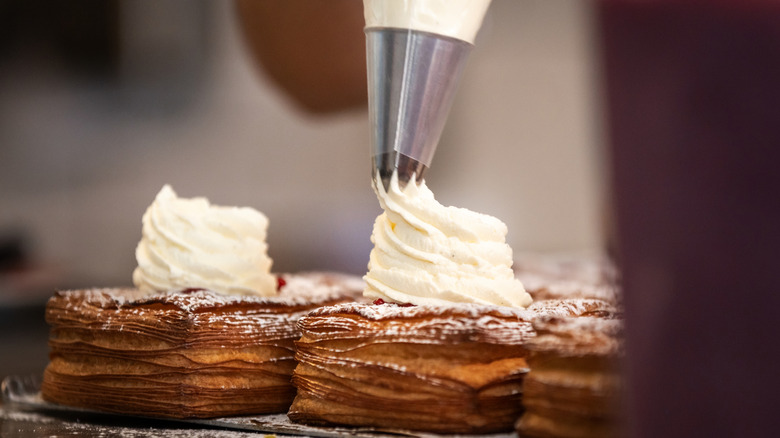
"Genuine fresh pastries have an aura to them that's hard to fake," says D'Aniello, who is a third-generation baker with more than 25 years of experience in the specialty food industry. "Fresh pastries have a natural, slightly imperfect look to them, while pastries that are made to look fresh tend to feel a little too polished." Start by assessing a pastry's texture, if possible. For example, does a treat made with puff pastry have crispy edges and a softer inside? Or do all the textures kind of blend together, giving it a kind of "leathery" impression? If the latter, it's probably not fresh.
Certain visual cues may be less reliable, D'Aniello notes. While a dusting of powdered sugar may give a sense of freshness — because powdered sugar tends to melt and disappear over time — the bakery may have just zhuzhed up an older pastry with a fresh application. And a layer of glaze (like ones made with soda) can be used in the same way. "There's nothing inherently wrong with that, but it does change what you're getting," D'Aniello points out.
Assessing specific types of pastry
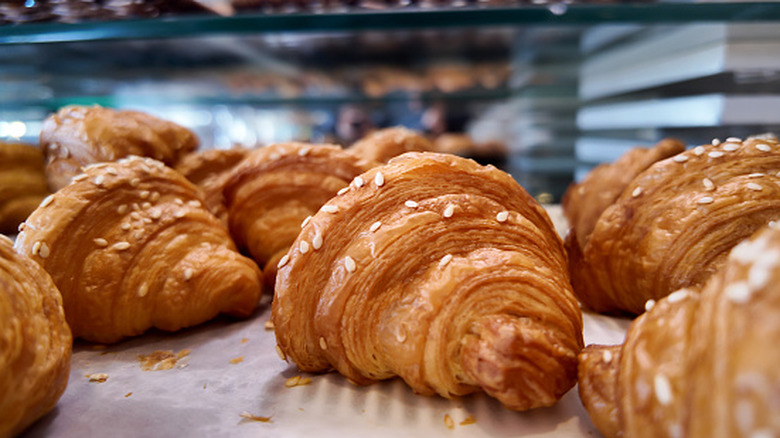
Beyond these general guidelines, there are some specific things to look for, depending on which type of pastry you're purchasing. If you're after fresh croissants, you've got it fairly easy. Odette D'Aniello says it's not difficult to tell when a croissant is past its prime: "Fresh croissants feel light for their size, with visible layers and a honeycomb interior." On the other hand, older croissants may feel dense or damp (though you could always turn them into croutons).
When it comes to Danishes, consider two factors: the pastry itself and the filling. A flaky exterior is key. (Lack of flakiness is one reason we ranked the Bake Shop cheese Danish so low in our ranking of Aldi baked goods.) "The filling (especially fruit fillings because the contrast is so evident in the color), shouldn't have bled too much into the pastry or formed a thick skin," D'Aniello emphasizes. "Muffins are a little more forgiving," she continues. But if the top of the muffin looks sticky, rather than crisp and nicely domed, you may want to skip it.
Beyond trying to ferret out the freshness of every pastry, D'Aniello says there's a simpler way: Just ask. The bakery should be able to tell you which pastries were baked that morning. And timing is key, too. "If you can, go earlier in the day or right after a bakery opens!" D'Aniello says. "That's when you're most likely to catch items at their freshest."