

Don't Believe This Old Wives' Tale About Stopping Beans From Causing Gas: Here's What Actually Works
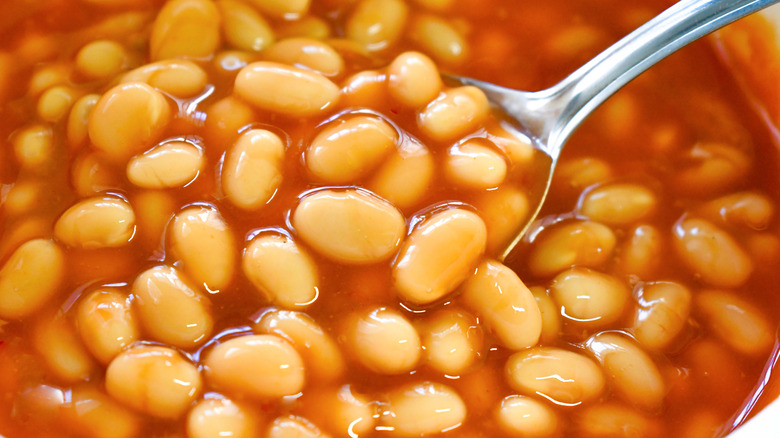
If you've ever heard that adding apples to a pot of beans means the beans will make you less gassy, you may be the victim of an old wives' tale. These rumors tend to stick around because, on paper, they sound like they could be true. We know beans cause bloating, and apples are often associated with good digestion, so why wouldn't it work? Well, food scientist Brian Chau, M.Sc., principle owner and food science consultant at Chau Time, is here to (helpfully) burst our bubble.
Speaking exclusively with Chowhound, Chau explained that an enzyme called alpha-galactosidase is present in instances when oligosaccharides (the carbohydrates in beans responsible for gas) break down in the body before they have a chance to cause gas or bloating. Cooking, either with or without an apple, doesn't introduce that enzyme. In fact, it may even have the opposite effect.
While apples do contain their own enzymes, those enzymes are specific to breaking down the carbohydrates in the apples, not in beans. "There is no evidence showing how apples can reduce gas when cooking with beans," Chau told us. Plus, even if they did have the function, Chau explained that "enzymes won't survive the duration of heat to reach and break down bean oligosaccharides." In other words, anything added to the pot as you cook it would lose its effectiveness before it could make a meaningful difference. So, when you're making extra-creamy butter beans or a big pot of BBQ-style baked beans, throwing in some apple slices could be a nice sweet touch, but it doesn't do much at all in terms of how your body processes the food.
What to do with your beans instead

"The idea might be from [the] understanding that apples, when cooked, break down [their] own fibers and cellulose into more digestible carbohydrates," Brian Chau explained. From there, the assumption was apples may aid digestion in a broader sense, but this process is specific only to apples, not beans or other food in general. Luckily, there are other methods that may be even more straightforward if you want to help make beans more stomach-friendly.
For example, soaking beans in water before you cook them can help remove some of the gas-causing compounds. However, soaking isn't required from a food safety standpoint and is generally optional, even if it does help with digestion and speeds up cooking time. Chau also suggests that sprouting your beans (letting them sit in water for a few days until small roots form) can help in digestion. This works because beans naturally break down their own complex carbs in the process of sprouting. Other science-backed suggestions include sprinkling in some baking soda or cooking them in an Instant Pot. If you're using canned beans, the simple trick is to rinse them thoroughly before adding them to your pot, which drains off the gas-causing compounds.