

The Alarming Reason You'll Never See Lay's Wow Chips On Store Shelves Again
Food fads come and go. Buffets, for example, were one of the food trends that were all the rage in the 1980s, and yet are scant to be found in today's fast casual dining scene. And Snackwell's Devil's Food cookies, once all the rage in the 1990s, have since dissolved into oblivion. Sometimes, these fads go out with more of a bang than a whimper: spiraling from grace with controversy, virality, and a fair amount of stomach upset. Such was the case with Frito-Lays' foray into the world of low-fat snacking: Wow potato chips. First introduced in 1998, Wow potato chips were fat-free and had a lower calorie count than regular potato chips thanks to the newly FDA-approved olestra, a calorie-free fat subsitute that was used instead of frying oil in the chips. For a while, Wow chips wowed customers with their seemingly impossible nutritional profile.
It was quite the coup for fat-watching diners across the board. However, this success was short lived, as the added olestra gave these chips more than just a nice, crispy crunch. It could also give snackers intestinal upset and, perhaps most infamously, rectal leakage. This potentially embarrassing side effect soon soured customers on the chips, and they faded to irrelevance along with Beanie Babies, bowl cuts, Coca-Cola's Gen X-focused OK Soda, and other relics of the 1990s. Or so says our collective cultural memory. In reality, the story of Wow chips is much more extensive and complex than its spotty reputation reflects.
The science behind olestra
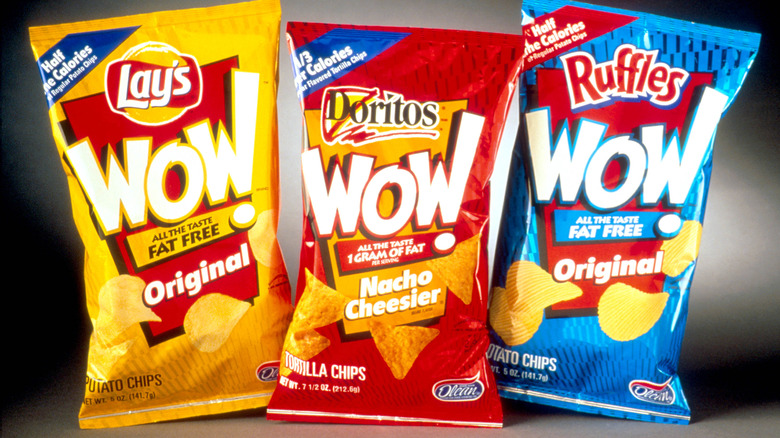
To fully understand this flash-in-the-pan snack, one must first understand its key ingredient: olestra. Olestra was made by Procter & Gamble and was marketed under the brand name Olean. The conglomerate spent several years and hundreds of millions of dollars developing olestra to be used as a fat substitute. It was first introduced to market in 1996 after it was approved by the FDA. Olestra is made from oils such as soybean oil, and functions as a fat in cooking, but has a molecular size too large to be processed by the human digestive system. Since it isn't able to be absorbed by the body, it contributes no fat or calories.
This made olestra a great swap for fat-laden potato chips, and many diners noted Wow's great, crispy texture and unaltered flavor. Since olestra can't be absorbed, however, it is pushed through the digestive system in very little time. This can result in symptoms such as gas and diarrhea, especially when eaten in large amounts. These side effects were noted in a warning label on the chips' bag, but that didn't stop some diners from taking one too many handfuls of the chips, and its laxative properties soon became synonymous with the product. Even so, these chips managed to last nearly 20 years on store shelves, perhaps thanks to a key name change.
The legacy of the olestra era
Officially, Frito-Lay's Wow potato chip line ceased to exist in 2004. However, this was not the end of the brand's olestra journey. Far from it. Wow chips were simply rebranded as Lay's Light in 2004, which were sold by the brand until 2016, when they were discontinued with little fanfare. And though La'ys no longer uses olestra in its products, it is still an FDA-approved food additive (and as of 2003, it no longer requires a warning label). However, it doesn't seem to be as popular as it was in the 1990s. And while its potential side effects are unpleasant, when compared to other food additives, we must really ask, did olestra warrant the controversy it kicked up?
After all, products such as Halo Top, a low calorie ice cream, contain sugar alcohols such as erythritol which, when eaten in large amounts, can cause similar side effects as olestra. Yet many sugar alcohol-containing products continue to be popular and haven't seen as much blow back as Wow potato chips. Perhaps it was a matter of novelty, or maybe that pesky warning label affixed to Wow's packaging stirred the effect out of proper proportion, serving as the ultimate sabotage. After all, who wants a snack that might come with a side of stomach cramps and possible public humiliation?