

Oyster Lovers Need To Make The Trip To The Oyster Capital Of The World
When you hear "oyster capital of the world," you might think of bustling cities located on waterways or coastal fishing towns with thriving tourist scenes. But while a few places around the world have made the claim, arguably none have leaned into it as hard as South Bend, Washington. Sure, visitors to the state may find their tastes satisfied with Seattle's numerous happy hour oyster deals, but serious oyster fans will want to head further south for one of the most recognized towns on the planet for all things oyster.
If you've never heard of South Bend, that's probably because it's a bit out of the way for normal tourist travels. It's a quaint Pacific Northwest town that sits along the Willapa River, just around the corner from a large bay feeding into the Pacific Ocean, and has a population just under 2,000. It's also an over two-hour trek from Seattle, taking you through miles of state forest with peeks of snow-capped volcanoes along the way. But while it may seem inconvenient, South Bend's location is ideal for oyster harvesting, as evidenced by a Pacific Shellfish facility and multiple oyster bars and restaurants with bivalves on the menu. Even the tiny local brewery, Willapa Brewing, sells smoked oysters in souvenir shot glasses. If you're not feeling like dining out during your visit, you can also grab pints of fresh oysters from South Bend Products, a local fishery and restaurant that advertises a "boat to table" experience (following some basic oyster-buying tips, of course).
How South Bend claimed the Oyster Capital title
Despite its reputation for marine mollusks, South Bend's foray into an oyster world leader was a somewhat slow journey. The town got its start in 1869, with the introduction of a sawmill for the booming Pacific Northwest logging industry. However, both manufacturing and logging businesses left the area or closed by the 1930s, causing South Bend residents to focus more acutely on the local fishing industry. Since native oyster populations had been largely depleted by over-harvesting during the logging years, Japanese oysters were brought in, successfully repopulating the local waters. Those same waters have meanwhile been kept relatively clean thanks to the decline of the area's prior industries, enabling oysters to thrive in the area to this day.
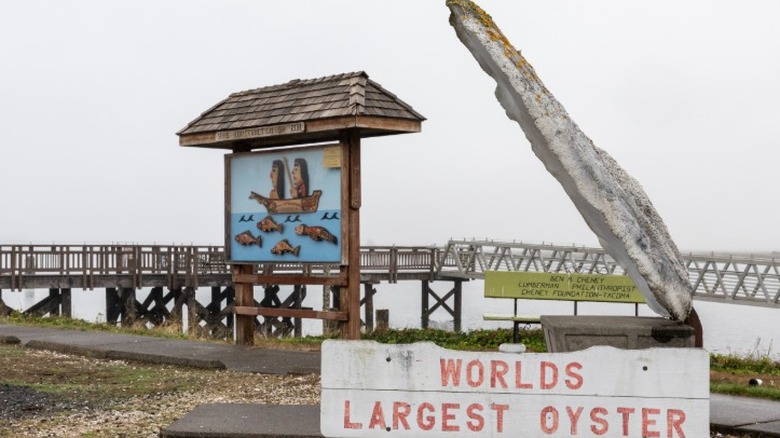
In case it's still not clear how big South Bend is on oysters today, the town is also home to the "world's largest oyster." Of course, it's a concrete sculpture erected to commemorate the local culture rather than an actual overgrown monster oyster from the sea. If it were really the world's largest oyster, it would be the 14-inch-long oyster found in Denmark in 2013.
Still, South Bend isn't alone in its "oyster capital" claim. For example, Cancale is the oyster capital of France. New York City might have had a claim to the name in the 1600s since it accounted for half of the world's oysters, but centuries of pollution severely damaged the harbor's oyster beds and caused major decline. You can still get great raw oysters in New York today, but an environmental effort called the Billion Oyster Project is consistently working to repair the city's damage and restore oyster reefs.