

Burger King's Latest Fast Food AI Endeavor Comes Across More Creepy Than Caring
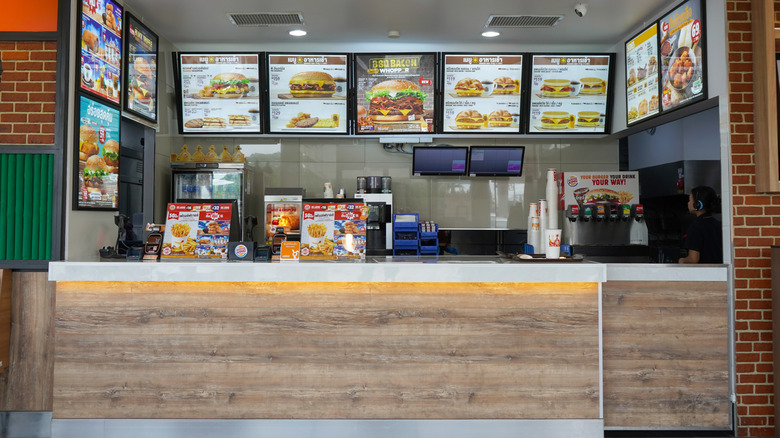
AI is everywhere, and the culinary world is no exception. From your kitchen appliances to Coca-Cola's AI Share a Coke campaign, it's impossible to escape. While AI-powered devices can certainly be helpful in some cases, there's a thin line between creepy and caring, and Burger King is walking the line — hard.
The fast food giant announced the debut of "Patty," an OpenAI-powered bot that will exist within employee headsets. In addition to providing instructions on food preparation, Patty will also keep track of how employees speak to customers — specifically, whether their friendless factor is up to par. While execs at Burger King are insisting that Patty is simply a training tool, we can see how employees might feel like they're being big-brothered by their bosses. Managers are able to check in with Patty to monitor employee performance, specifically, the number of times employees use the phrases "welcome to Burger King," "please," and "thank you." The company is testing Patty at fewer than 100 restaurants right now, and Burger King acknowledges that it might rub some customers the wrong way. "We're tinkering it, we're playing around with it, but it's still a risky bet," said Thibault Roux, chief digital officer at Burger King, in an interview with The Verge.
What customers think about Burger King's AI-powered Patty

Burger King customers — and the general public — are disturbed by the idea of "Patty," according to social media. Many Redditors share the sentiment that the idea in and of itself is dystopian, saying that what they actually care about is the quality of the food — not whether employees speak in canned, forced, polite phrases. Others are talking about boycotting BK on principle, saying that they'd rather the company lower the menu prices than use its cash flow to invest in unnecessary AI surveillance.
Some former fast food employees say that working the drive-thru is one of the toughest parts of the job, and being monitored to make sure they're saying the right words at the right time adds insult to injury. Customers are chiming in to support employees, saying that they'd rather see the money spent on AI go toward paying employees a better wage. Perhaps then, they wouldn't need AI monitoring to ensure that their chipper factor is up to par.