

How The Lining On Your Baking Sheet Affects Cookies Spreading
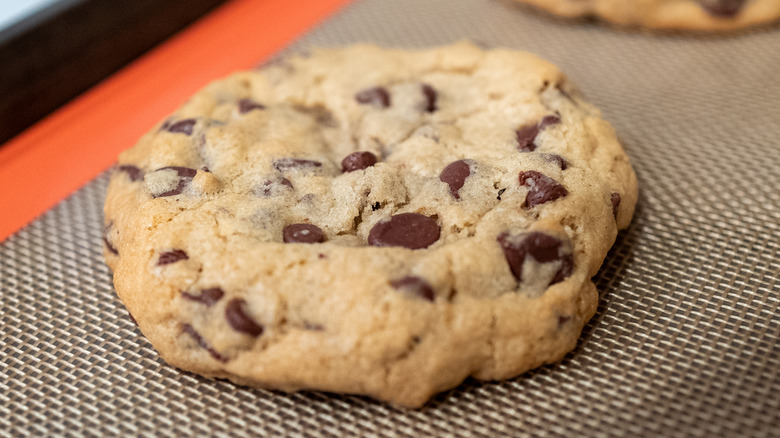
Anyone who bakes cookies semi-regularly has probably contemplated whether the baking sheets you use — either parchment or silicone — have an effect on the final product. The answer is yes, they do have an impact, especially when it comes to the way your cookies spread while they're baking.
Here's the quick version: Parchment paper usually results in cookies that spread less. This is because of the way it conducts heat. Parchment's thinness means that heat transfers more directly from the metal baking tray to the cookie dough. When cookies bake, there's effectively a race between the butter, which melts and spreads out as it bakes, and the mix of gluten-forming proteins and starches in flour, and proteins from eggs, which get firmer as they bake.
That fast heat conduction means that on parchment, the dough bakes into a solid state faster. With silicone baking mats, you'll get the reverse: They're thicker, causing a slower heat transfer between the baking tray to the cookie dough. That gives the cookies more time to spread before the heat firms up those proteins and starches, resulting in a thinner cookie. It's worth noting that although parchment paper is typically coated with silicone, it's a really thin layer, so the heat conduction isn't really slowed down like it is with a thicker silicone mat.
Choosing the right liner
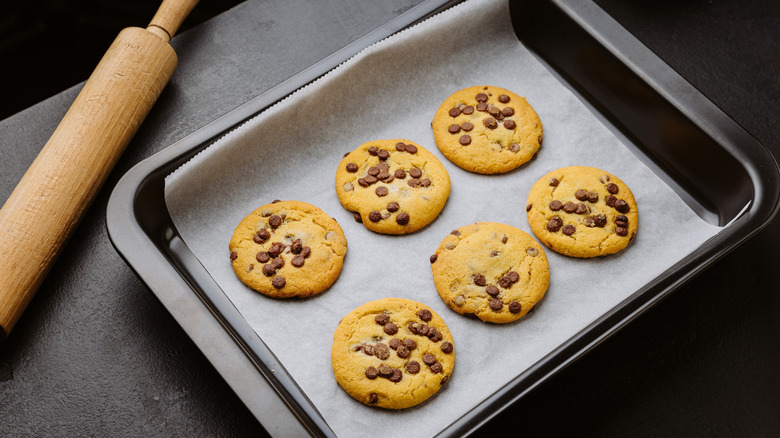
These differences may have you questioning which cookie sheet lining is better. Unfortunately, the answer is a potentially annoying "it's subjective."
The thinner cookies you'll get from silicone may be crispier, although silicone doesn't breathe well, so moisture can get trapped, making them thinner but also kind of sweaty. It's worth noting that if your silicone is seriously slippery, this also facilitates spreading. In this case, you might get some particularly thin and crispy cookies. While it's not a spreading issue, silicone mats also tend to distribute heat more evenly, in turn baking your cookies more evenly (although bear in mind that uneven baking can also indicate a problem with your oven). So, it may be a wise choice if you're concerned about consistency.
As for parchment, it tends to be put forward as a reliable way to get a cookie that spreads a little, but still retains some thickness and chewiness. Plus, while silicone mats are considered to allow for super-even baking, parchment still does a good job at this. So, at least when it comes to the issue of cookie spread, the decision comes down to whether you prefer your cookies thinner and crunchier, or thicker and chewier. In any case, we can more confidently say that both of them are better choices than one other erroneously popular option: Aluminum foil, which tends to burn your cookies.