

Why You Hardly Ever See Grade B Eggs At The Grocery Store
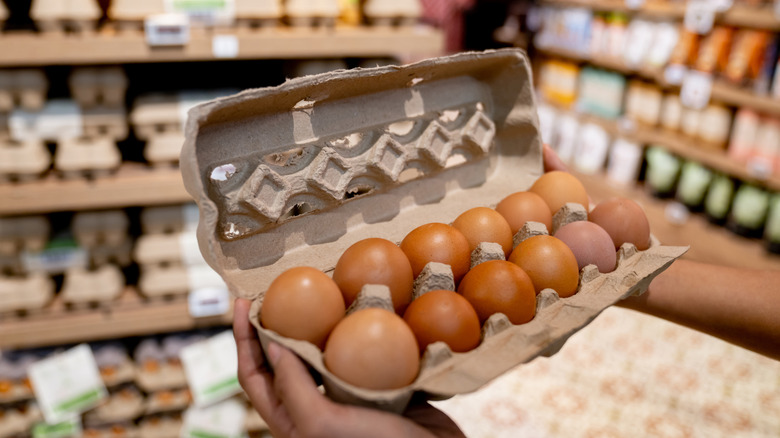
Go shopping for eggs at the supermarket (at least in the United States), and you'll probably notice USDA grades on the cartons. Yet often, you'll only see two grades: AA and A. If you happen to have wondered "surely 'grade A' can't be the lowest", then you're right: There is one more grade, B, yet it tends to not be sold in grocery stores.
Before explaining why, it's necessary to understand how egg grading works. As you may have guessed by their grade, B-grade eggs are lower quality, and this can be in terms of their insides or outsides. Inside, this could mean they have thinner, watery whites, and flatter yolks in comparison with A or AA eggs (this is checked by "candling", or shining lights on the egg shells to peep inside). On the outside, there could be stains or blemishes on the shell, although it must be intact. That said, grades are sort of a vanity thing, too: Grades only reflect quality and appearance, not safety or nutritional value. Grade B eggs are nutritionally equivalent to higher grades, and obviously, they are safe to eat. However, they might be a bit uglier, or the texture might be a little less appealing, thanks to the more watery whites. Those flaws are why you won't see B eggs in supermarkets. Consumers are reputedly fussy about appearance, and prefer eggs that look nice, whether it's in the carton or the frying pan.
So where do grade B eggs go?

Grade B eggs end up in places where their looks won't matter so much, like commercial or industrial kitchens, and importantly, in settings where any "ugly" egg won't really be visible. This could include mass-produced baked goods or scrambled eggs, or they could be processed into liquid egg products or freeze-dried into not-particularly-appetizing powdered eggs.
Grade B eggs may sometimes appear more in grocery stores in the case of shortages: This could be seen during the infamous 2025 egg price spikes, when customers may have sometimes scored a deal of sorts by purchasing comparatively cheap grade B eggs. If you're wondering how eggs earn the A or AA grades, it's basically by avoiding the problems that characterize grade B eggs. Those "better" eggs will have cleaner-looking shells, with AA eggs having "thick, firm whites" and A eggs having "reasonably firm whites". Grade A eggs are the most common variety in supermarkets.
Finally, it's worth noting that the egg grading system is technically optional: Egg producers pay for inspections that in turn allow them to put the grades on their packaging (the weight classification system is also part of this, with eggs being classed from "jumbo" down to "peewee"). That said, some states don't allow ungraded eggs to be sold or only allow producers to sell very limited quantities of them, so you probably won't see them very often.