

Where Exactly Was Fried Chicken Invented? The Answer Is Hard To Pin Down
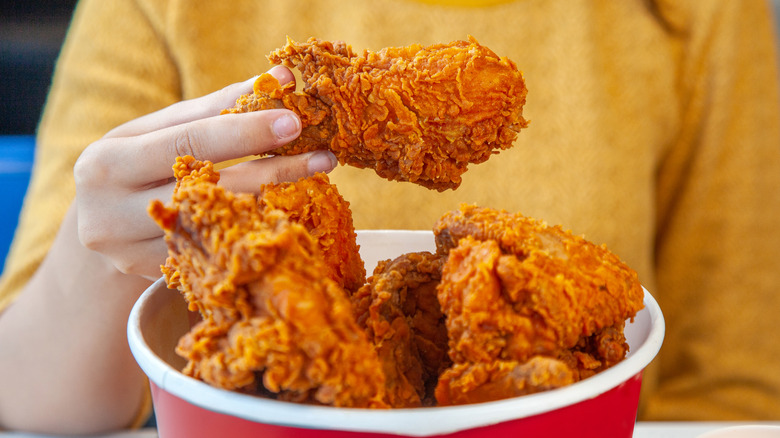
There is no doubt about it, fried chicken has real star power. From the globally popular KFC to the uniquely crispy Korean fried chicken, and the uniquely delicious combination of chicken and spaghetti found at the fast food chain, Jollibee, there seems to be no limit to the dish's ability to adapt to and transcend cultural barriers. Just about everyone loves fried chicken, and it's easy to see why. The crunchy, golden brown exterior gives way to incredibly moist meat: perfect for dipping into sauces or enjoying as a part of a hearty meal. But where, pray tell, does this delectable chicken dish come from? While many different countries and cultures feature fried chicken in various dishes, the most well-known mainstream form comes by way of the American South.
Still, that's not the full story to the dish's actual cultural roots. Most American foods are a result of cultures merging, overlapping, or evolving. For instance, black-eyed peas come from West Africa, and many Creole dishes developed from blending French, Spanish, Caribbean, and West African cooking methods. So what are the origins of this quintessentially Southern dish? Many historians suggest the dish was introduced to America by Scottish immigrants in the 17th century when Scottish landowners provided recipes to enslaved African Americans who, in turn, developed the dish into a Southern staple. However, this theory isn't without critics and detractors, who assert West African influence has been over emphasized and the dish is perhaps more English than once thought.
Conflicting fried chicken origin theories
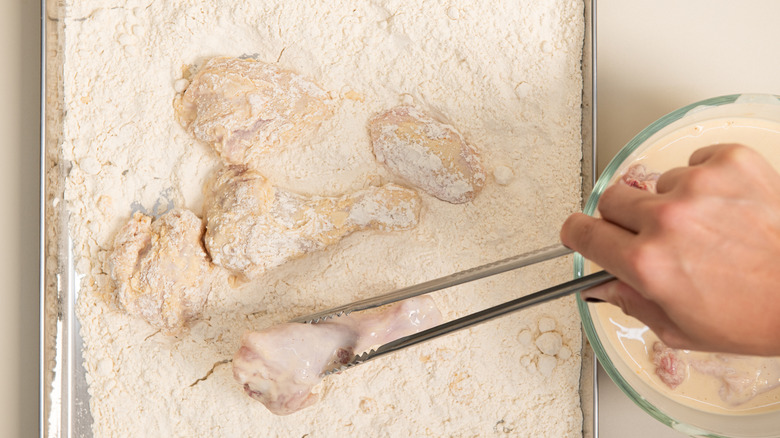
The first printed fried chicken recipe is widely attributed to a Virginian woman named Mary Randolph who authored "The Virginia House-Wife" in 1824. It was the first regional American cookbook to be published, and it was a success, helping to bring the recipe broader attention. The book also includes a recipe for oyster ice cream, a dish that somehow didn't have the same staying power as fried chicken. Many of Randolph's recipes, including her fried chicken recipe, were sourced from enslaved African Americans who did the lion's share of domestic labor in her kitchen.
This is likely not the first fried chicken recipe, either; it is simply the first one to be published and it does not attribute any specific cultural origin. Plus, as Edmund Standing wrote in his article, "On the 'African Origins' Theory of Southern Fried Chicken," Randolph was far from the first person to publish a similar recipe. In fact, there is a similar one from French writer, François Massialot, who wrote the 1691 volume "Le Cuisinier Royal et Bourgeois." In this text, which was translated to English in 1702, Massialot described a dish wherein sole is coated in flour and fried in lard. Still another recipe, published in "Royal Cookery" in 1716 London from Patrick Lamb, called for chicken to be marinated and then dipped in a batter of flour, wine, and egg yolks, and then fried in lard. This is quite similar to the American method of marinating, battering, and frying chicken in animal fat. So perhaps this dish is English or even French in origin.
A fraught fried chicken legacy
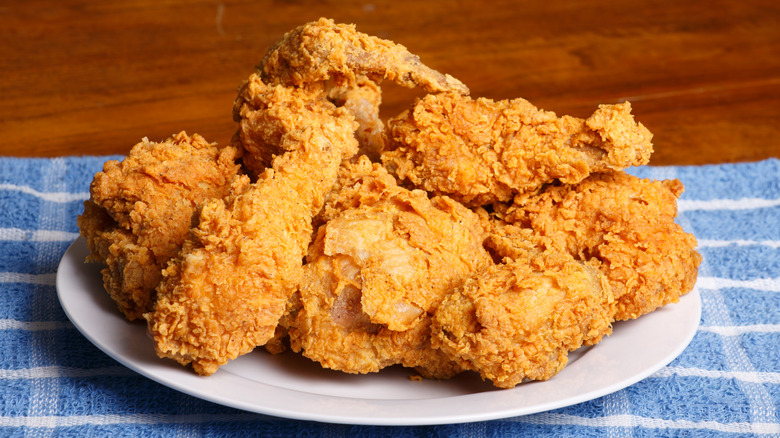
The exact origin for fried chicken remains rather foggy. What we know is this European-derived recipe has, over the centuries, been adapted by countless enslaved African Americans, who used the ingredients and resources they had available at the time. Through the years, fried chicken has become much more than just a delicious food, it has become a symbol of economic self-determination.
After the Civil War, many Black Americans were faced with brutal Jim Crow laws, which boxed many Black communities out of economic, and literal, freedom, limiting their options for social and economic mobility, but chicken (especially fried chicken) provided a pathway for entrepreneurship for many. Cooking and selling fried chicken allowed many within the Black community to gain wealth and elevate their social class.
It is perhaps because of this liberating aspect of the dish that it was then turned into a racist stereotype. Many racist texts from the Jim Crow era, including the 1915 film, "Birth of a Nation," depict Black Americans eating fried chicken during a legislative meeting, signaling a negative connotation. In short, this object of liberation soon became a racial stereotype, one which still impacts Black communities to this day. Over the past few decades, many have worked to reclaim fried chicken as an integral part of Black culture and history through Black-owned restaurants with historic, family recipes and works that more closely integrate the influence of Black culture on Southern foods, such as the beloved fried chicken.