

Here's What The Stickers On Your Apples Mean
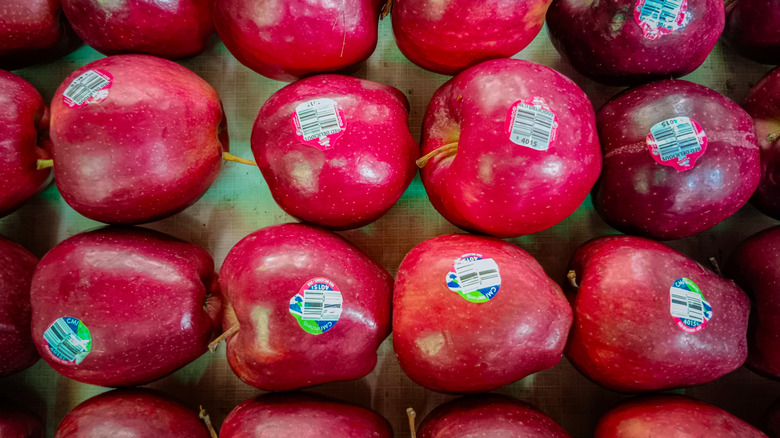
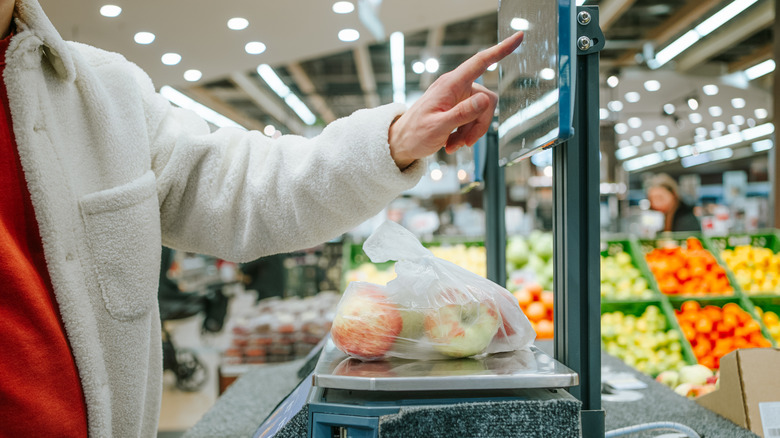
If you've ever wondered why it's necessary to slap little stickers all over grocery store apples (and many other fruits, for that matter), you'll be relieved to know that they do serve a useful purpose. Those stickers usually feature a short string of numbers, and those numbers are generally the raison d'être for the sticker. The numbers are called PLU codes, short for price look-up codes, and they're basically there so that cashiers can ring up your apples correctly at checkout. As you've likely noticed, most supermarkets carry a wide range of apples, so to save cashiers from having to remember minuscule differences between different apple varieties or from just guessing, the PLU numbers offer a shortcut. Punch in the number, and the correct apple type should be put through the register. In the era of self-checkout, the stickers are useful for customers for the exact same reason.
PLU codes have been used in grocery stores since the 1990s, and they were standardized in the 2000s thanks to the International Federation for Produce Standards (IFPS), which was tasked with making sure they're the same around the world. That means the designer Cosmic Crisp apple should always be numbered 3507, for example, no matter where you buy it. PLU stickers aren't a legal requirement though. There's nothing stopping stores from wrapping six apples in a container and putting a barcode on it so they can be scanned like other packaged groceries, of course. But when it comes to produce sold by weight, this standardized system has become the industry norm in many countries.
Decoding the numbers
Most of the time, there's not really a whole lot of useful information to extract from these fruit sticker codes. After all, if you wanted Granny Smith apples for some sour, sticky caramel apples, you probably went to the bin marked "Granny Smith" rather than memorizing a series of numbers and looking at the tiny stickers. That said, the structure of the code can give some details about how the apple was produced. Five-digit codes starting with 9 usually signal organic produce, grown to organic standards without synthetic chemicals, while four-digit codes are for conventionally grown produce.
If you poke around online, you might find theories that a five-digit code beginning with 8 indicates genetically modified produce.There's some truth here, as the IFPS planned to use codes starting with 8 this way, but it never actually happened. So, whether or not there's an 8 isn't a reliable indicator of genetic modification in your fruit. Arguably, the only real use the average shopper will have for PLU codes is if you're trying to pick out organic produce with no other indicator. Otherwise, they're really just for cashiers or to allow easy identification elsewhere in the supply chain.
Oh, and if you're wondering whether it's safe to eat the stickers? Yes, at least sort of: They're typically made of paper or plastic, and the general verdict is that while you probably shouldn't eat them, you don't need to panic if you do. The plastic ones in particular have raised environmental concerns, as you shouldn't put produce stickers down your kitchen sink drain or in the compost. But that may be changing: The EU, for example, is requiring that stickers be compostable by early 2028.