

Meet Japanese-Style Iced Coffee: The Decades-Old Technique Making A Chill Come Back

We love Japan's palate for innovation and reverence for home-grown flavors, which has resulted in a serious matcha obsession (and hojicha might share the limelight pretty soon). Consequently, more coffee drinkers have discovered the beauty of Kyoto-style cold brew, which can make even the most delicate flavors shine. While Japan's beverage-ready mayonnaise never took off internationally, its novelty and uniqueness make it interesting for adventure seekers. Japanese-style iced coffee might even be the next craze, but it's actually a decades-old technique that's just making a chill come back. Created in 1891, this is a pretty flexible caffeine fix; you just brew hot coffee onto ice.
While it does sound simple to do — and it is — there's some careful thought behind the process that comes with its fair share of nuances you can't get just from a simple black cold brew. Japanese-style iced coffee's distinct process creates a more flavorful cup because it uses hot water, which causes more rapid movement of molecules. Faster movement equals better flavor extraction, resulting in a more well-rounded taste. And because hot water and ice collide — making the cooling process faster — you get a fresh cup with more pronounced flavors that really highlight the beans, as opposed to cold brew that takes overnight, which, admittedly, can taste a bit stale for some folks.
Making Japanese-style iced coffee at home
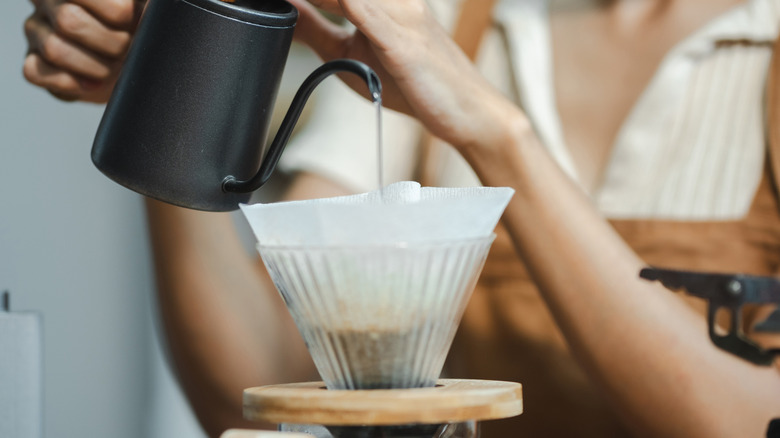
Your setup should look like you're making a pour-over coffee. So you need a coffee filter, dripper cone, carafe, and a pour-over device like a V60. But of course, the difference is in the technique. The carafe needs to be filled with ice cubes to allow the brew to cool in no time. For the brew, medium-fine grounds work best here, which shouldn't be an issue if you have a burr grinder — your secret weapon for a full-bodied coffee. If you don't have one, there are a lot of budget-friendly coffee grinders on the market, and if you're someone who can't live without caffeine and is in the process of setting up a home cafe, it's a good investment to get one.
The process itself is quite foolproof once you've assembled all the paraphernalia. A coffee scale can be helpful in this scenario for better accuracy, as you'll need eight ounces of ice and equal amounts of water. You can use pulse pouring, which requires stopping in between pours to develop a punchier sharpness, while also creating a crisper taste. Alternatively, continuous pouring also works but make sure to drip a consistent amount. Whatever technique you're going for, give the beans a chance to bloom for 30 seconds after your initial pour in order to release carbon dioxide. This helps mellow the sourness for a more consistent brew. Continue pouring after you've watched it bloom, let the filter empty through, and enjoy.